





Pull to refresh
Logo
New Horizons finds signs of liquid nitrogen flowing on Pluto

New Horizons finds signs of liquid nitrogen flowing on Pluto

New Capabilities

Dark streaks on the dwarf planet's heart-shaped glacier point to active geology, 11 years after the spacecraft's flyby

Today: SwRI announces Pluto liquid nitrogen evidence

Overview

Updated 1 hour ago

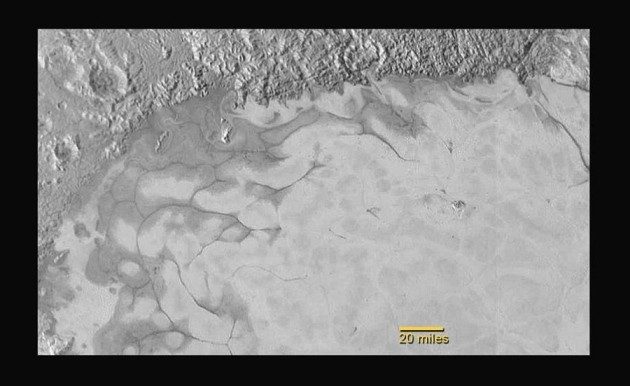
Pluto's surface was supposed to be inert. New analysis of New Horizons imagery reveals dark streaks on Sputnik Planitia, the huge nitrogen glacier, that look like liquid nitrogen recently flowed across the ice. It is the first evidence that liquid has moved across Pluto's surface in the modern era.

Computer models show nitrogen melting at the glacier's base and rising through narrow conduits, staying liquid long enough to wet the surface. The finding suggests Pluto is more geologically active than it looks, and it may explain geysers spotted on Neptune's moon Triton.

Why it matters

Pluto appears to harbor liquid below its frozen shell, suggesting the solar system's cold edge is more geologically active than anyone assumed.

Questions about this story

Free account needed to ask — your question is kept and asked for you right after sign-up. Answers are public.

No questions yet — be the first to ask.

Key Indicators

1,000,000+ km²
Area of Sputnik Planitia
The nitrogen glacier where liquid flow evidence was found is larger than Texas and Oklahoma combined.
11 years
Years between flyby and discovery
New Horizons collected the imagery in July 2015; the analysis was published in July 2026.
50%+
Pluto still unmapped at high resolution
Over half of Pluto's surface has not been imaged in detail, so more liquid evidence may exist.

Voices

Curated perspectives — historical figures and your fellow readers.

Ever wondered what historical figures would say about today's headlines?

Sign up to generate historical perspectives on this story.

People Involved

Organizations Involved

Timeline

January 2006 September 2026

5 events Latest: Today
Tap a bar to jump to that date
  1. SwRI announces Pluto liquid nitrogen evidence

    Today Announcement

    Southwest Research Institute issues a press release describing the evidence that liquid nitrogen recently flowed across Pluto's surface, reported by ScienceDaily.

  2. NASA publicizes the finding

    Announcement

    NASA's science blog reports the evidence of recently flowing liquid on Pluto, calling it a first.

  3. Liquid nitrogen study published

    Publication

    A paper in the Planetary Science Journal proposes that dark features on northern Sputnik Planitia are caused by liquid nitrogen rising from beneath the glacier.

  4. New Horizons flies past Pluto

    Mission milestone

    The spacecraft makes its closest approach, capturing the first high-resolution images of Sputnik Planitia and the rest of Pluto's surface.

  5. New Horizons launches

    Mission milestone

    NASA's New Horizons spacecraft lifts off from Cape Canaveral on a nine-year journey to Pluto.

Scenarios

1

NASA backs a new Pluto mission after liquid discovery

Possible Resolves by End of 2028

Discussed by: Southwest Research Institute science team and the planetary science community

The evidence of active liquid on Pluto strengthens the case for a follow-up orbiter or flyby. NASA's current decadal survey prioritizes a Uranus orbiter, but the new findings could elevate Pluto in the next mission-planning cycle. A concrete trigger would be NASA commissioning a Pluto mission concept study or adding Pluto to its exploration roadmap.

2

Rival theory explains the dark streaks without liquid nitrogen

Possible Resolves by End of 2027

Discussed by: Planetary geology researchers

The dark linear features on Sputnik Planitia may have non-liquid explanations, such as dust accumulation, thermal contraction cracking, or differential sublimation of nitrogen ice. A competing paper offering such an alternative would directly test the basal-melt hypothesis. Publication in a peer-reviewed journal would be the measurable signal.

3

Analysis of unmapped regions confirms widespread liquid activity

Uncertain Resolves by Q2 2027

Discussed by: New Horizons science team

Over half of Pluto remains unmapped at high resolution. If similar dark wetting features appear in newly analyzed regions, the basal-melt mechanism would gain broader support. The New Horizons team has the data in hand and would publish any such findings in a follow-up paper.

Historical Context

3 moments from history that rhyme with this story — and how they unfolded.

August 1989

Voyager 2 discovers geysers on Triton (1989)

Voyager 2 flew past Neptune's moon Triton and caught geyser-like plumes of nitrogen gas and dark particles erupting from the icy surface. It was the first active cryovolcanism seen on any world beyond Earth.

Then

The plumes confirmed Triton had an active surface despite being smaller and colder than Pluto.

Now

Triton became the reference point for exotic cryovolcanic activity on Kuiper Belt bodies.

Why this matters now

Triton is thought to be a captured Kuiper Belt object and a close cousin of Pluto. The New Horizons team explicitly suggests the same basal-melt mechanism could drive Triton's geysers.

2005-2006

Cassini finds vents on Enceladus (2005)

Cassini arrived at Saturn in 2004 and within months detected jets of water vapor and ice spraying from Enceladus's south pole. The small moon was expected to be frozen solid.

Then

The jets revealed a subsurface ocean heated by tidal forces.

Now

Enceladus became a top target in the search for habitable environments, and Cassini was extended to fly through the plumes.

Why this matters now

Enceladus showed that a frozen moon can hide liquid and internal heat. Pluto's possible nitrogen flows extend that lesson to the distant Kuiper Belt.

2015-2019

Dawn finds recent brines on Ceres (2015)

NASA's Dawn spacecraft orbited the dwarf planet Ceres in 2015 and found bright salt deposits in Occator Crater, later tied to brines that rose from below within the past few million years.

Then

Analysis suggested cryovolcanic and hydrothermal activity continued far more recently than expected.

Now

Ceres joined the short list of small bodies with evidence of recent liquid-driven geology.

Why this matters now

Ceres showed that small, cold worlds can host recent liquid activity. Pluto's case parallels it, though the liquid is nitrogen rather than water.

Sources

(7)