
Pull to refresh
Logo
Juno finds Jupiter's bow shock runs on layered plasma waves

Juno finds Jupiter's bow shock runs on layered plasma waves

New Capabilities

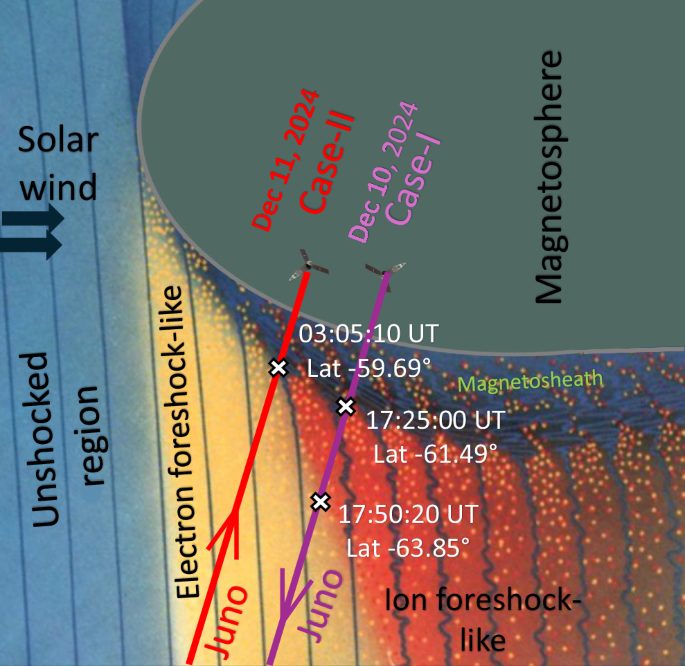
Two crossings in December 2024 revealed harmonic waves and repeating shocklets that Earth's simpler boundary does not produce

Overview

Updated 1 hour ago

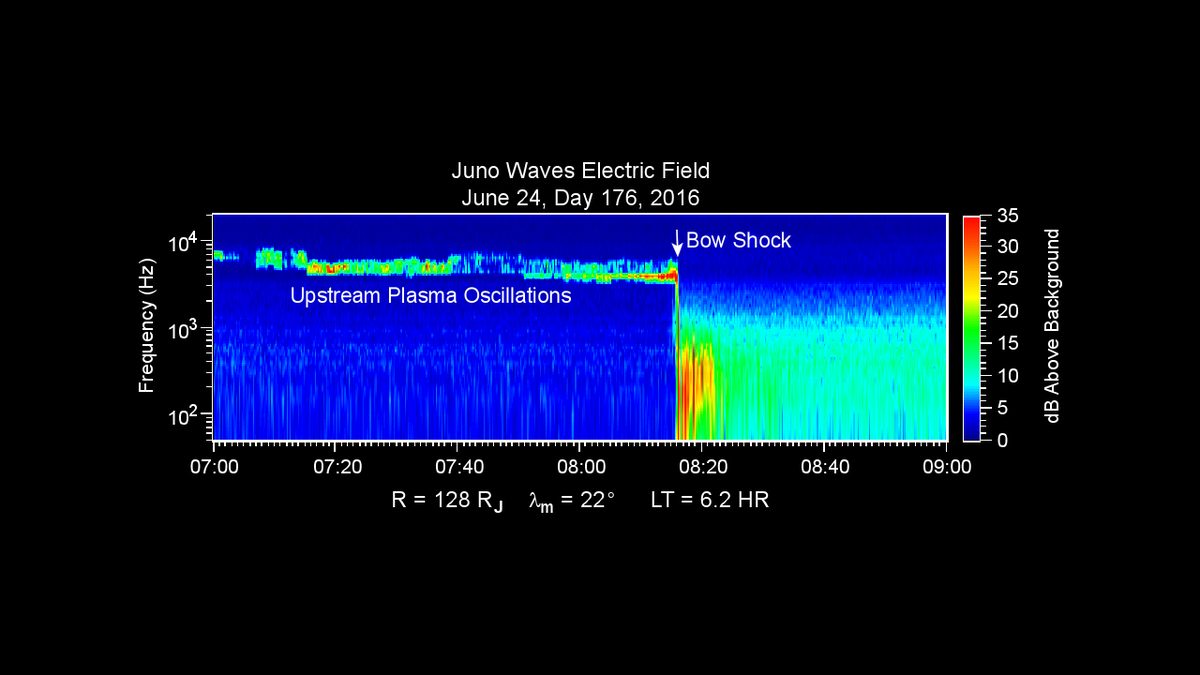
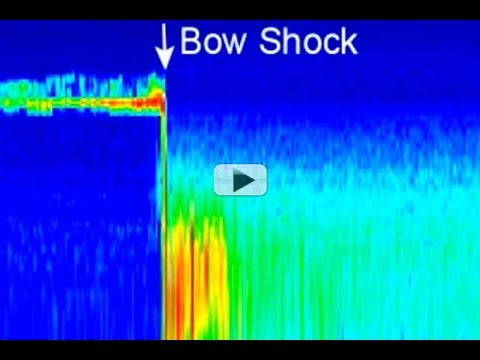
NASA's Juno spacecraft crossed Jupiter's bow shock twice on December 10 and 11, 2024, and recorded something no spacecraft had caught at any planet's shock front: an electric-field wave ringing at several frequencies at once. The main tone sat near 5,600 hertz, with overtones at roughly double and triple that pitch.

Earth's bow shock mostly does the job with waves at a single frequency. Jupiter's layered version can trap and heat a wider range of electrons, and a run of smaller shocklets ahead of the main boundary slows the solar wind before it arrives. The University of Iowa-led team published the analysis in Nature Communications on July 31.

Why it matters

Jupiter's shock is a nearby stand-in for the vastly more powerful shocks around supernova remnants, which are hard to measure directly.

Questions about this story

Free account needed to ask — your question is kept and asked for you right after sign-up. Answers are public.

No questions yet — be the first to ask.

Key Indicators

5,600 Hz
Main wave frequency
The base electric-field tone Juno recorded at the second bow-shock crossing.
8.3 s
Spacing of magnetic pulses
Roughly a quarter of the time a proton takes to loop around the local magnetic field.
10.5 nT
Peak magnetic field in a shocklet
More than five times the surrounding field farther upstream.
2
Bow-shock crossings analyzed
Both occurred on December 10 and 11, 2024, just over nine hours apart.
18
Evenly spaced spectral peaks
Roughly 300 hertz apart, produced by electrons drifting past reflected ions.
9x
Solar wind speed over disturbance speed
The ratio at both crossings, which is what makes a shock necessary.

Voices

Curated perspectives — historical figures and your fellow readers.

Sign up to generate historical perspectives on this story.

People Involved

Organizations Involved

Timeline

July 2016 October 2026

5 events Latest: 3 days ago
Tap a bar to jump to that date
  1. Jupiter's bow shock reported more complex than Earth's

    Latest Report

    The University of Iowa findings reach public audiences through a science news release.

  2. Study published in Nature Communications

    Publication

    The Iowa-led team details harmonic waves and repeating shocklets at Jupiter.

  3. Second crossing records multi-frequency plasma waves

    Discovery

    Juno hits the boundary more squarely and catches a wave with stacked overtones.

  4. Juno crosses the bow shock at a shallow angle

    Observation

    The first of two crossings, heading out into the solar wind.

  5. Juno enters orbit around Jupiter

    Mission

    The spacecraft begins circling the planet, eventually carrying it through the bow shock.

Scenarios

1

Juno gets a dedicated bow-shock campaign

Possible Resolves by Q2 2028

Discussed by: The study's authors, who note mission planners had not aimed the wave instrument at the boundary until late 2024

Because the December 2024 passes were opportunistic rather than designed, the team's picture rests on two crossings. A planned campaign would point the Waves instrument at the boundary repeatedly and at different solar wind conditions, turning a snapshot into a survey.

2

Harmonic waves turn out to be routine at Jupiter

Likely Resolves by End of 2029

Discussed by: The Iowa team, which expects self-reforming shocks to be stronger and more common across the outer solar system

The team's reasoning is that Jupiter's weaker interplanetary magnetic field, a consequence of its distance from the Sun, lets nearly the full set of wave frequencies appear. If that holds, later crossings should keep finding the layered pattern rather than a single dominant tone.

3

The December 2024 crossings prove a one-off

Unlikely Resolves by End of 2029

Discussed by: The study's own caveats, which note the whole picture rests on two crossings nine hours apart

Juno caught the boundary once at a shallow, near-parallel angle and once more squarely. If later passes show single-frequency waves and no shocklets, the December 2024 readings would describe an unusual solar wind episode rather than Jupiter's normal behavior.

Historical Context

3 moments from history that rhyme with this story — and how they unfolded.

March-July 1979

Voyager 1 and 2 at Jupiter (1979)

Voyager 1 flew past Jupiter in March 1979 and Voyager 2 followed in July, both crossing the planet's bow shock. Their instruments confirmed the boundary existed but could not resolve the fine structure of the plasma waves inside it.

Then

The flybys established that Jupiter's magnetic environment was far larger and more energetic than Earth's.

Now

For four decades, the Voyager crossings remained the reference measurements for Jupiter's bow shock.

Why this matters now

Eight spacecraft crossed this boundary before Juno. None carried an instrument able to see the harmonic wave structure the Iowa team has now described.

1960s-2020s

Earth's bow shock as the textbook case (1960s onward)

Decades of satellite measurements made Earth's bow shock the standard model for how a planetary magnetic field slows and heats the solar wind. That model centers on plasma waves concentrated around a single frequency.

Then

The single-frequency picture explained most Earth observations well enough to become the default.

Now

It also set expectations for other planets, which the Jupiter data now complicate.

Why this matters now

The Juno result is measured against this template. Jupiter's extra frequencies and shocklets are differences from Earth, not refinements of it.

1987-present

Supernova remnant shocks (ongoing)

Expanding debris from exploded stars drives shock waves vastly more powerful than anything at Jupiter. These shocks accelerate particles and convert flow energy into heat on scales no spacecraft can fly through.

Then

Astronomers infer their behavior from remote observations of X-ray and radio emission.

Now

The physics of energy transfer in plasma shocks remains a live modeling problem across astrophysics.

Why this matters now

The Iowa team argues Jupiter's boundary is a nearby natural laboratory for the same energy-conversion process, measured directly rather than inferred.

Sources

(3)