

Pull to refresh
Logo
Astronomers find first stellar stream beyond the Milky Way

Astronomers find first stellar stream beyond the Milky Way

New Capabilities

A faint ribbon of stars in a distant ultra-diffuse galaxy reveals its dark matter halo

Yesterday: Stream analysis details galaxy's dark matter halo

Overview

Updated 1 hour ago

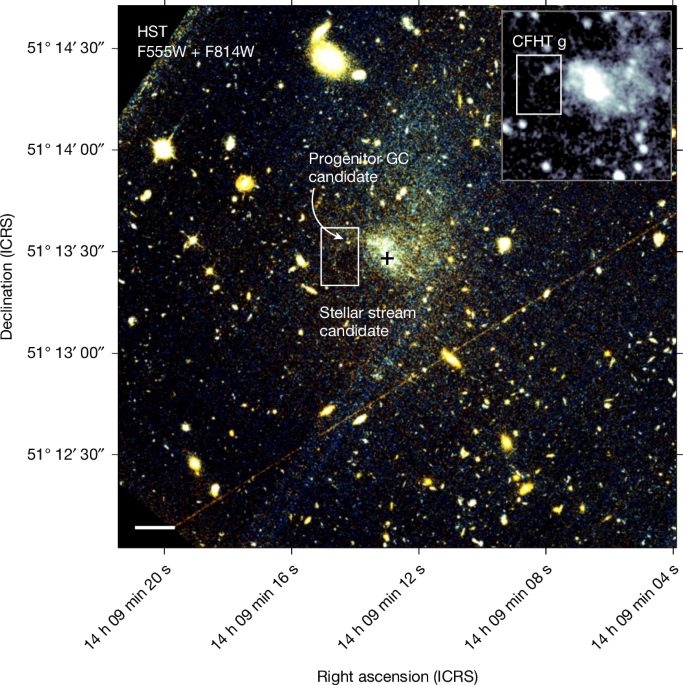
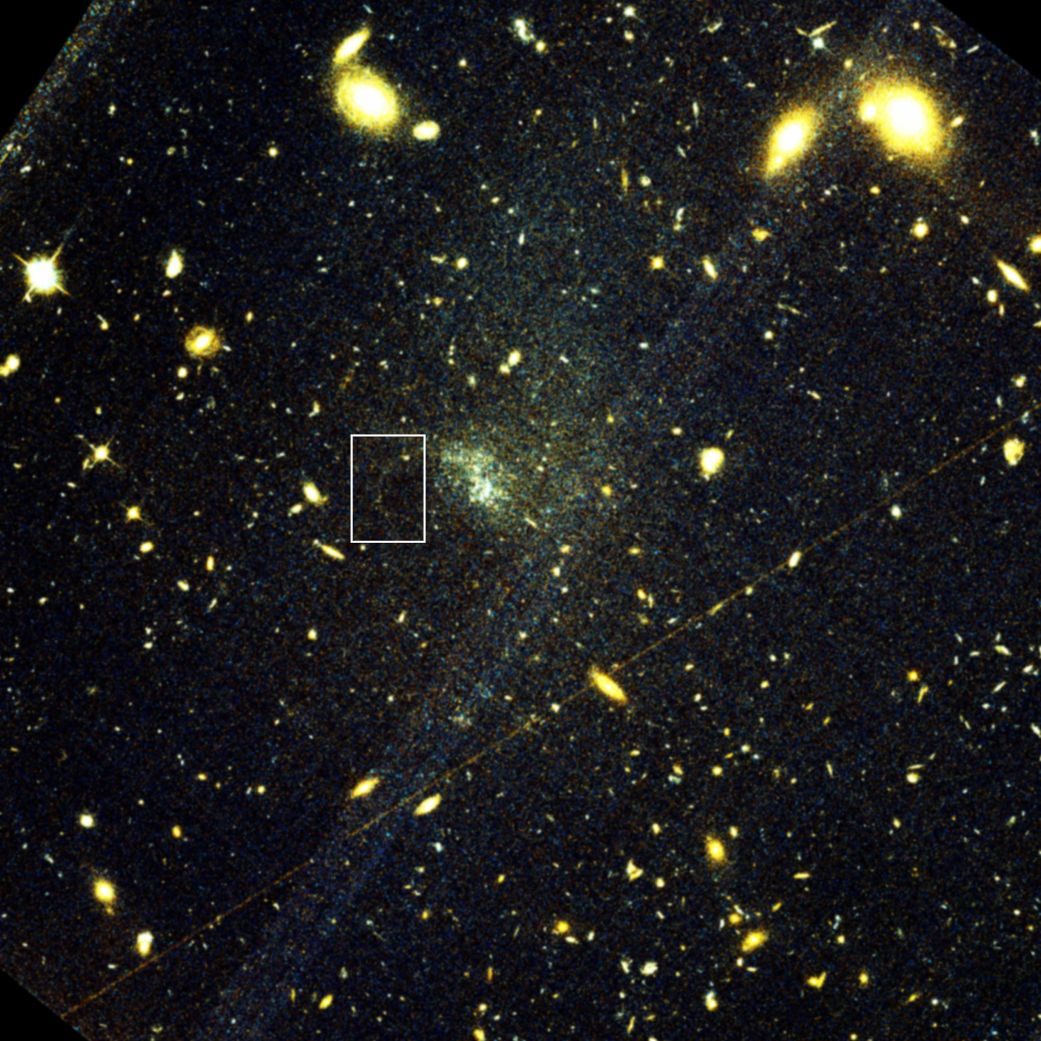
Astronomers have found a thin ribbon of stars being torn from a globular cluster by a galaxy 35 million parsecs away. Named Oyashio, it is the first stellar stream of its kind ever seen outside the Milky Way.

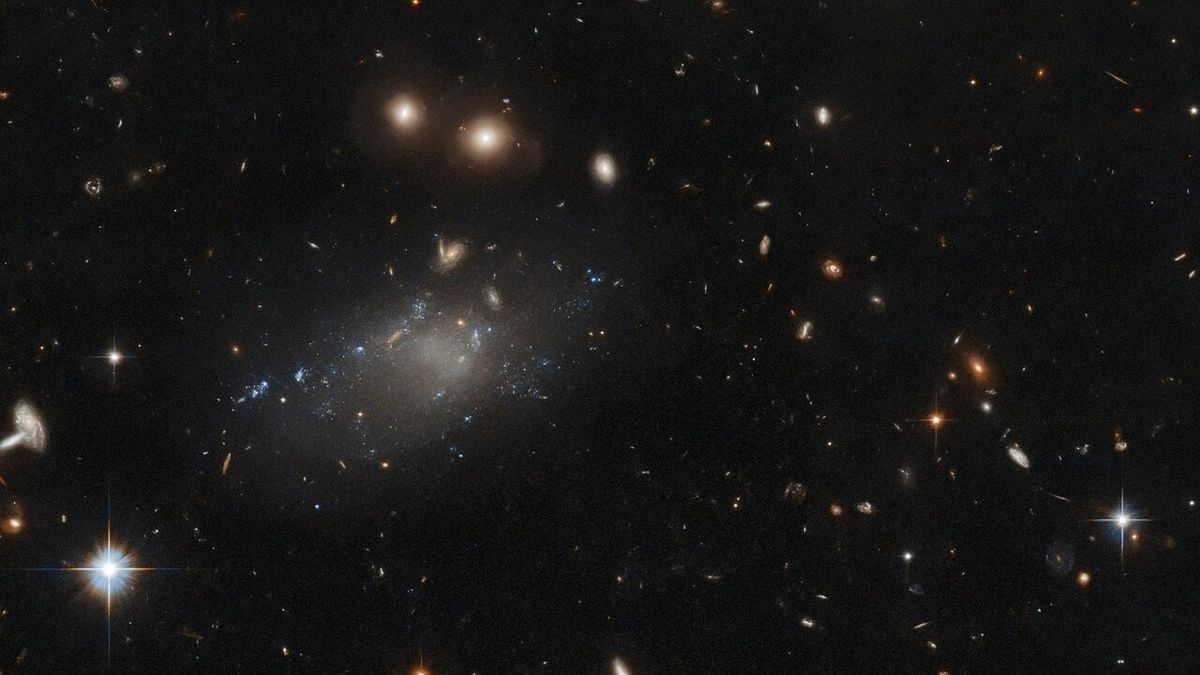
The stream's curved shape traces the gravity of its host, the ultra-diffuse galaxy UGC 9050-Dw1, and reveals a massive dark matter halo. That makes extragalactic stellar streams a new tool for studying the unseen matter that holds most of the universe's mass.

Why it matters

Extragalactic stellar streams can now map dark matter, which holds most of the universe's mass but remains unseen.

Questions about this story

Free account needed to ask — your question is kept and asked for you right after sign-up. Answers are public.

No questions yet — be the first to ask.

Key Indicators

1
Extragalactic globular cluster stellar streams
Oyashio is the first found beyond the Milky Way; streams were previously known only in our own galaxy.
35.2 Mpc
Distance to host galaxy UGC 9050-Dw1
The ultra-diffuse galaxy sits about 115 million light-years from Earth.
< 2.5 × 10⁶ M☉
Upper limit on progenitor cluster mass (95% confidence)
Dynamical modeling places the stream's origin solidly in globular cluster territory.
log₁₀(Mh/M☉) = 11.31
Dark matter halo scale mass of UGC 9050-Dw1
First stream-based measurement of an ultra-diffuse galaxy's dark matter halo.

Voices

Curated perspectives — historical figures and your fellow readers.

Ever wondered what historical figures would say about today's headlines?

Sign up to generate historical perspectives on this story.

People Involved

Organizations Involved

Timeline

August 2026 September 2026

2 events Latest: Yesterday
  1. Stream analysis details galaxy's dark matter halo

    Latest Research

    Researchers detail stream-based constraints on the galaxy's dark matter halo mass and density profile.

  2. Nature publishes discovery of Oyashio stream

    Discovery

    First globular cluster stellar stream identified outside the Milky Way, in UGC 9050-Dw1.

Scenarios

1

Spectroscopy confirms Oyashio's globular cluster origin

Likely Resolves by Q2 2028

Discussed by: The Nature paper's authors, who propose Keck observations to compare the stream and progenitor's stellar populations

Dynamical modeling already supports a globular cluster progenitor with mass below 2.5 million solar masses. Deeper Hubble or James Webb imaging plus Keck spectroscopy could confirm the cluster and stream share stellar populations, locking in the interpretation and clearing the way for broader searches.

2

Survey telescopes uncover a population of extragalactic streams

Likely Resolves by End of 2029

Discussed by: Euclid and Roman mission teams; the Nature paper projects many more detections

Euclid and Roman survey far larger regions than Hubble. If globular cluster streams are as common in other galaxies as Milky Way counts suggest, these missions could identify dozens, giving dark matter researchers a comparative sample across different galaxy types.

3

Dark matter gaps detected in an extragalactic stream

Possible Resolves by End of 2031

Discussed by: Starkenburg and colleagues, who note thin streams reveal dark matter substructure

Small concentrations of dark matter passing through a thin stream can create visible gaps or clumps. Finding such features in Oyashio or another extragalactic stream would offer a new test of how dark matter is distributed, including whether it clumps into compact structures predicted by some models.

Historical Context

3 moments from history that rhyme with this story — and how they unfolded.

1933

Zwicky's Coma Cluster measurement (1933)

Fritz Zwicky found that galaxies in the Coma Cluster move too fast for their visible mass to hold them together, implying a large amount of unseen matter. The term 'dark matter' entered astronomy from his work.

Then

Zwicky's result was largely ignored for decades until rotation curve measurements revived it in the 1970s.

Now

Dark matter is now understood to make up most of the universe's mass, though its nature remains unknown.

Why this matters now

The stream-based measurement of UGC 9050-Dw1's halo is a new way to weigh this same unseen mass, in a galaxy type whose dark matter content is actively debated.

2006

GD-1 stellar stream discovery (2006)

Astronomers identified a thin tidal stream of stars in the Milky Way's outer halo, stripped from a globular cluster by our galaxy's gravity. GD-1 became the reference object for studying how dark matter substructure disturbs thin streams.

Then

GD-1 provided some of the strongest constraints on dark matter clumping in the Milky Way.

Now

It established stellar streams as a standard tool for probing unseen mass, now being extended to other galaxies.

Why this matters now

Oyashio applies the same technique that made GD-1 valuable, but at a distance of 35 Mpc, opening stream analysis to galaxies far beyond our own.

September 2015

First gravitational wave detection (2015)

LIGO detected the first gravitational wave signal from two merging black holes, confirming a prediction Albert Einstein made a century earlier. The signal carried information no telescope could capture.

Then

The detection inaugurated gravitational wave astronomy, with dozens of merger events catalogued since.

Now

It showed that entirely new observational windows can transform what astronomers can measure about the universe.

Why this matters now

Like gravitational waves, extragalactic stellar streams are a newly opened observational channel, letting researchers study dark matter in galaxies where it could not previously be probed.

Sources

(11)