


Pull to refresh
Logo
Daily Brief
Following
Why Ranks Sign Up
Atmospheric water harvesting reaches commercial scale

Atmospheric water harvesting reaches commercial scale

New Capabilities

Nobel laureate Omar Yaghi's startup Atoco unveils a container-sized device that pulls drinking water from desert air

May 12th, 2026: Atoco unveils the device

Overview

For most of human history, getting drinking water meant finding it or moving it. A startup founded by a Nobel-winning chemist now sells a steel box that pulls clean water out of desert air, with no electrical grid required.

Atoco's device uses metal-organic frameworks, a sponge-like material whose internal surface area, packed into a sugar-cube-sized sample, can exceed a football field. The company says its off-grid unit produces up to 1,000 liters per day in places with less than 20% humidity. Commercial orders open later this year.

Why it matters

If MOF-based water harvesters hit the price target, dry regions that today depend on trucks, wells, or pipes get a fourth option.

Questions about this story

No questions yet — be the first to ask.

Play on this story Voices Debate Predict

Key Indicators

1,000 L
Daily output, off-grid unit
Atoco's stated production in arid conditions with no external power.
<20%
Humidity floor
The relative humidity at which Atoco says its device still produces water.
2.1B
People without safe drinking water
UN World Water Development Report 2026 estimate of those lacking safely managed supply.
$2.89B
Atmospheric water generator market, 2025
Grand View Research estimate for the global AWG sector.
2025
Nobel Prize year
Yaghi shared the chemistry prize for inventing the MOF class used in the device.

Voices

Curated perspectives — historical figures and your fellow readers.

Ever wondered what historical figures would say about today's headlines?

Sign up to generate historical perspectives on this story.

Play

Exploring all sides of a story is often best achieved with Play.

Log in to play. Track your picks, climb the leaderboards. Log in Sign Up
Predict 4 ways this could play out. Contrarian picks score more — points lock when the scenario resolves. Log in to play
Timeline Five events from this story — drag them oldest to newest. Log in to play
Connections Sixteen names from the news. Find the four hidden groups of four. Log in to play

People Involved

Organizations Involved

Timeline

November 1995 May 2026

9 events Latest: May 12th, 2026 · 2 months ago
Tap a bar to jump to that date
  1. Atoco unveils the device

    Latest Product launch

    Bloomberg publishes the first detailed look at Atoco's containerized unit, which produces up to 1,000 liters daily from desert air.

  2. Atoco announces commercial rollout target

    Business

    Atoco confirms it will begin taking orders for a 20-foot containerized water harvester in late 2026.

  3. UN declares era of 'water bankruptcy'

    Policy

    United Nations University researchers publish a report saying global water stress has reached a permanent crisis state.

  4. Yaghi shares Nobel Prize in Chemistry

    Recognition

    The Royal Swedish Academy awards the 2025 chemistry Nobel to Yaghi, Kitagawa, and Robson for MOFs.

  5. Yaghi founds Atoco

    Business

    Yaghi launches Atoco in California to commercialize MOF technology for water harvesting and carbon capture.

  6. Field prototype runs in Tempe, Arizona

    Research

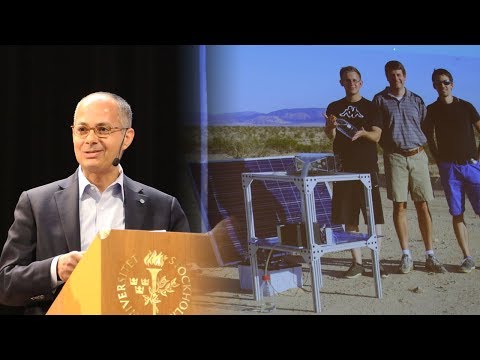
    A Berkeley-MIT team tests a MOF water harvester outdoors, validating the lab results in real desert conditions.

  7. SOURCE Global founded in Arizona

    Business

    Cody Friesen launches the first commercial atmospheric water harvesting company, using solar hydropanels.

  8. Berkeley lab shows MOFs capture water from dry air

    Research

    Yaghi's team demonstrates a MOF that can pull water vapor from low-humidity air using only sunlight to release it.

  9. Yaghi reports the first metal-organic framework

    Research

    Yaghi's group publishes the first MOF in Nature, opening the field of reticular chemistry.

Historical Context

3 moments from history that rhyme with this story — and how they unfolded.

October 2013

Sorek desalination plant opens (2013)

Israel opened the Sorek reverse-osmosis desalination plant, then the largest of its kind, producing 624,000 cubic meters of fresh water per day. The technology had existed since the 1960s but cost too much to scale. Sorek hit a price point near 58 US cents per cubic meter.

Then

Israel went from chronic water shortage to a water surplus within five years and began exporting water to Jordan.

Now

Desalination is now a routine water source across the Gulf, Spain, and parts of California, supplying about 1% of the world's drinking water.

Why this matters now

Desalination took 50 years to move from lab to mainstream infrastructure because it needed cheap energy and big membranes. MOF water harvesting faces the same scaling question, but at a much smaller and more distributed unit size.

2015

SOURCE Global launches commercial hydropanels (2015)

Cody Friesen founded SOURCE Global in Arizona to sell solar hydropanels that absorb water vapor from air. Each panel produces a few liters per day. SOURCE has raised more than $360 million and deployed in 52 countries.

Then

Demonstrated commercial demand for off-grid AWH, especially for premium bottled water and remote communities.

Now

Still searching for unit economics that compete with municipal water. Growth has slowed since the 2022 funding round.

Why this matters now

SOURCE's decade-long track record is the closest benchmark for what Atoco faces. Atoco's pitch is that MOF chemistry is more efficient than the hygroscopic salts SOURCE uses.

1944-1963

Norman Borlaug's wheat reaches Mexico (1944-1963)

Borlaug spent two decades developing rust-resistant, high-yield wheat varieties in Mexico. By 1963, Mexico had become a net wheat exporter for the first time. The same varieties then spread to India and Pakistan.

Then

Mexico tripled its wheat output and avoided expected famines.

Now

The Green Revolution is credited with preventing famine for an estimated one billion people. Borlaug won the 1970 Nobel Peace Prize.

Why this matters now

Borlaug's work shows the path a Nobel-grade scientific advance can take from lab to global resource problem, including the politics and aid economics that determine whether it actually reaches people who need it.

Sources

(10)