Pull to refresh
Logo
Daily Brief
Following
Why Ranks Sign Up
AUKUS ships its first hardware

AUKUS ships its first hardware

New Capabilities

Five years after the pact, three navies commit to a shared underwater drone program

Today: First Pillar Two signature project announced

Overview

When the Australia-United Kingdom-United States (AUKUS) pact was unveiled in September 2021, the headline was nuclear-powered submarines that would not arrive in Australia until at least 2032. Five years on, the partnership has finally produced a piece of joint hardware, and it is not a submarine.

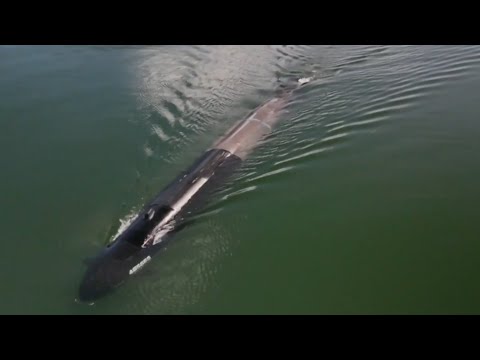
On May 30, 2026, defense chiefs from the three countries met on the sidelines of the Shangri-La Dialogue in Singapore and committed to develop a common family of unmanned underwater drones. The United Kingdom put £150 million ($201 million) on the table, deliveries are scheduled to begin in 2027, and it is the first signature project under AUKUS Pillar Two, the side of the pact that covers undersea robotics, artificial intelligence, hypersonics, and electronic warfare.

Why it matters

Three navies now share a way to hunt Chinese submarines and map contested waters without putting sailors in the boats.

Key Indicators

$201M
UK funding commitment
Britain's £150 million pledge to the signature project announced in Singapore.
8
Pillar Two technology areas
Undersea, quantum, AI and autonomy, advanced cyber, hypersonics, electronic warfare, innovation, and information sharing.
2027
Scheduled first delivery
The year the three partners expect the first underwater drone payloads to reach their navies.
3
Partner nations
Australia, the United Kingdom, and the United States. Japan has been discussed as a possible Pillar Two associate.

Voices

Curated perspectives — historical figures and your fellow readers.

Ever wondered what historical figures would say about today's headlines?

Sign up to generate historical perspectives on this story.

Play

Exploring all sides of a story is often best achieved with Play.

Log in to play. Track your picks, climb the leaderboards. Log in Sign Up
Predict 4 ways this could play out. Contrarian picks score more — points lock when the scenario resolves. Log in to play
Higher or Lower Two numbers from this story. Guess which is bigger. 5 rounds to set a streak. Log in to play
Timeline Five events from this story — drag them oldest to newest. Log in to play
Connections Sixteen names from the news. Find the four hidden groups of four. Log in to play

People Involved

Organizations Involved

Timeline

September 2021 May 2026

7 events Latest: Today
Tap a bar to jump to that date
  1. First Pillar Two signature project announced

    Today Announcement

    Hegseth, Healey, and Marles announce a joint underwater drone program at the Shangri-La Dialogue. The UK commits £150 million and first deliveries are scheduled for 2027.

  2. Congressional review affirms Pillar One

    Legislative

    A Congressional Research Service report concludes that the Virginia-class transfer to Australia remains on track despite shipyard production pressure.

  3. Pillar Two opens door to Japan

    Policy

    AUKUS defense ministers say they are considering cooperation with Japan on specific Pillar Two projects, without offering full membership.

  4. First trilateral AI and autonomy trial

    Demonstration

    British, US, and Australian forces complete a joint test of AI-enabled autonomous systems in the United Kingdom, the first Pillar Two field demonstration.

  5. San Diego summit sets submarine pathway

    Summit

    Biden, Sunak, and Albanese announce that Australia will buy Virginia-class submarines from the early 2030s before SSN-AUKUS boats arrive in the 2040s.

  6. Pillar Two scope expands to eight areas

    Policy

    Hypersonics, counter-hypersonics, electronic warfare, innovation, and information sharing are added to the original four Pillar Two technology areas.

  7. AUKUS pact announced

    Treaty

    President Biden, Prime Minister Johnson, and Prime Minister Morrison unveil the trilateral pact, anchored by a plan to give Australia nuclear-powered submarines.

Historical Context

3 moments from history that rhyme with this story — and how they unfolded.

April 1963

Polaris Sales Agreement (1963)

The United States agreed to sell Polaris submarine-launched ballistic missiles to the United Kingdom after the cancellation of the US Skybolt missile left Britain's nuclear deterrent without a delivery system. The deal gave Britain access to one of the most sensitive American weapons programs and tied the Royal Navy's nuclear force to US technology for the next 60 years.

Then

Britain laid down four Resolution-class ballistic missile submarines, the first of which entered service in 1968. The deal preserved an independent British deterrent on paper while making it dependent on US missiles and maintenance in practice.

Now

The Polaris framework set the template for the Trident missile deal in 1980 and for AUKUS Pillar One in 2021. Each agreement deepens the merger of US and UK naval nuclear programs.

Why this matters now

Pillar One of AUKUS is the same kind of deal stretched to a third country. Pillar Two is now testing whether that closed-club model can produce conventional hardware on a faster cycle than nuclear submarines have ever managed.

November 1996

F-35 Joint Strike Fighter program (1996 onward)

The Pentagon launched the Joint Strike Fighter competition to design a stealth fighter that the US Air Force, Navy, Marines, and eight partner countries could all buy. Lockheed Martin won the contract in 2001. Partner nations contributed funding and industrial work in exchange for a place in the supply chain.

Then

Costs ballooned from an initial estimate of around $200 billion to more than $400 billion, and the first operational squadrons did not stand up until 2015, nearly a decade behind schedule.

Now

More than 1,000 F-35s are now in service across 19 countries. The program is the working example of multinational defense development, with all its benefits in interoperability and all its costs in schedule slippage and political friction.

Why this matters now

The F-35 shows the upside and the downside of pooled defense projects. AUKUS Pillar Two is trying to repeat the upside with underwater drones on a much shorter timeline. The F-35's history is what the Singapore commitment to 2027 deliveries is implicitly betting against.

September 1951 to February 1986

ANZUS Treaty (1951) and the New Zealand split (1986)

Australia, New Zealand, and the United States signed the ANZUS Treaty in San Francisco in 1951 to coordinate Pacific security. In 1984 the new Labour government in Wellington barred nuclear-armed and nuclear-powered ships from New Zealand ports, and in 1986 the United States suspended its treaty obligations to New Zealand.

Then

ANZUS effectively became a bilateral US-Australia pact. New Zealand kept its nuclear-free policy and lost access to US military exercises and intelligence for years.

Now

The split shaped a generation of Australian defense planning around the assumption that Canberra, not Wellington, would be Washington's lead Pacific partner. AUKUS is the direct descendant of that arrangement.

Why this matters now

ANZUS is a reminder that trilateral pacts can fracture over political shifts in any one capital. AUKUS already faces questions about how a future US, UK, or Australian government might handle nuclear cooperation, submarine basing, or technology sharing.

Sources

(8)