

Pull to refresh
Logo
Blackstone battery project clears federal environmental hurdle in Queensland

Blackstone battery project clears federal environmental hurdle in Queensland

Built World

Octopus Australia's 500 MW battery near Ipswich passes national assessment; storage capacity still unconfirmed

Today: Press reports federal clearance and capacity discrepancy

Overview

Updated 1 hour ago

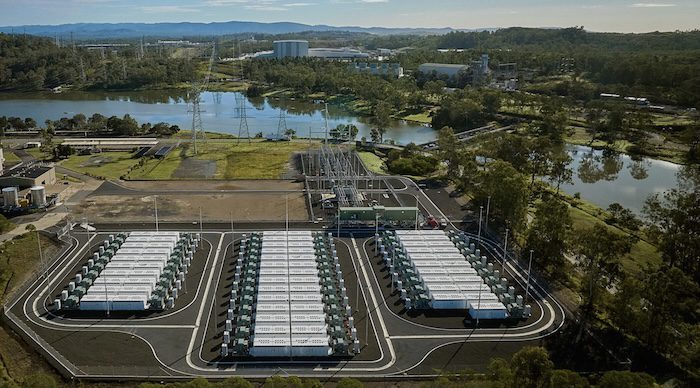
Australia's federal environment department has cleared Octopus Australia's 500-megawatt battery project in Queensland under national environmental law. The ruling means no further federal assessment is needed. The decision pushes the Blackstone battery, 30 kilometers southwest of Brisbane, toward a construction start scheduled for November 2026.

The federal referral describes a 2,000-megawatt-hour system, able to store four hours of power at full output. Octopus's own materials and its state approval specify half that, 1,000 megawatt-hours. Which configuration actually gets built remains open.

Why it matters

If built at full 2,000 MWh, it would be among Queensland's largest batteries, adding four hours of grid storage to back renewables.

Questions about this story

Free account needed to ask — your question is kept and asked for you right after sign-up. Answers are public.

No questions yet — be the first to ask.

Key Indicators

500 MW
Planned power output
Nameplate capacity for the Blackstone battery, consistent across the federal referral and state approval.
2,000 MWh
Storage capacity per federal referral
Four hours at 500 MW, the configuration described in the October 2026 EPBC referral decision.
1,000 MWh
Storage capacity per Octopus and state approval
Two hours at 500 MW — half the referral figure, shown on Octopus's website and the June 2024 approval.
7.25 ha
Project footprint
Total disturbance area including battery units, a new 275 kV substation and access roads.

Voices

Curated perspectives — historical figures and your fellow readers.

Ever wondered what historical figures would say about today's headlines?

Sign up to generate historical perspectives on this story.

Organizations Involved

Timeline

October 2023 November 2026

6 events Latest: Today
Tap a bar to jump to that date
  1. Construction scheduled to begin

    Upcoming Scheduled

    Per the referral, site works start in November 2026, with completion and operation targeted for Q1 2029.

  2. Press reports federal clearance and capacity discrepancy

    Today Reporting

    Construction Review reports the clearance and flags the 2,000 MWh referral versus 1,000 MWh state approval.

  3. Federal 'approval not required' decision published

    Regulatory

    The department posts decision 2026/10624 on its public portal, clearing the federal hurdle for the 500 MW / 2,000 MWh referral.

  4. Federal EPBC assessment closes

    Regulatory

    The Environment Protection and Biodiversity Conservation Act assessment concludes the project is not a controlled action.

  5. State and local planning approval granted

    Approval

    Ipswich City Council and Queensland's State Assessment and Referral Agency approve the 500 MW / 1,000 MWh development.

  6. Octopus acquires Blackstone battery project

    Acquisition

    Octopus Investments buys the proposed battery from developer Firm Power.

Scenarios

1

Blackstone battery built at full 2,000 MWh capacity

Possible Resolves by End of 2027

Discussed by: Construction Review and reneweconomy note the federal referral describes the larger four-hour configuration

Octopus revises its state approval and marketing to match the 2,000 MWh referral, delivering a four-hour battery beside the Blackstone substation. This requires financial close in the fourth quarter of 2026 and construction starting in November 2026 as planned, with Tesla as the engineering, procurement and construction partner.

2

Blackstone battery scales back to 1,000 MWh

Possible Resolves by End of 2027

Discussed by: reneweconomy and Lightning Energy flag Octopus's website and state approval specify half the referral capacity

The built system matches the state approval and Octopus's marketing at two hours of storage, and the referral's 2,000 MWh figure is cut in final design. Construction proceeds at the smaller size, still among Queensland's larger batteries but not the four-hour system the federal assessment described.

3

Blackstone construction slips past the 2026 target

Unlikely Resolves by Q1 2027

Discussed by: The EPBC referral lists financial close and Notice to Proceed for late 2026, with construction from November 2026

Financing, Powerlink connection agreements, or secondary council consents push the start past late 2026, as has happened with several Australian storage projects. Operation then shifts beyond the first quarter of 2029.

Historical Context

2 moments from history that rhyme with this story — and how they unfolded.

November 2017

Hornsdale Power Reserve (2017)

Tesla built a 100 MW / 129 MWh lithium-ion battery beside a South Australian wind farm in under 100 days, after a public bet between the state premier and Elon Musk. It was the country's first grid-scale big battery.

Then

The battery cut frequency-control costs and stabilized the grid, turning a political gamble into a working template.

Now

It started an Australian storage boom, and gigawatt-hour-scale projects are now standard in every state.

Why this matters now

Blackstone is a far larger standalone descendant of that model, sited for grid services rather than attached to a wind farm.

2024-2026

Quinbrook's Supernode battery (2024-2026)

Quinbrook built a storage project at a surrendered coal-power site north of Brisbane. Its first two stages, at 1,858 MWh, are already operating, with a third stage lifting the total past 3,000 MWh.

Then

Supernode became Queensland's largest operating battery and set the benchmark Blackstone is chasing.

Now

It showed coal plant sites offer ready grid connections for storage, a logic Blackstone repeats beside the shuttered Swanbank generators.

Why this matters now

If Blackstone reaches 2,000 MWh it would trail only Supernode in Queensland, showing how fast storage is scaling in the state.

Sources

(8)