
Pull to refresh
Logo
EU drops 'associate member' offer to Canada after member states object

EU drops 'associate member' offer to Canada after member states object

Rule Changes

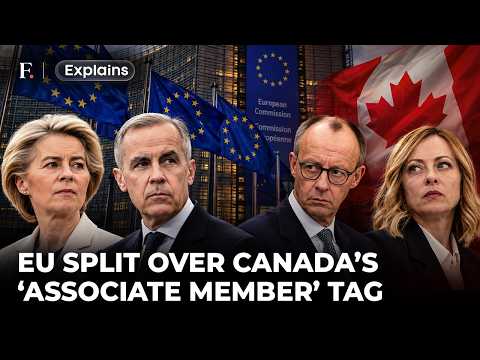
Germany, Italy, France and Greece pushed to remove the term von der Leyen proposed in September

Overview

Updated 1 hour ago

The European Union deleted "associate member" from the joint statement prepared for this week's EU-Canada summit in Montreal, after Germany, Italy, France and Greece objected to the term. Commission President Ursula von der Leyen had proposed in September that Canada become the first non-EU country with that status.

The revised text pledges instead an "ever closer association" and commits both sides to define what that means by the 2027 summit. The label fight exposed a structural gap: the EU has no formal category between ordinary trade partner and full member, and 27 governments disagree on how to build one.

Why it matters

A failed partnership label leaves Canada and Ukraine without a clear path to deeper EU ties — keeping transatlantic trade dependent on case-by-case deals.

Questions about this story

Free account needed to ask — your question is kept and asked for you right after sign-up. Answers are public.

No questions yet — be the first to ask.

Key Indicators

4
EU member states that objected to the term
Germany, Italy, France and Greece blocked the wording in the draft statement.
0
Third countries holding EU associate member status
The Canada proposal would have been the first such designation.
2027
Deadline to define 'ever closer association'
Both sides committed to define the concept at the 2027 EU-Canada summit.

Voices

Curated perspectives — historical figures and your fellow readers.

Sign up to generate historical perspectives on this story.

People Involved

Organizations Involved

Timeline

January 2026 October 2026

5 events Latest: Today
Tap a bar to jump to that date
  1. EU-Canada summit opens; 'associate member' dropped

    Today Summit

    The Montreal summit begins with a joint statement pledging 'ever closer association' — the term is gone, but LNG, subsea cable and youth mobility initiatives remain.

  2. Member states block the term in draft statement

    Objection

    Germany, Italy, France and Greece raise formal objections to the draft EU-Canada declaration, forcing a revised text.

  3. Von der Leyen offers Canada first associate membership

    Proposal

    In her state of the union address, the Commission president proposes Canada as the EU's first associate member — without consulting member states.

  4. Merz floats associate membership for Ukraine

    Proposal

    German Chancellor Friedrich Merz proposes associate membership as a security-guarantee path for Ukraine; Zelenskyy rejects it.

  5. Carney calls for middle-power alliance in Davos

    Statement

    Canadian PM Mark Carney proposes a coalition of middle powers to safeguard global stability.

Scenarios

1

EU and Canada agree 'ever closer association' framework by 2027

Likely Resolves by End of 2027

Discussed by: The Guardian, reporting the joint communiqué commits both sides to define the concept by the 2027 summit

The joint statement survives its own ambiguity. Both sides spend 2027 negotiating what "ever closer association" means in practice — likely a package of sectoral deals on trade, defense, critical minerals, and energy. The label matters less than the substance; the relationship deepens through a defined framework without a new legal status.

2

Associate membership resurfaces after member states set the terms

Unlikely Resolves by Q2 2027

Discussed by: Euronews, noting von der Leyen continues to use the term and that some diplomats see a path if substance is defined first

Von der Leyen keeps the label alive in public statements. Germany's objection was about process — define the content first, then the name. If a detailed cooperation package is negotiated and member states sign off on the substance, the label could return in a later document. Precedent concerns from Italy and Greece remain the main obstacle.

3

Sector-by-sector deals replace any umbrella label

Possible Resolves by End of 2027

Discussed by: EU diplomats quoted by Euronews, describing a 'technical, sector-by-sector approach'

No umbrella framework emerges. Instead the EU and Canada deepen ties through individual agreements: the LNG feasibility study proceeds, the subsea cable initiative launches, youth mobility expands, trade and critical minerals talks continue. The relationship is real but has no single name or formal legal category.

Historical Context

3 moments from history that rhyme with this story — and how they unfolded.

January 1994

European Economic Area established (1994)

The EEA extended the EU single market to Norway, Iceland and Liechtenstein without granting them EU membership. It created a new legal category — neither full membership nor a standard trade deal.

Then

Norway and Iceland gained access to the single market and four freedoms. The agreement created the deepest integration framework ever offered to non-members.

Now

The EEA remains in force today, but it codified a one-way relationship: non-members adopt EU rules without a vote on them. Norway has repeatedly debated membership since.

Why this matters now

The EEA is the precedent for creating a new formal category for non-members. The associate membership proposal was a similar institutional innovation, and the debate around it echoes the EEA negotiations — including member states' fear of creating a half-membership that complicates the EU's own decision-making.

March-June 2014

EU-Ukraine Association Agreement (2014)

After months of protests in Kiev over former President Yanukovych's decision to abandon the agreement, Ukraine signed an association agreement with the EU including a deep and comprehensive free trade area. The political provisions were signed in March 2014, the economic part in June.

Then

The agreement became a flashpoint with Russia, which annexed Crimea and backed separatists in the east. Ukraine began implementing EU standards and norms across dozens of sectors.

Now

It became the foundation of Ukraine's EU path, leading to candidate status in 2022 — the closest a non-member has come to membership without joining.

Why this matters now

The Ukraine association agreement shows the EU's traditional answer to non-members seeking deep ties: tailored sectoral agreements, not new legal categories. The associate membership proposal for Canada was meant to go further — and Merz's original version of the concept was itself designed for Ukraine.

October 2022

European Political Community launched (2022)

President Emmanuel Macron proposed the European Political Community as a loose forum for European countries outside the EU — including the UK, Ukraine, Norway and the Balkans. The first summit took place in Prague in October 2022.

Then

The EPC brought dozens of leaders together for dialogue on security, energy and infrastructure, without any binding legal framework.

Now

It remains an informal forum, deliberately avoiding the institutional machinery of the EU. It showed the bloc's willingness to engage non-members without creating new legal statuses.

Why this matters now

The EPC is the opposite approach to associate membership: a flexible forum rather than a formal category. The failure of the associate membership label may push the EU back toward informal, forum-style structures — or reveal that neither approach satisfies partners like Canada and Ukraine.

Sources

(6)