

Pull to refresh
Logo
First PROTAC prostate cancer drug shows tumor and pain responses in early trial

First PROTAC prostate cancer drug shows tumor and pain responses in early trial

New Capabilities

Bavdegalutamide is the first androgen receptor degrader of its class tested in metastatic castration-resistant prostate cancer.

Overview

Updated 1 hour ago

Men with metastatic castration-resistant prostate cancer have few options once hormone therapy stops working. A Yale-led Phase I/II trial reported that bavdegalutamide, a drug built to destroy the testosterone receptor, reduced prostate-specific antigen levels, shrank soft-tissue lesions and eased pain in some patients.

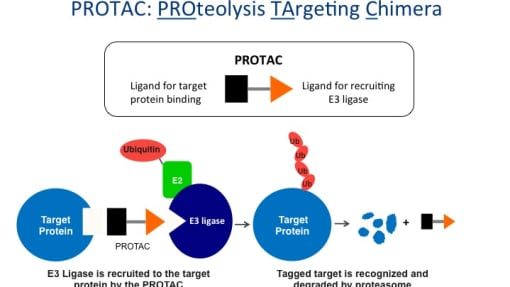
The drug is the first PROTAC androgen receptor degrader tested in people. Instead of only blocking testosterone, it uses the cell's protein-recycling system to remove the receptor that prostate cancer uses to grow. The results are early: the trial had no comparison group and did not report survival.

Why it matters

If larger trials confirm it, destroying the androgen receptor could give men whose cancer evades hormone therapy a new treatment option.

Questions about this story

Free account needed to ask — your question is kept and asked for you right after sign-up. Answers are public.

No questions yet — be the first to ask.

Key Indicators

35,000+
Annual U.S. mCRPC deaths
Petrylak cited more than 35,000 deaths from metastatic castration-resistant prostate cancer this year.
420 mg
Daily dose found safe in Phase I
The trial settled on 420 milligrams daily for patients already treated for mCRPC.
2
Androgen receptor mutations linked to better PSA response
Cancers with T878 and H875 mutations showed greater prostate-specific antigen reductions.
1
First PROTAC androgen receptor degrader tested clinically
Bavdegalutamide is the first drug of its class to enter human testing against prostate cancer.

Voices

Curated perspectives — historical figures and your fellow readers.

Sign up to generate historical perspectives on this story.

People Involved

Organizations Involved

Timeline

1 event Latest: October 9th, 2026 · 1 month ago
  1. Bavdegalutamide trial results published

    Latest Clinical trial

    The Phase I/II study found 420 mg daily safe and reported PSA reductions, soft-tissue lesion regressions and pain improvements.

Scenarios

1

Larger trial confirms bavdegalutamide responses

Possible Resolves by End of 2027

Discussed by: Yale researchers and trial investigators

A follow-up Phase II or Phase III study reports a confirmed PSA50 response rate and durable tumor responses. This would move bavdegalutamide from an early signal to a candidate for regulatory review.

2

FDA grants breakthrough designation to bavdegalutamide

Unlikely Resolves by Q2 2028

Discussed by: Oncology analysts watching PROTAC development

The FDA grants breakthrough therapy designation or accelerated approval based on early prostate cancer data. This would require larger response data and a clear advantage over existing hormone therapies.

3

A rival AR degrader reaches Phase III first

Possible Resolves by Q2 2027

Discussed by: J&J and BMS early trial reports

JNJ-6143 and BMS-986365 are competing androgen receptor-targeting drugs in early trials. If one begins a Phase III study before bavdegalutamide, the competitive lead shifts even if bavdegalutamide was first in its specific PROTAC class.

Historical Context

3 moments from history that rhyme with this story — and how they unfolded.

1980s-2002

Fulvestrant for breast cancer (2002)

Fulvestrant was approved in 2002 for breast cancer that had progressed after tamoxifen. It degrades the estrogen receptor instead of only blocking it.

Then

It gave patients with hormone-resistant breast cancer another endocrine option.

Now

Receptor degradation became a proven strategy in breast cancer, separate from receptor blockade.

Why this matters now

Bavdegalutamide applies the same logic to the androgen receptor in prostate cancer.

1990s-2001

Imatinib for chronic myeloid leukemia (2001)

Imatinib was approved in 2001 for chronic myeloid leukemia. It targets the BCR-ABL protein and turned a deadly leukemia into a manageable condition for many patients.

Then

Many patients saw deep remissions, but some later developed resistance.

Now

The drug established targeted cancer therapy as a clinical model and showed that tumors adapt.

Why this matters now

Prostate cancer has followed a similar path: hormone therapy works, then resistance sets in.

1990s-2003

Bortezomib and the proteasome (2003)

The FDA approved bortezomib for multiple myeloma in 2003. It blocks the proteasome, the cell structure that breaks down proteins.

Then

It showed that protein-recycling machinery could be a cancer drug target.

Now

Researchers began looking for ways to direct that machinery at specific cancer proteins.

Why this matters now

PROTACs use the same recycling system, but to remove specific cancer-driving proteins rather than block it broadly.

Sources

(3)