

Pull to refresh
Logo
Daily Brief
Following
Why Sign Up
FDA approves first protein-destroying PROTAC drug for advanced breast cancer

FDA approves first protein-destroying PROTAC drug for advanced breast cancer

New Capabilities
By Newzino Staff |

Arvinas and Pfizer's vepdegestrant launches a drug class chemists have pursued for 25 years

Yesterday: FDA approves VEPPANU, first PROTAC ever cleared

Overview

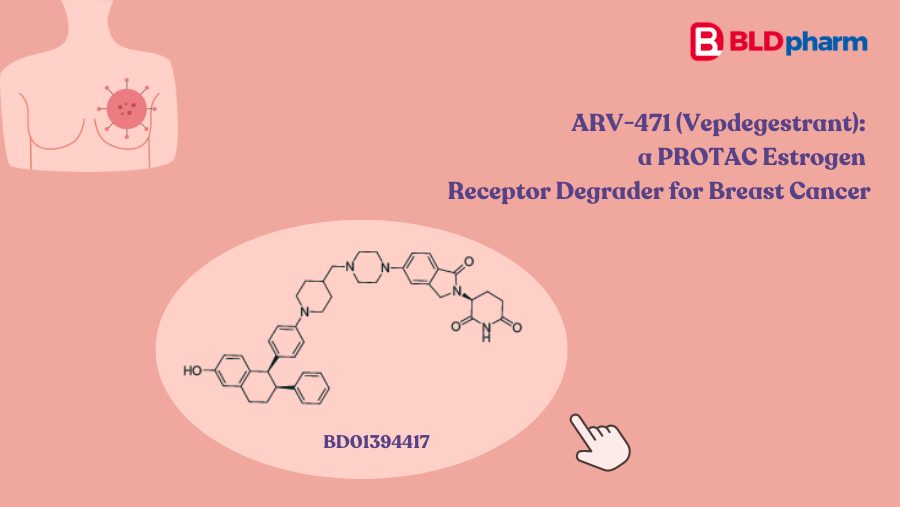
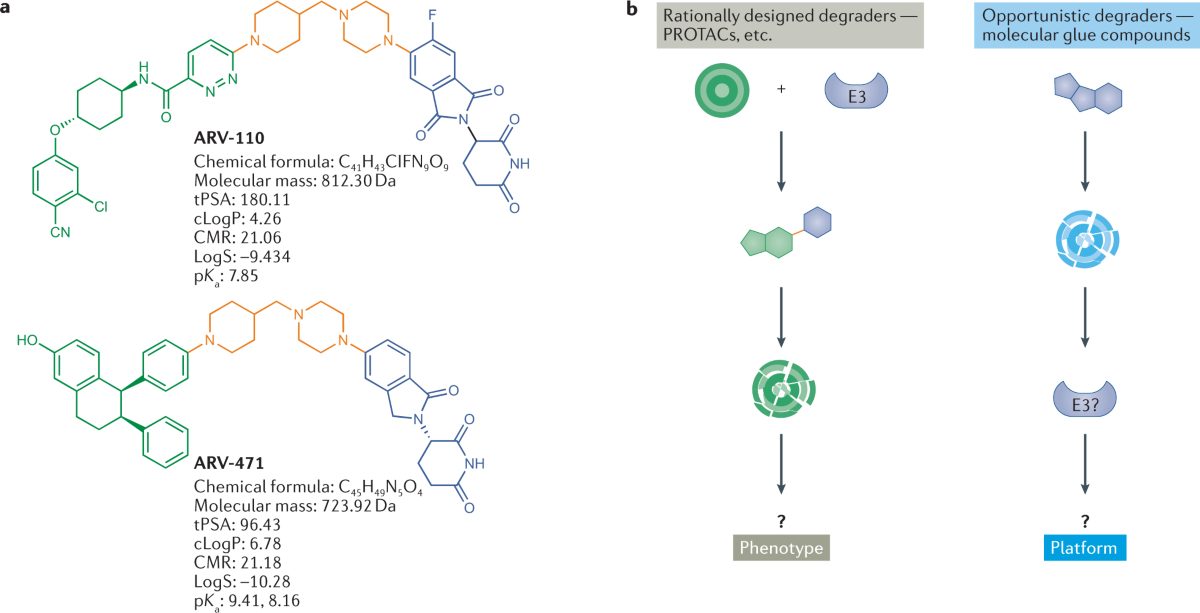
For 25 years, drug companies have tried to design medicines that don't just block harmful proteins but destroy them outright. On May 1, the U.S. Food and Drug Administration (FDA) approved the first one. VEPPANU, developed by biotech Arvinas and Pfizer, treats a hard-to-treat form of metastatic breast cancer by hijacking the cell's own garbage-disposal system to shred a mutated estrogen receptor that fuels the tumor.

Why it matters

If PROTACs deliver, drugs may finally reach the roughly 80% of human proteins that conventional medicines cannot touch.

Key Indicators

1st
PROTAC ever approved
VEPPANU is the first proteolysis-targeting chimera cleared by any major regulator.
25 years
From concept to clinic-ready
Crews, Sakamoto and Deshaies published the original PROTAC concept in 2001.
43%
Reduction in progression risk
Phase 3 VERITAC-2 result vs. fulvestrant in ESR1-mutated patients (hazard ratio 0.57).
5.0 vs 2.1
Median months without progression
Vepdegestrant more than doubled progression-free survival compared with the standard hormone therapy.
$50M
Approval milestone to Arvinas
Triggered by the FDA decision under the 2021 Pfizer collaboration.
$2.05B
Total Pfizer-Arvinas deal value
Combined upfront, equity, approval and commercial milestones from the 2021 partnership.
35 days
Approval ahead of deadline
FDA acted before the assigned June 5, 2026 review date.

Interactive

Exploring all sides of a story is often best achieved with Play.

Ever wondered what historical figures would say about today's headlines?

Sign up to generate historical perspectives on this story.

Sign Up

Debate Arena

Two rounds, two personas, one winner. You set the crossfire.

People Involved

Organizations Involved

Timeline

  1. FDA approves VEPPANU, first PROTAC ever cleared

    Regulatory

    FDA approves vepdegestrant for ESR1-mutated, ER+/HER2− advanced or metastatic breast cancer 35 days ahead of the PDUFA deadline. Arvinas receives a $50M milestone payment.

  2. FDA accepts NDA, sets June 5 deadline

    Regulatory

    FDA accepts the application for review with a Prescription Drug User Fee Act (PDUFA) target action date of June 5, 2026.

  3. Partners decide to out-license commercial rights

    Corporate

    Arvinas and Pfizer announce they will jointly seek a third-party partner to commercialize vepdegestrant rather than launch it themselves; Arvinas restructures and lays off staff.

  4. New Drug Application submitted

    Regulatory

    Arvinas and Pfizer submit a New Drug Application to the FDA for vepdegestrant in ESR1-mutated, ER+/HER2− advanced breast cancer.

  5. VERITAC-2 Phase 3 topline reported

    Clinical results

    Vepdegestrant cuts progression risk 43% in ESR1-mutated patients vs. fulvestrant, but misses statistical significance in the broader intent-to-treat population, narrowing its likely label.

  6. Pfizer signs $2.05B vepdegestrant deal

    Corporate

    Pfizer pays Arvinas $650M upfront, buys $350M of equity and offers up to $1.05B in milestones for joint development and commercialization of ARV-471 (vepdegestrant).

  7. First PROTAC enters human trials

    Clinical milestone

    Arvinas dosed the first patient with ARV-110 (bavdegalutamide), an androgen receptor degrader for prostate cancer — the first PROTAC ever tested in humans.

  8. Arvinas founded

    Corporate

    Crews founds Arvinas in New Haven to translate PROTAC chemistry into drugs, seeded by Canaan Partners and 5AM Ventures.

  9. PROTAC concept published

    Scientific milestone

    Kathleen Sakamoto, Craig Crews and Ray Deshaies publish the founding PROTAC paper in PNAS, proposing chimeric molecules that recruit E3 ubiquitin ligases to degrade target proteins.

Scenarios

1

PROTACs become a standard tool, with multiple approvals by 2030

Discussed by: Nature Reviews Drug Discovery, BioPharma Dive, sell-side analysts at Stifel and Leerink

VEPPANU's approval sets a regulatory template that pulls roughly two dozen PROTACs in trials at Kymera, C4, Nurix, Bristol Myers Squibb, Foghorn and others through review more quickly. Investors who pulled back from protein degraders in 2024–25 return; large pharma signs new option deals like Gilead's recent CDK2 degrader pickup from Kymera. By 2030, three to five PROTACs are on the market across oncology and immunology.

2

VEPPANU loses the launch race to elacestrant

Discussed by: BioPharma Dive, FierceBiotech, oncology key opinion leaders

Menarini's elacestrant has a three-year head start in the same ESR1-mutated subset and an entrenched commercial team. With Arvinas and Pfizer publicly seeking a third-party commercial partner — and that partner not yet named at approval — the launch lacks the sales force and physician outreach a Pfizer-led launch would have had. VEPPANU's better trial numbers fail to translate into market share, making the first PROTAC a scientific success but a commercial disappointment.

3

Combination data expands vepdegestrant beyond the ESR1-mutated niche

Discussed by: OncLive, ASCO presenters, Arvinas/Pfizer pipeline updates

The companion VERITAC-3 study testing vepdegestrant with the CDK4/6 inhibitor palbociclib in first-line metastatic disease, plus the lidERA-Breast Cancer adjuvant trial, read out positive. Vepdegestrant's label expands beyond a few thousand ESR1-mutated patients to a much larger first-line and adjuvant population, restoring blockbuster commercial expectations.

4

Class hits a safety wall outside oncology

Discussed by: Endpoints News, FDA advisory discussions, academic pharmacologists

PROTACs in inflammation and neurology — where patients tolerate less risk than cancer patients — run into off-target degradation, neutropenia, or hepatotoxicity in larger trials. Programs at Kymera (STAT6, IRAK4) and others slow or fail. PROTACs settle into a permanent oncology niche rather than becoming a true platform.

Historical Context

Gleevec (imatinib) approval (2001)

May 2001

What Happened

FDA approved Novartis's imatinib for chronic myeloid leukemia in just 2.5 months, validating Brian Druker's argument that designing a small molecule to block a single cancer-driving kinase (BCR-ABL) could turn a fatal disease into a manageable one. The drug produced durable remissions in patients who had previously had a five-year survival of about 30%.

Outcome

Short Term

Imatinib became the foundation of CML treatment and Novartis's biggest oncology product, validating targeted therapy as a paradigm.

Long Term

More than 70 kinase inhibitors have since been approved across cancers, building a multi-billion-dollar drug class that did not exist before Gleevec.

Why It's Relevant Today

Like PROTACs, kinase inhibitors were a long-pursued idea waiting for a first approval to unlock investor and regulator confidence. Gleevec's success made the next dozen kinase inhibitor approvals routine — the template VEPPANU may now provide for protein degraders.

Muromonab-CD3 (OKT3) approval (1986)

June 1986

What Happened

FDA approved Ortho Biotech's OKT3 for organ transplant rejection — the first monoclonal antibody drug. The product was technically crude (a mouse antibody causing immune reactions), commercially modest, and clinically replaced within a decade. But it proved monoclonal antibodies could be manufactured, dosed, and reimbursed.

Outcome

Short Term

OKT3 carved out a niche in transplant medicine but never became a blockbuster; the technology was clearly first-generation.

Long Term

It took 11 years before Rituxan (1997) showed antibodies could deliver oncology blockbusters. Today antibody drugs generate over $200 billion in annual sales — the largest single drug class.

Why It's Relevant Today

A first-in-class approval is not a guaranteed commercial success, and the first product is rarely the best one. PROTACs may follow OKT3's pattern: VEPPANU validates the platform, but the class-defining commercial winners may be drugs that have not yet reached late-stage trials.

Kymriah (tisagenlecleucel) approval (2017)

August 2017

What Happened

FDA approved Novartis's tisagenlecleucel for relapsed pediatric leukemia, the first chimeric antigen receptor (CAR-T) cell therapy. The treatment produced complete remissions in roughly 80% of children whose cancers had failed conventional therapy, but it required custom manufacturing for each patient and listed at $475,000 per dose.

Outcome

Short Term

Kymriah's narrow indication and complex logistics led to slower-than-expected uptake; six more CAR-T products followed within five years.

Long Term

CAR-T became standard of care for several blood cancers and attracted tens of billions in investment, though the broader promise — solid-tumor CAR-T, off-the-shelf manufacturing — is still unproven.

Why It's Relevant Today

Kymriah showed that a 'first' approval can simultaneously validate a platform and reveal hard scaling problems. PROTACs share some of that profile: the chemistry is complex, manufacturing is non-trivial, and broadening beyond the first cancer indication is the real test of the class.

Sources

(12)