



Pull to refresh
Logo
Astronomers watch a hot Jupiter disappear as a hidden planet tilts its orbit

Astronomers watch a hot Jupiter disappear as a hidden planet tilts its orbit

New Capabilities

Seven years of transits ended when TOI-2535b slipped out of view. A Saturn-sized companion is wobbling its orbit.

Overview

Updated Yesterday

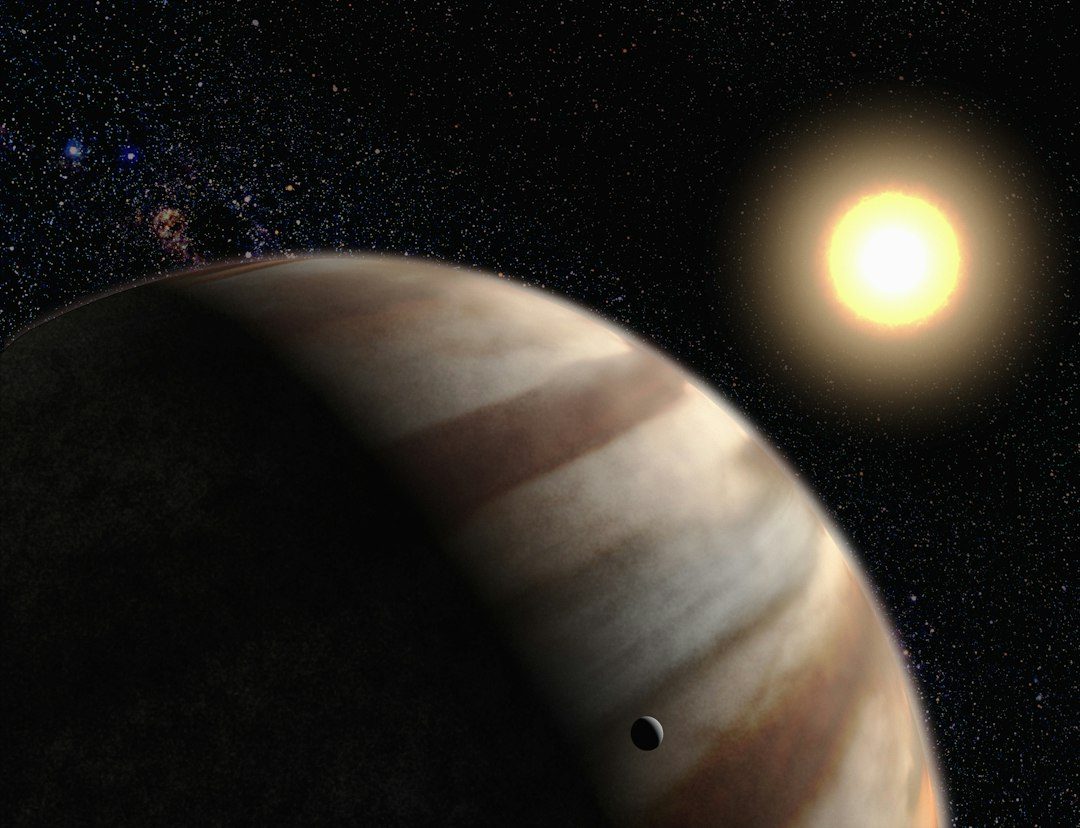
For seven years, a Jupiter-sized planet crossed its star on a schedule astronomers could time to within hours. Then the transits drifted, shortened, and by March 2026 stopped entirely.

The planet did not vanish. A second, unseen planet is tugging its orbit out of alignment with Earth's line of sight. The discovery gives astronomers a rare look at how giant planets tilt and migrate.

Why it matters

Astronomers can now watch a hot Jupiter's orbit wobble and use that wobble to find planets too tilted to see directly.

Questions about this story

Free account needed to ask — your question is kept and asked for you right after sign-up. Answers are public.

No questions yet — be the first to ask.

Key Indicators

1,100 light-years
Distance to TOI-2535
The star sits about 1,100 light-years from Earth.
~8.4 days
Orbital period of TOI-2535b
The hot Jupiter circles its star in just over eight days, about ten times faster than Mercury.
6 hours
Maximum transit timing offset
The planet arrived early or late by up to six hours as its orbit wobbled.
≥5 degrees
Minimum mutual orbital tilt
The two planets' orbits are tilted at least five degrees apart, far more than most multi-planet systems.
30–50 years
Wobble cycle and return window
The orbital tilt cycles over decades; TOI-2535b's next transit is expected around 2056 to 2076.

Voices

Curated perspectives — historical figures and your fellow readers.

Sign up to generate historical perspectives on this story.

People Involved

Organizations Involved

Timeline

April 2019 November 2026

3 events Latest: Yesterday
  1. Hidden companion blamed for the orbital tilt

    Latest Publication

    UCLA researchers publish in The Astrophysical Journal Letters, attributing the vanishing act to a Saturn-sized neighbor.

  2. TOI-2535b slips out of view

    Observation

    The planet's transits shorten and graze the star's edge, then stop appearing entirely.

  3. TESS spots the first transit of TOI-2535b

    Discovery

    NASA's TESS spacecraft detects the hot Jupiter crossing its star, beginning seven years of observations.

Scenarios

1

Hidden neighbor confirmed by radial velocity

Possible Resolves by End of 2032

Discussed by: The study's authors, who note the companion's pull should be detectable once cleaner measurements exist

The unseen planet's gravity should shift TOI-2535's light spectrum in a repeating pattern. With enough clean data, radial velocity measurements can confirm its mass and orbit, turning an inference into a listed planet.

2

A third planet turns up in the TOI-2535 system

Unlikely Resolves by End of 2033

Discussed by: The researchers, who say noise in the transit timing variations leaves room for a third body

The transit timing variations contain enough noise that a third planet cannot be ruled out. If one exists, its gravity would add its own signature to the timing data.

3

The hidden companion transits into view

Possible Resolves by End of 2040

Discussed by: The researchers, who say the companion could come into view sooner than TOI-2535b's 30-to-50-year return

The companion's tilted orbit may eventually cross the star from Earth's vantage point. If it does, its transit would confirm the wobble model directly and pin down its size.

Historical Context

3 moments from history that rhyme with this story — and how they unfolded.

September 1846

Neptune's discovery (1846)

Uranus's orbit showed unexplained irregularities. French mathematician Urbain Le Verrier calculated where an unseen planet must sit to cause them. On September 23, 1846, Johann Galle found Neptune within a degree of the predicted spot.

Then

Neptune became the first planet found by mathematical prediction rather than chance observation.

Now

The method established that gravitational disturbances could reveal unseen bodies, the same logic used to infer TOI-2535's companion.

Why this matters now

TOI-2535b's drifting transits are the modern equivalent of Uranus's wobble: a visible planet's odd motion pointing to an invisible one.

October 1995

51 Pegasi b (1995)

Michel Mayor and Didier Queloz announced a Jupiter-mass planet orbiting the star 51 Pegasi in just over four days. It was the first planet found around a sun-like star, and it orbited far closer than any planet in the solar system.

Then

The discovery upended models of planet formation, which had assumed giant planets form far from their stars.

Now

It launched the study of hot Jupiters and the migration question that TOI-2535b now informs.

Why this matters now

TOI-2535b is a hot Jupiter, and the paper tests competing ideas for how such planets reach their stars.

August 2010

Kepler-9 and transit timing variations (2010)

NASA's Kepler mission found two planets around the star Kepler-9 whose transits arrived early or late in a repeating pattern. The timing shifts showed the planets were pulling on each other gravitationally.

Then

It was the first system where planets were confirmed through transit timing variations.

Now

The technique became a standard tool for finding and weighing planets that tug on transiting ones.

Why this matters now

TOI-2535's companion was inferred the same way: from transits that ran up to six hours early or late.

Sources

(8)