



Pull to refresh
Logo
Daily Brief
Following
Why Sign Up
Five-generation study finds millennial incomes still rising

Five-generation study finds millennial incomes still rising

Money Moves
By Newzino Staff |

Demography journal research challenges the narrative that each new generation earns less than the last

2 days ago: Demography publishes peer-reviewed study

Overview

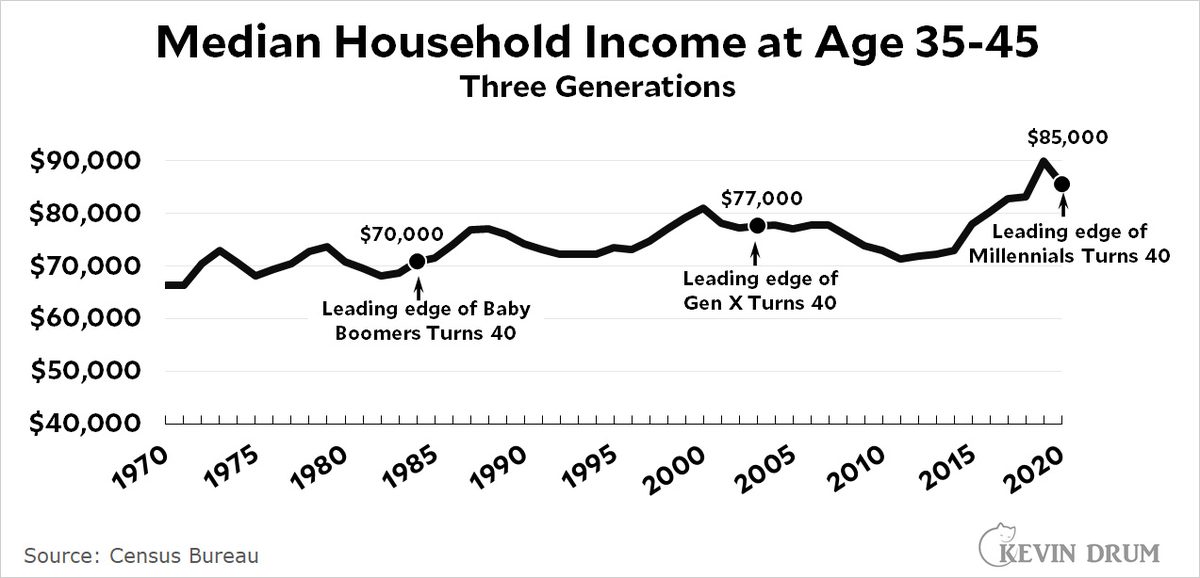
American millennials at ages 36 to 40 earn 20 percent more in real household income than Generation X did at the same age. That finding, published April 24 in the journal Demography, contradicts a decade of writing that argued each new generation was losing ground.

Why it matters

Whether each American generation is doing better than the last shapes debates over taxes, housing, student debt, and Social Security.

Key Indicators

20%
Millennial income growth vs. Gen X
Real median household income at ages 36–40, posttax and posttransfer.
36%
Silent Generation income growth
Largest generational jump in the dataset, set against the Greatest Generation.
26%
Baby boomer income growth
Boomer households earned 26 percent more than the Silent Generation at the same age.
16%
Generation X income growth
The slowest generational gain in the series, just below the millennial figure.
60
Years of data analyzed
Census Current Population Survey records from 1963 through 2023.
5
Generations compared
Greatest, Silent, Boomer, Gen X, and Millennial cohorts measured at the same ages.

Interactive

Exploring all sides of a story is often best achieved with Play.

Ever wondered what historical figures would say about today's headlines?

Sign up to generate historical perspectives on this story.

Sign Up

Debate Arena

Two rounds, two personas, one winner. You set the crossfire.

People Involved

Organizations Involved

Timeline

  1. Demography publishes peer-reviewed study

    Research

    The journal Demography publishes the final version of Corinth and Larrimore's analysis, finding millennial households earn 20 percent more than Gen X did at ages 36 to 40.

  2. Corinth presents findings at Cornell

    Presentation

    Corinth speaks at Cornell's Program on Freedom and Free Societies, framing the data as cause for cautious optimism about young Americans' prospects.

  3. ITIF highlights generational income gains

    Commentary

    The Information Technology and Innovation Foundation cites the working paper to argue that each generation continues to earn more than the last, slower but not stalled.

  4. Federal Reserve releases working paper

    Research

    Corinth and Larrimore publish 'Has Intergenerational Progress Stalled?' as a Federal Reserve discussion paper, putting an early version of the findings into circulation.

  5. GAO compares millennial and earlier households

    Research

    Government Accountability Office report finds millennial households have similar incomes to Gen X at the same age but lower net worth and higher student debt.

  6. Pew finds millennial households earn more than past young adults

    Research

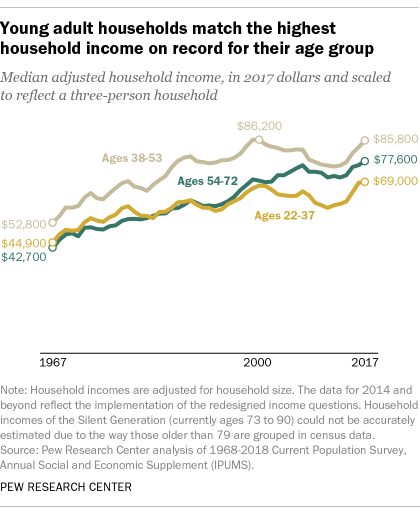
    Pew Research Center reports that young adult households today have higher median incomes than nearly any generation of young adults before them, complicating the decline narrative.

  7. Chetty team finds absolute mobility falling

    Research

    Raj Chetty and colleagues report in Science that the share of children earning more than their parents fell from 90 percent for those born in 1940 to 50 percent for those born in 1984.

Scenarios

1

Public debate splits income gains from cost-of-living gains

Discussed by: AEI, Brookings, Pew Research Center analysts

Commentators absorb the income finding and refocus the affordability debate on specific costs—housing, child care, higher education, and health insurance—where younger cohorts genuinely face steeper bills than their parents did. The 'millennials are doing worse' framing softens; the 'housing is broken' framing hardens.

2

Counter-research challenges the methodology

Discussed by: Progressive economists, Opportunity Insights, Economic Policy Institute

Researchers question the posttax, posttransfer measure, arguing that counting government benefits as income masks pretax stagnation and that household-level data hides growing within-cohort inequality. A rebuttal paper reignites the debate over whose definition of progress is right.

3

Findings filter into 2028 campaign economics

Discussed by: Political analysts at FiveThirtyEight, Cook Political Report

Candidates on the right use the 20 percent number to argue that doom narratives about young workers are overblown; candidates on the left counter with wealth, housing, and debt data. The study becomes a recurring citation in op-eds and debate prep.

4

Wealth gap eclipses income story

Discussed by: Federal Reserve researchers, New America Foundation

Within a few years, focus shifts from income to wealth, where millennials still trail older cohorts at the same age once housing equity is included. The income finding remains intact, but the conversation moves on to assets and intergenerational transfers.

Historical Context

Chetty 'Fading American Dream' study (2017)

April 2017

What Happened

A team led by Stanford economist Raj Chetty published findings in Science showing that 90 percent of children born in 1940 out-earned their parents at age 30, but only 50 percent of those born in 1984 did. The paper became one of the most-cited social-science results of the decade.

Outcome

Short Term

The 50 percent figure ran in major newspapers for years and shaped how politicians, journalists, and economists talked about young Americans.

Long Term

It hardened a public assumption that absolute mobility had collapsed, an assumption the Corinth–Larrimore household-income data now partially complicates.

Why It's Relevant Today

Chetty measured individual earnings against parents'; Corinth and Larrimore measure household income at the same age across cohorts. Different lenses, different answers—both can be true at once.

Pew 'Young Adults Earning More' brief (2018)

December 2018

What Happened

Pew Research Center reported that the median household income of young adult households reached its highest level in 50 years, even as their personal earnings stagnated. The result was driven largely by women's rising labor force participation.

Outcome

Short Term

The brief was widely shared but failed to dislodge the dominant 'millennials are broke' narrative.

Long Term

It foreshadowed the Corinth–Larrimore explanation: household income kept rising for a generation because women joined the paid workforce, and the slowdown began when that shift plateaued.

Why It's Relevant Today

Pew's finding is essentially the same mechanism the new paper formalizes—millennial households earn more, mostly because of dual earners—now extended over five generations and adjusted for taxes and transfers.

Government Accountability Office millennial report (2019)

December 2019

What Happened

Congress asked the Government Accountability Office to compare millennial household economics with earlier generations. The agency found median incomes roughly in line with Generation X at the same age, but lower median net worth and far higher student-loan balances.

Outcome

Short Term

Lawmakers used the report in hearings on student debt and housing affordability.

Long Term

It cemented a two-track view of millennial economics: income roughly steady, balance sheets weaker.

Why It's Relevant Today

The GAO and Demography findings agree on incomes. The remaining argument is over wealth, debt, and the specific costs young households now carry.

Sources

(8)