

Google DeepMind releases AlphaGenome Atlas, a predictive map of all 9 billion human DNA variants
New CapabilitiesFree database precomputes the effects of every possible single-letter change in the human genome
Yesterday: AlphaGenome Atlas launchesNew here? Follow stories to track developments over time. Create a free account to get updates when stories you care about change.
Overview
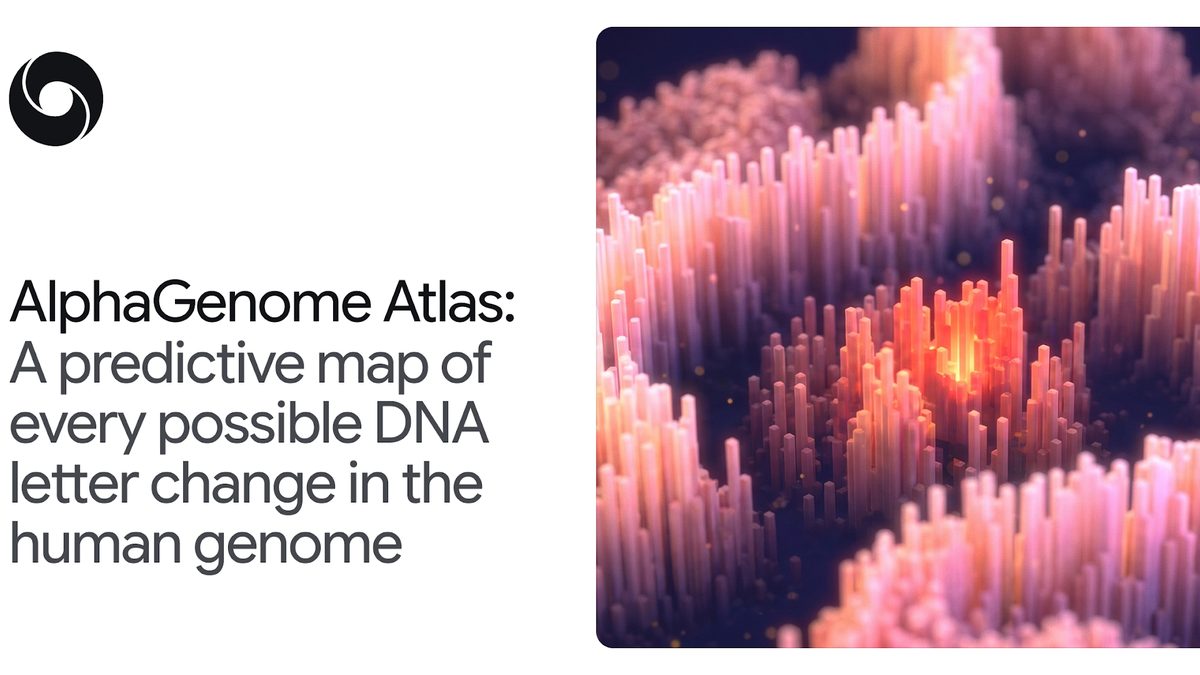
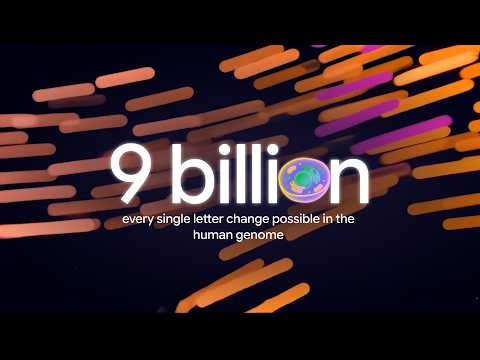
Updated YesterdayGoogle DeepMind released AlphaGenome Atlas on Tuesday, a free online database that predicts the effects of all 9 billion possible single-letter changes to human DNA. The 1-petabyte resource is the most complete catalogue of human genetic variation ever built.
Until now, researchers working on the 98% of the genome that doesn't code for proteins had to run predictive models one variant at a time, or rely on statistical signals too weak to detect. The Atlas precomputes everything, so any researcher can look up a variant in a web browser and see both an impact score and the biological details behind it. The tool builds on AlphaGenome, the AI model DeepMind unveiled in 2025.
Why it matters
Researchers can now instantly rank any of 9 billion DNA variants by predicted impact, narrowing rare disease searches from thousands of candidates to a handful.
Questions about this story
Free account needed to ask — your question is kept and asked for you right after sign-up. Answers are public.
No questions yet — be the first to ask.
Key Indicators
Voices
Curated perspectives — historical figures and your fellow readers.
Play
Exploring all sides of a story is often best achieved with Play.
Higher or Lower
A number from this story, against one from elsewhere in the news — guess which is bigger, then keep the chain going. 5 rounds, 3 strikes; a miss costs a strike and resets your streak.
Keyboard: ↓/L lower · ↑/H higher
0 points — sign up to put that on the leaderboard.
Connections
Sixteen names from the news. Find the four hidden groups of four. Four mistakes max.
Sign up to keep a daily streak — a new puzzle lands every day.
Exit debate?
Your progress in this debate will be lost.
- 1 Two AI personas square off on this story.
- 2 You predict who'll win each round — correct picks earn XP.
- 3 One crossfire question is yours to fire. Pick it carefully.
Couldn't generate a topic
Select Your Champions
Choose one persona for each side of the debate
DEBATE TOPIC
Choose personas with different perspectives for a more dynamic debate.
Select debater for this side:
No debate personas available right now.
Select debater for this side:
No debate personas available right now.
Who's Got This Round?
Make your prediction before the referee scores
The referee scores both sides on
Round Results
Set the Crossfire
Pick the question both personas must answer in the final round
Debate Oracle! You called every round!
Sharp Instincts! You know your debaters!
The Coin Flip Strategist! Perfectly balanced!
The Contrarian! Bold predictions!
Inverse Genius! Try betting the opposite next time!
XP Breakdown
Prediction History
People Involved
Organizations Involved
Alphabet's AI research lab and creator of the AlphaGenome Atlas.
Biomedical research institute that helped test the AVI score on unsolved rare disease cases.
Kansas City institute that helped guide the Atlas's design and analyzed its regulatory motif data.
Timeline
September 2023 September 2026
-
AlphaGenome Atlas launches
Latest Product launchFree database goes live with 9 billion precomputed DNA variant predictions, the AVI score, and 2,500+ motifs.
-
AlphaGenome base model unveiled
Model releaseDeepMind unveils the AlphaGenome model for predicting gene regulation effects genome-wide (exact date not confirmed).
-
AlphaMissense released
Model releaseDeepMind launches an AI model predicting effects of protein-altering DNA variants across the human proteome.
Historical Context
3 moments from history that rhyme with this story — and how they unfolded.
Human Genome Project (1990-2003)
An international consortium of 20 institutions spent 13 years and roughly $3 billion sequencing the first complete human genome. The project produced a reference sequence, not a map of individual variation.
Transformed biology by giving researchers a shared reference genome.
Set the foundation for modern genomics, but left the harder question of what variation means largely open.
AlphaGenome Atlas answers the question the Human Genome Project couldn't: what each variation does at the molecular level.
1000 Genomes Project (2008-2015)
An international effort sequenced over 2,500 genomes from 26 populations to catalogue human genetic variation. It found tens of millions of variants but couldn't say what most of them did.
Built the variant database researchers still use today.
Functional interpretation of variants remained the field's bottleneck.
The Atlas adds the missing layer: predicted molecular effects for every single-nucleotide variant.
AlphaFold (2020-2022)
DeepMind's AlphaFold2 solved the 50-year protein folding problem, predicting 3D structures for nearly all of the human proteome. The team released 350,000 predicted structures in 2021, expanding to 200 million proteins by 2022.
Turned a problem that took years per protein into one solvable in minutes.
Became the standard starting point for structural biology and a template for DeepMind's biology program.
AlphaGenome Atlas follows the same playbook: precompute predictions at genome scale, then give researchers instant access.
