


Pull to refresh
Logo
Daily Brief
Following
Why
The 40-year campaign to eradicate Guinea worm disease

The 40-year campaign to eradicate Guinea worm disease

New Capabilities
By Newzino Staff |

From 3.5 Million Cases to the Brink of Elimination

February 2nd, 2026: 2025 Cases Hit Historic Low of 10

Overview

In 1986, Guinea worm disease afflicted 3.5 million people annually across 21 nations. In 2025, only 10 human cases were recorded worldwide—the lowest number ever. If eradication succeeds, Guinea worm will become the second human disease eliminated globally after smallpox, and the first conquered without any medicine or vaccine.

The campaign, led by The Carter Center since 1986, has achieved a 99.99% reduction through low-technology interventions: teaching villagers to filter drinking water, treating contaminated water sources, and containing infected individuals. The milestone arrives one year after Jimmy Carter's death at age 100—the former president had long expressed his wish to outlive the last Guinea worm.

Key Indicators

10
Human cases in 2025
The lowest annual count ever recorded, down from 15 cases in 2024.
99.99%
Reduction since 1986
From approximately 3.5 million annual cases to single digits.
200
Countries certified disease-free
Six countries remain uncertified: Angola, Cameroon, Chad, Ethiopia, Mali, and South Sudan.
661
Animal infections in 2025
Primarily dogs and cats in Chad and Cameroon; animal transmission now poses the main obstacle to eradication.

Interactive

Exploring all sides of a story is often best achieved with Play.

Ever wondered what historical figures would say about today's headlines?

Sign up to generate historical perspectives on this story.

Sign Up

Debate Arena

Two rounds, two personas, one winner. You set the crossfire.

People Involved

Jimmy Carter
Jimmy Carter
Founder, The Carter Center; 39th President of the United States (Deceased (December 29, 2024))
Paige Alexander
Paige Alexander
Chief Executive Officer, The Carter Center (Active)
Adam Weiss
Adam Weiss
Director, Guinea Worm Eradication Program, The Carter Center (Active)

Organizations Involved

TH
The Carter Center
Nonprofit Organization
Status: Leading global Guinea worm eradication campaign

A nonprofit founded by Jimmy and Rosalynn Carter that leads the global Guinea worm eradication campaign and works on peace and health initiatives in over 80 countries.

World Health Organization (WHO)
International Organization
Status: Certifying body for disease eradication

The WHO is responsible for certifying countries as Guinea worm-free and is the only organization that can officially declare a disease eradicated.

Timeline

  1. 2025 Cases Hit Historic Low of 10

    Milestone

    The Carter Center announced that only 10 human cases were recorded in 2025—the lowest ever—with cases in Chad, Ethiopia, and South Sudan.

  2. World Health Assembly Adopts Acceleration Resolution

    Policy

    The 78th World Health Assembly adopted resolution WHA78.14, renewing global commitment to eradicate Guinea worm and endorsing the WHO's revised 2023 strategy.

  3. Jimmy Carter Dies at 100

    Leadership

    Former President Carter passed away without seeing complete eradication, though cases had fallen to historic lows during his lifetime.

  4. Abu Dhabi Declaration

    Policy

    World leaders signed the Abu Dhabi Declaration reaffirming commitment to Guinea worm eradication at a ministerial summit.

  5. Ghana Certified Disease-Free

    Milestone

    Ghana achieved WHO certification after sustained efforts, including Adam Weiss personally extracting the last worm from the country's final patient.

  6. Dog Infections Discovered in Chad

    Complication

    Guinea worm was first detected in domestic dogs in Chad, revealing a previously unknown animal transmission cycle that would complicate eradication efforts.

  7. Guinea Worm Eradicated from Asia

    Milestone

    With no remaining cases in Asian countries, the disease was confined to Africa.

  8. India Stops Transmission

    Milestone

    India, once heavily endemic, halted Guinea worm transmission, marking a major step toward eliminating the disease from Asia entirely.

  9. Carter Negotiates Sudan Ceasefire

    Diplomacy

    Carter negotiated the longest humanitarian ceasefire in history during Sudan's civil war, allowing health workers to access endemic areas.

  10. Pakistan Certified Disease-Free

    Milestone

    Pakistan became the first major endemic country to eliminate Guinea worm after Carter personally persuaded President Zia-ul-Haq to support the program.

  11. World Health Assembly Endorses Eradication Goal

    Policy

    The World Health Assembly formally agreed that Guinea worm disease should be eradicated, with approximately 400,000 cases reported annually at that time.

  12. Jimmy Carter Visits Endemic Village

    Leadership

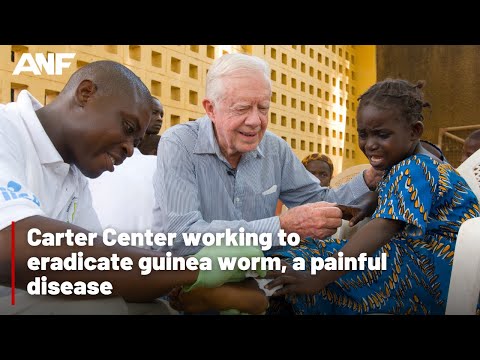
    Carter's firsthand encounter with Guinea worm victims, particularly children, intensified his personal commitment to the campaign.

  13. Carter Center Launches Global Campaign

    Campaign Launch

    The Carter Center assumed leadership of the Guinea worm eradication effort when an estimated 3.5 million cases occurred annually across 21 endemic countries.

Scenarios

1

Guinea Worm Eradicated by 2030

Discussed by: WHO, Carter Center, public health researchers

Human cases continue declining to zero, animal transmission is contained, and all six remaining countries achieve WHO certification by the 2030 target. This would make Guinea worm only the second human disease ever eradicated and the first eliminated without any medicine or vaccine—a validation of community-based, low-technology public health interventions.

2

Animal Transmission Delays Certification

Discussed by: The Lancet, CDC researchers, parasitology experts

Despite near-zero human cases, persistent Guinea worm infections in dogs—particularly in Chad—continue for years, creating ongoing spillover risk to humans. The WHO extends its certification timeline while researchers work to break the animal transmission cycle, possibly through interventions like tethering infected dogs and discouraging consumption of raw fish.

3

Conflict or Funding Gaps Stall Progress

Discussed by: Global health policy analysts, humanitarian organizations

Insecurity in South Sudan, Sudan, or the Sahel region prevents health workers from reaching endemic communities. Alternatively, declining international health funding reduces resources for the intensive surveillance and community engagement needed in the final phase. Cases plateau or increase modestly, pushing eradication beyond 2030.

Historical Context

Smallpox Eradication (1967-1980)

1967-1980

What Happened

The WHO launched an intensified eradication campaign in 1967 when smallpox killed an estimated 2 million people annually and afflicted 10-15 million more. Through mass vaccination and surveillance-containment strategies, the last natural case occurred in Somalia in October 1977.

Outcome

Short Term

On May 8, 1980, the World Health Assembly declared smallpox eradicated—the first and still only human disease to achieve this status.

Long Term

The $300 million campaign saves over $1 billion annually in vaccination and treatment costs. It established the template for disease eradication: sustained international cooperation, robust surveillance, and community-level engagement.

Why It's Relevant Today

Guinea worm would become only the second human disease eradicated, validating a different model: behavior change and water treatment rather than vaccination. Success would prove that diseases can be eliminated through low-technology community interventions.

Rinderpest Eradication (1994-2011)

1994-2011

What Happened

Rinderpest, a deadly cattle virus that devastated livestock and caused famines across Africa, Asia, and Europe for centuries, was targeted by a coordinated FAO-led eradication program. The last confirmed case occurred in Kenya in 2001.

Outcome

Short Term

In June 2011, the FAO officially declared rinderpest eradicated—the first animal disease ever eliminated globally.

Long Term

The success protected millions of pastoral livelihoods and demonstrated that diseases without vaccines in all host species could still be contained through surveillance and targeted intervention.

Why It's Relevant Today

Rinderpest showed that eradication is achievable for diseases affecting animals. Guinea worm's recent complication—transmission through dogs in Chad—echoes the challenge of controlling disease across species but suggests precedent for success.

Polio Eradication Campaign (1988-Present)

1988-present

What Happened

The Global Polio Eradication Initiative launched in 1988 when polio paralyzed 350,000 children annually across 125 countries. Cases fell 99% to just dozens per year, but wild poliovirus persists in Afghanistan and Pakistan despite decades of effort.

Outcome

Short Term

Cases dropped from 350,000 in 1988 to approximately 100 in 2024, with transmission limited to two countries.

Long Term

The campaign demonstrates both the power and limits of eradication: success requires reaching every child, including in conflict zones where access remains contested. Vaccine-derived outbreaks add complexity.

Why It's Relevant Today

Polio's stalled final phase illustrates the 'last mile' challenge Guinea worm now faces. Both campaigns struggle with conflict zones, cross-border movement, and the disproportionate difficulty of eliminating final cases. Guinea worm's simpler intervention requirements—no cold chain, no injection—may prove decisive.

11 Sources: