
Pull to refresh
Logo
HKUST prints a titanium alloy that keeps hardening as it deforms

HKUST prints a titanium alloy that keeps hardening as it deforms

New Capabilities

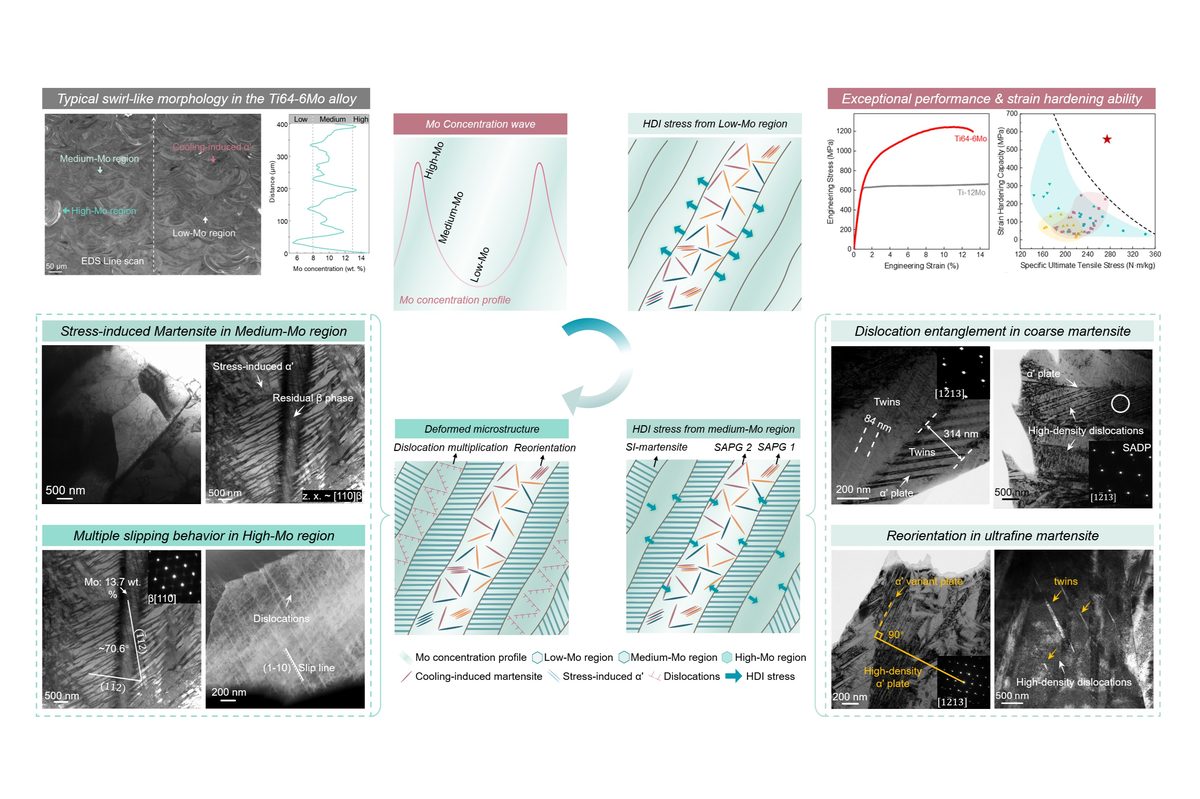
Microscale waves of molybdenum push Ti-6Al-4V's strain-hardening increment to about 557 MPa, more than double the conventional ceiling, while holding 1,236 MPa tensile strength

Overview

Updated Yesterday

Titanium alloy Ti-6Al-4V has gone into jet engine parts and bone implants since the 1950s. It has one weakness: once it deforms permanently, it stops hardening, and the strain piles into a single spot that eventually tears.

A team at the Hong Kong University of Science and Technology (HKUST) mixed molybdenum powder into Ti-6Al-4V powder and fused it with a laser, leaving microscale waves of molybdenum through the printed metal. Each region of the wave deforms by a different mechanism, and their interaction keeps the hardening going: about 557 MPa of it, against a conventional ceiling below 250 MPa, at a tensile strength of 1,236 MPa.

Why it matters

Safety-critical titanium parts are sized around a hardening ceiling of 250 MPa. This printed alloy more than doubles it, at 1,236 MPa tensile strength.

Questions about this story

Free account needed to ask — your question is kept and asked for you right after sign-up. Answers are public.

No questions yet — be the first to ask.

Key Indicators

557 MPa
Strain-hardening increment
Gain in stress between yield and ultimate tensile strength, against a conventional titanium ceiling below 250 MPa.
1,236 MPa
Ultimate tensile strength
Peak stress the printed Ti64-6Mo alloy carried in tensile tests, reported as 1,236 plus or minus 16 MPa.
11.5%
Uniform elongation
How far the alloy stretches evenly before it starts to neck, plus or minus 0.5 percentage points.
679 MPa
Yield strength
Stress at which the alloy begins to deform permanently, plus or minus 23 MPa.
0.55
Yield ratio
Yield strength divided by tensile strength; conventional titanium alloys often run above 0.9.

Voices

Curated perspectives — historical figures and your fellow readers.

Sign up to generate historical perspectives on this story.

People Involved

Organizations Involved

Timeline

1 event Latest: 7 days ago
  1. HKUST reports a printed titanium alloy that keeps hardening

    Latest Research

    A team led by Zhang Tianlong publishes tensile results for Ti64-6Mo: a 557 MPa strain-hardening increment, 1,236 MPa tensile strength and 11.5 percent uniform elongation.

Scenarios

1

An aerospace or implant manufacturer licenses the process

Possible Resolves by End of 2027

Discussed by: HKUST names aerospace, vehicle manufacturing and medical implants as target applications; no manufacturer has announced involvement

The alloy is a laboratory result with no announced commercial partner. A licensing deal or pilot production run would show that a printer can hold the molybdenum waves steady at production volumes, which the paper does not test. Aerospace qualification usually takes years of fatigue and defect data before a printed part flies.

2

An outside lab reproduces the 557 MPa hardening increment

Possible Resolves by Q2 2027

Discussed by: The paper reports results from more than three independent measurements, all inside the original team

The headline number comes from one group's coupons. Reproduction by an unaffiliated lab would confirm that the compositional waves are a property of the process rather than of one powder batch or one printer. Failure to reproduce would narrow the claim to a laboratory demonstration.

3

Fatigue testing shows whether the alloy survives repeated loads

Possible Resolves by End of 2027

Discussed by: The paper's supplementary material flags cyclic-loading behavior as not yet quantified

Strain hardening matters most in parts that see repeated stress, such as engine components and implants. The team's own supplementary note says it is still unclear whether the reversible martensitic transformation helps under cyclic loading. A published fatigue curve would decide whether the alloy can be considered for safety-critical use.

Historical Context

3 moments from history that rhyme with this story — and how they unfolded.

1950s

Ti-6Al-4V becomes the aerospace workhorse (1950s)

Researchers in the United States developed a titanium alloy with 6 percent aluminum and 4 percent vanadium, trading some ductility for high strength and corrosion resistance. It became the standard structural titanium for airframes, engines and later medical implants.

Then

Manufacturers adopted it wherever weight and corrosion resistance mattered.

Now

It became the most widely used titanium alloy, which is why a process that improves it reaches many industries at once.

Why this matters now

The HKUST work does not invent a new alloy. It alters the familiar one during printing, so existing supply chains and specifications are the starting point.

2004

High-entropy alloys (2004)

Two groups, one led by Brian Cantor in Britain and one by Yeh Jien-Wei in Taiwan, independently published alloys made of five or more metals in near-equal proportions. The premise was that mixing many elements could yield properties no simple alloy had.

Then

The papers launched a large research field.

Now

Commercial use stayed limited, largely because of cost and difficult processing.

Why this matters now

Both approaches treat chemical variation as a design tool. HKUST applies it inside a conventional alloy, which avoids the cost of an entirely new chemistry.

2015-2016

GE's printed LEAP fuel nozzle (2016)

GE Aviation's 3D-printed fuel nozzle tip for CFM LEAP engines was certified and entered commercial service, one of the first printed parts cleared for a jet engine.

Then

It proved printed metal parts could pass aviation certification.

Now

It set the template for qualifying printed hardware, which requires fatigue, defect and process-control data.

Why this matters now

The gap between a laboratory coupon and a certified part is the gap this alloy now has to cross. No fatigue data has been published for it yet.

Sources

(6)