



Pull to refresh
Logo
Brain's temporal processing windows develop hierarchically through youth, stabilize in adulthood

Brain's temporal processing windows develop hierarchically through youth, stabilize in adulthood

New Capabilities

Two independent datasets of 1,294 youth show timescales lengthen along a sensorimotor-to-association axis between ages 8 and 22

2 days ago: Study published in PLOS Biology

Overview

Updated 1 hour ago

Neurons in different brain regions don't process information on the same clock: sensory regions integrate input over fractions of a second, while association regions hold it longer. A study published September 29 in PLOS Biology shows this hierarchy of temporal windows develops during childhood and adolescence, then stabilizes in young adulthood.

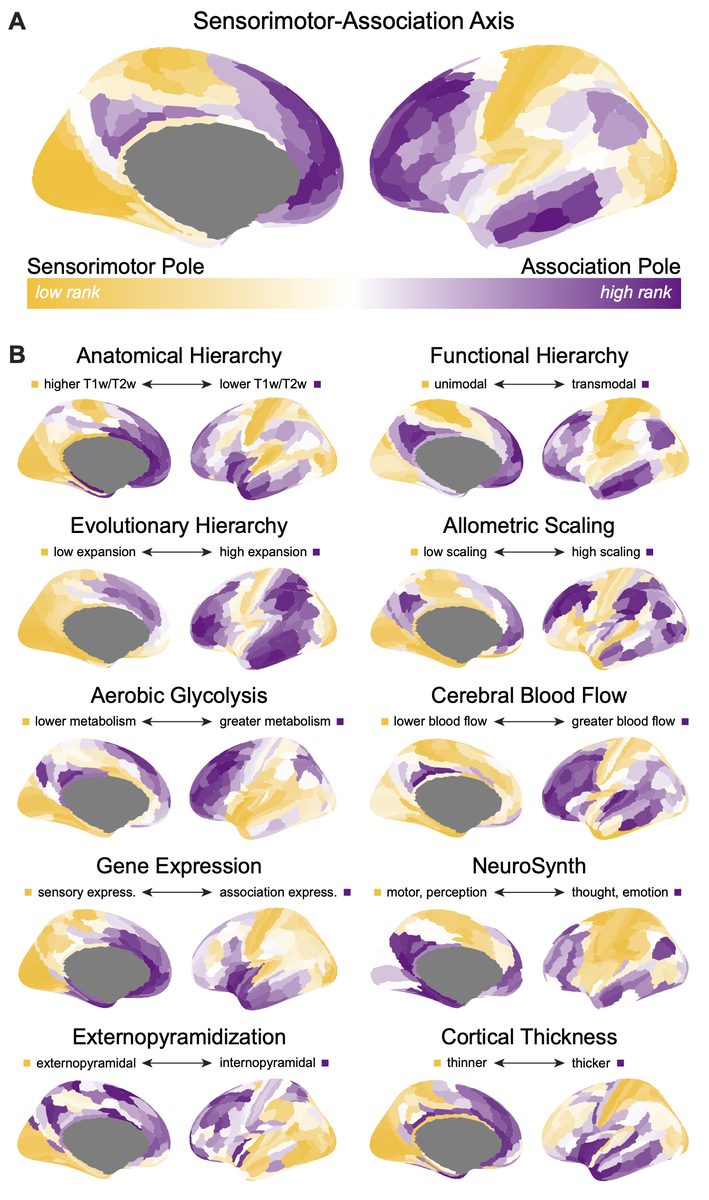
Using resting-state functional MRI from 1,294 youth across two independent datasets, researchers found the brain's intrinsic timescale lengthens in association cortex between ages 8 and 22, while sensorimotor regions remain stable. The pattern follows a known sensorimotor-to-association cortical axis and disappears as a developmental effect in adults.

Why it matters

If the brain's temporal processing hierarchy matures on a fixed schedule, disruptions to that schedule may help explain when psychiatric disorders emerge in adolescence.

Questions about this story

Free account needed to ask — your question is kept and asked for you right after sign-up. Answers are public.

No questions yet — be the first to ask.

Key Indicators

1,294
Youth studied across two datasets
565 from HCPD and 729 from HBN, ages 8-22
973
Young adults in validation sample
HCPYA participants, ages 22-37
0.41
Correlation with cortical hierarchy
Spearman correlation between age effects and sensorimotor-to-association axis (p = 0.001)
11.7%
Regions with age effects in adults
Only 11.7% of brain regions showed significant age effects in young adults, indicating stability

Voices

Curated perspectives — historical figures and your fellow readers.

Ever wondered what historical figures would say about today's headlines?

Sign up to generate historical perspectives on this story.

People Involved

Organizations Involved

Timeline

April 2026 September 2026

2 events Latest: 2 days ago
  1. Study published in PLOS Biology

    Latest Publication

    Peer-reviewed paper confirms hierarchical timescale development in youth and stability in adulthood.

  2. Preprint of timescale study posted on bioRxiv

    Preprint

    Shafiei and colleagues post their analysis of intrinsic timescale development across two youth datasets.

Scenarios

1

Longitudinal data confirm hierarchical timescale development

Likely Resolves by End of 2028

Discussed by: The study authors, who note the cross-sectional design as a limitation

The finding is based on cross-sectional data, which compares different individuals at different ages. If HCPD's longitudinal follow-up data show the same within-subject pattern, the developmental trajectory is confirmed.

2

Altered timescale development linked to psychiatric disorders

Possible Resolves by End of 2028

Discussed by: The authors, who frame timescale as a potential marker of brain maturation

If timescale development is disrupted in psychiatric disorders, it could serve as a biomarker. Studies comparing timescale trajectories in youth with and without psychiatric diagnoses would test this.

3

Mechanistic drivers of hierarchical timescale development identified

Possible Resolves by End of 2028

Discussed by: The 2023 Nature Neuroscience paper, which linked intrinsic activity to myelination

The mechanism driving hierarchical timescale development is unknown. Candidates include myelination, synaptic pruning, and excitatory-inhibitory balance. A study directly linking one of these to timescale development would resolve this.

Historical Context

3 moments from history that rhyme with this story — and how they unfolded.

2023

Intrinsic activity development along the S-A axis (2023)

A Nature Neuroscience study by the same group analyzed resting-state fMRI from 1,033 youths (ages 8-23) and found that the amplitude of intrinsic brain activity declines during development, with changes organized along a sensorimotor-to-association cortical axis.

Then

Established the S-A axis as a framework for understanding brain development.

Now

Provided the foundation for the current study, which extends the framework to intrinsic timescale.

Why this matters now

The current study uses the same axis and similar methods, showing that intrinsic timescale follows the same hierarchical developmental pattern.

2025

Aging and intrinsic timescales (2025)

A Communications Biology study mapped intrinsic timescales in young and elderly adults, finding shorter timescales in the elderly and a positive association with gray matter volume. A computational model showed that age-related neuronal and synaptic loss pushes brain dynamics toward a subcritical regime.

Then

Showed that intrinsic timescales shorten in old age.

Now

Complemented the developmental picture, showing timescales lengthen in youth and shorten in aging.

Why this matters now

Together with the current study, it shows intrinsic timescale follows a lifespan trajectory: lengthening during development, stabilizing in adulthood, and shortening in old age.

2026

Infant intrinsic timescale development (2026)

A Cerebral Cortex study using EEG in a longitudinal sample of infants (6-16 months) found that intrinsic timescales shorten during infancy but remain longer than adult levels. The spatial organization in infants differed from adults.

Then

Showed that the hierarchical organization of timescales is not present in infancy.

Now

Suggested the adult-like hierarchy emerges gradually through childhood and adolescence.

Why this matters now

The current study picks up where the infant study leaves off, showing the hierarchy develops between ages 8 and 22.

Sources

(7)