
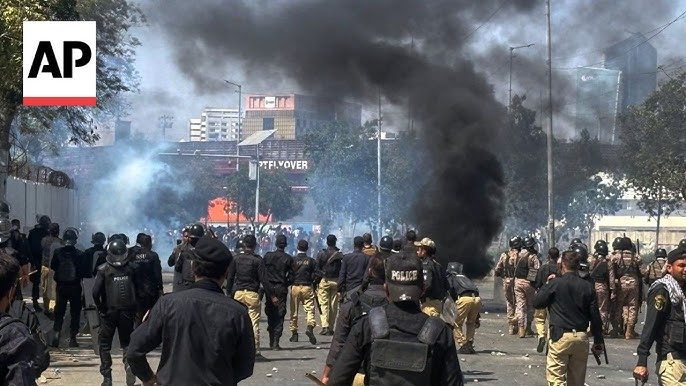
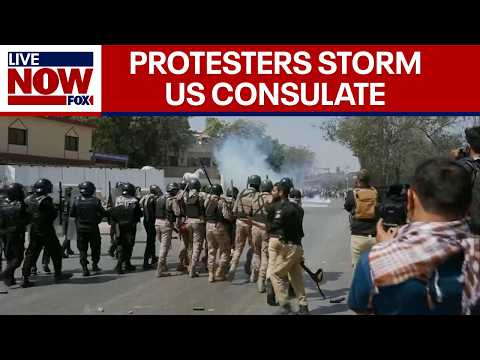
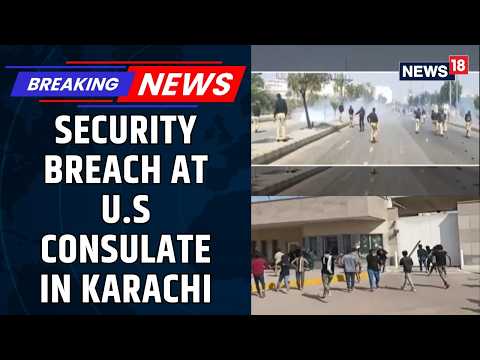
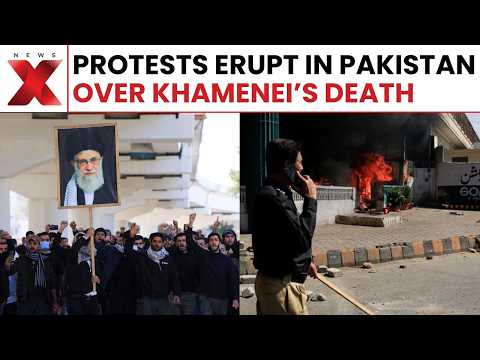
Pakistan has the second-largest Shia Muslim population on earth, roughly 30 million people. When joint United States-Israeli airstrikes killed Iran's Supreme Leader Ayatollah Ali Khamenei on February 28, the grief and fury of that community spilled into the streets of every major Pakistani city within hours. In Karachi, hundreds of protesters tried to breach the perimeter of the US consulate; security forces opened fire, killing at least nine people and wounding more than 50. In the northern Shia-majority region of Gilgit-Baltistan, crowds torched a United Nations office, a police station, and several government buildings in Skardu, prompting the army's deployment under emergency constitutional authority.
The violence marks the first time a US-Iran military confrontation has produced mass casualties on Pakistani soil. It also exposes a structural vulnerability: Pakistan's government condemned the strikes on Iran and offered condolences for Khamenei's death, but simultaneously reaffirmed its defense commitments to Saudi Arabia and the Gulf states that Iran attacked in retaliation. Holding that middle ground while Shia citizens storm American and international facilities, and while the army deploys domestically, is a position that may not survive a second week of escalation.
Click a figure to generate their perspective on this story
Debate Arena
Two rounds, two personas, one winner. You set the crossfire.
Choose Your Battle
Watch two AI personas debate this story using real evidence
Make predictions and set the crossfire to earn XP and cred
Select Your Champions
Choose one persona for each side of the debate
DEBATE TOPIC
SIDE A (PRO)
Select debater for this side:
✓
SIDE B (CON)
Select debater for this side:
✓
Choose personas with different perspectives for a more dynamic debate
VS
Get ready to make your prediction...
Round of
Claim
Evidence
Stakes
Crossfire Answer
Closing Statement
Claim
Evidence
Stakes
Crossfire Answer
Closing Statement
Your Crossfire Question
Generating arguments...
Who's Got This Round?
Make your prediction before the referee scores
Correct predictions earn +20 XP
Evidence
40%
Logic
30%
Detail
20%
Style
10%
Round Results
Your Pick!
+20 XP
Your Pick
Not this time
Evidence (40%)
Logic (30%)
Detail (20%)
Style (10%)
Overall Score
/10
Your Pick!
+20 XP
Your Pick
Not this time
Evidence (40%)
Logic (30%)
Detail (20%)
Style (10%)
Overall Score
/10
Set the Crossfire
Pick the question both personas must answer in the final round
Crafting crossfire questions...
Choosing a question earns +10 XP crossfire bonus
🏆
Total XP Earned
Cred Change
Predictions
Debate Oracle! You called every round!
Sharp Instincts! You know your debaters!
The Coin Flip Strategist! Perfectly balanced!
The Contrarian! Bold predictions!
Inverse Genius! Try betting the opposite next time!
XP Breakdown
Base completion+20 XP
Rounds played ( rounds x 5 XP)
+ XP
Correct predictions ( correct x 20 XP)
+ XP
Crossfire bonus+10 XP
Accuracy
%
Prediction History
Round
You picked:
✓✗
Keep debating to level up your credibility and unlock achievements
Who Said What?
WHO SAID WHAT?
Can you match the quotes to the right people?
Rounds
People
Score:
Round /
streak
-- ?
Score:
Round /
streak
Next Up
Round
of
points
Correct
Best Streak
Time Bonus
People Involved
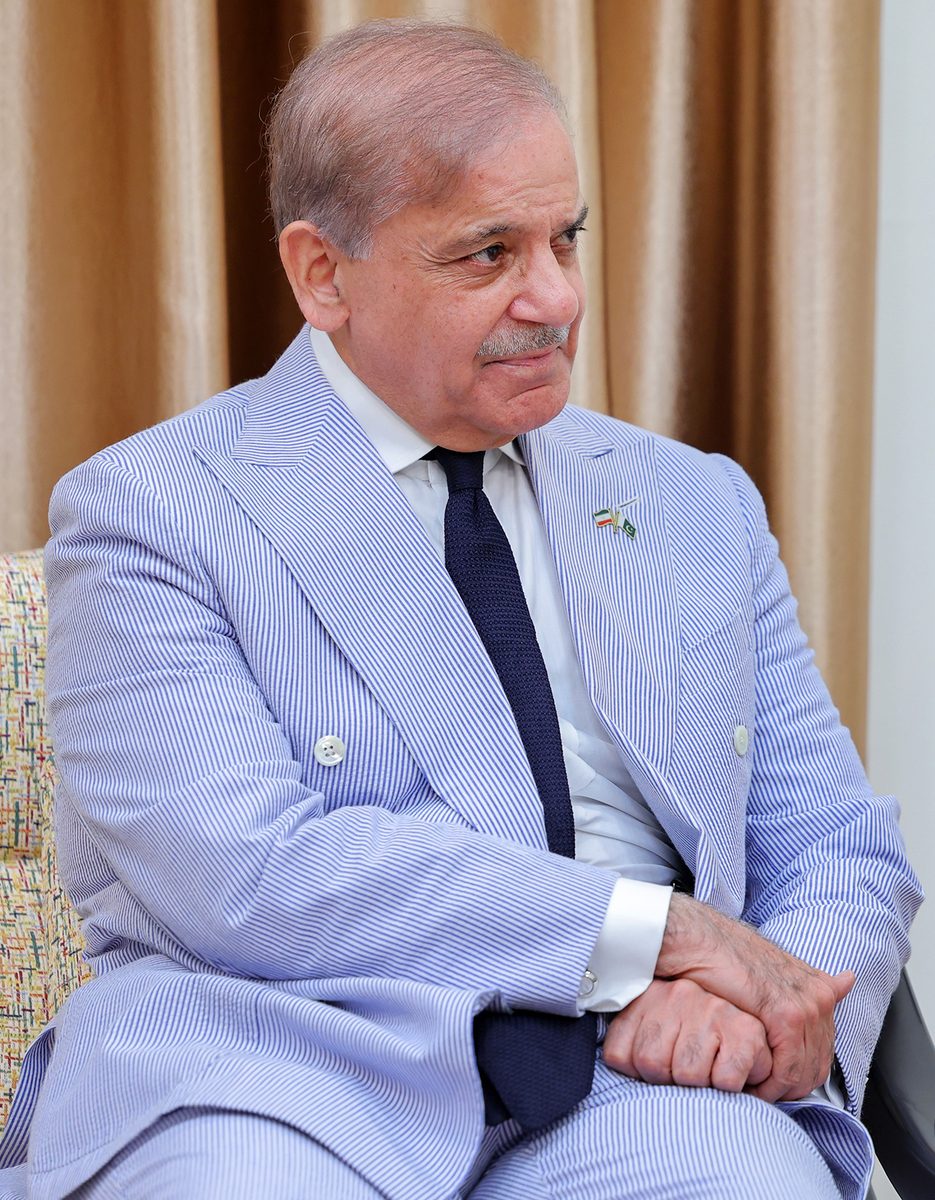
Shehbaz Sharif
Prime Minister of Pakistan (Managing domestic unrest while balancing ties with Iran, Saudi Arabia, and the United States)
Ayatollah Ali Khamenei
Supreme Leader of Iran (1989–2026) (Killed in US-Israeli airstrike on February 28, 2026)
Ishaq Dar
Deputy Prime Minister and Foreign Minister of Pakistan (Leading diplomatic response to the crisis)
Organizations Involved
UN
United States Consulate General, Karachi
Diplomatic Facility
Status: Damaged; visa services suspended; shelter-in-place advisory issued
The largest US consulate general in the world, bigger in personnel and facilities than many US embassies.
PA
Pakistan Rangers (Sindh)
Paramilitary Force
Status: Deployed at US consulate in Karachi; used lethal force against protesters
A federal paramilitary force operating under the Interior Ministry, responsible for internal security in Sindh province including protecting diplomatic facilities in Karachi.
Timeline
Protesters storm US consulate in Karachi; at least 9 killed
Violence
Hundreds of demonstrators attempted to breach the US consulate in Karachi, smashing windows and torching a police post. Security forces fired on the crowd, killing at least nine and wounding more than 50. Protests also erupted at US facilities in Islamabad, Lahore, and Peshawar.
UN office and government buildings torched in Skardu
Violence
In the Shia-majority Gilgit-Baltistan region, protesters burned a United Nations sub-office, the superintendent of police's office, an Aga Khan Rural Support Programme facility, and a technology park. The Pakistan Army was deployed under Article 245 of the Constitution.
Protesters attempt to storm US embassy compound in Baghdad
Violence
Hundreds of Iraqis dressed in black attempted to breach the fortified Green Zone housing the US embassy. Security forces used tear gas to repel stone-throwing crowds. Iraq declared three days of mourning for Khamenei.
US Embassy suspends operations across Pakistan
Diplomatic
The US Embassy canceled all visa appointments and issued shelter-in-place advisories for all American missions in Pakistan, including Islamabad, Karachi, Lahore, and Peshawar.
US and Israel launch massive strikes on Iran
Military
Joint US-Israeli strikes hit Tehran, Isfahan, Qom, and other cities. Targets included Khamenei's compound, the Defense Ministry, intelligence headquarters, and nuclear facilities. More than 200 Iranians were reported killed.
Khamenei and senior Iranian officials killed
Military
Ayatollah Ali Khamenei was killed in the strike on his Tehran compound, along with Iran's defense minister, the Islamic Revolutionary Guard Corps commander, and the secretary of the Security Council.
Iran launches retaliatory strikes across Gulf
Military
Iran fired hundreds of ballistic missiles and drones at US military bases in Bahrain, Kuwait, Qatar, the United Arab Emirates, Jordan, and Saudi Arabia. Most were intercepted; three people were killed in the UAE.
Pakistan condemns strikes, pledges support to Saudi Arabia
Diplomacy
Prime Minister Shehbaz Sharif called the strikes on Iran 'unwarranted' while simultaneously reaffirming solidarity with Saudi Arabia after Iranian missiles hit Gulf states. Iran declared 40 days of national mourning.
Trump endorses regime change at Fort Bragg
Statement
Speaking to troops, President Trump declared that regime change in Iran would be 'the best thing that could happen,' signaling a shift beyond nuclear negotiations.
Indirect US-Iran talks held in Oman
Diplomacy
The United States and Iran held indirect nuclear-focused negotiations in Muscat, mediated by Oman's foreign minister. Both sides called it a 'good start.'
Trump announces 'massive Armada' heading to Iran
Escalation
President Donald Trump declared on social media that a large naval force was heading to Iran, as the aircraft carrier USS Abraham Lincoln and three warships arrived in the Middle East.
Iranian rial collapses, triggering protests
Background
The Iranian rial plunged to a record 1.42 million to the US dollar, sparking protests in Tehran's major markets that would grow into nationwide unrest.
Scenarios
1
Protests escalate into sustained sectarian crisis
Discussed by: South Asian Voices (a Carnegie Endowment-affiliated publication) and regional security analysts
If the US-Iran conflict continues to escalate, Pakistan's Shia communities could mobilize for weeks during the 40-day mourning period Iran declared for Khamenei. Sustained protests would strain Pakistan's security forces, risk triggering retaliatory violence from Sunni extremist groups like Lashkar-e-Jhangvi that have historically targeted Shia, and force Islamabad into increasingly difficult diplomatic contortions between Washington, Tehran, and Riyadh. The Gilgit-Baltistan region, which is majority Shia and already saw military deployment, would be especially volatile.
2
Pakistan contains unrest through security crackdowns and diplomatic balancing
Discussed by: Dawn (Pakistan's leading English-language newspaper) and Pakistan Today analysis
The government imposes Section 144 bans on public gatherings, deploys Rangers and Army in major cities, and suspends mobile internet in protest zones, as it already began doing on March 1. Sharif's government leans into its condemnation of the strikes to give Shia communities a political outlet while physically preventing further attacks on diplomatic facilities. The protests burn out within days as the initial shock fades and heavy security makes gathering costly. This mirrors Pakistan's typical response to regional crises.
3
US drawdown of diplomatic presence in Pakistan
Discussed by: Bloomberg, Military.com, and US State Department security analysts
If the security environment deteriorates further, the State Department could order a partial evacuation of non-essential personnel from Pakistan, as it has done during past crises. The Karachi consulate, already the largest US consular facility in the world and a repeated target of attacks, would be the most likely candidate for reduced operations. A drawdown would signal that the US-Iran conflict has made one of America's most important diplomatic posts in South Asia functionally untenable.
4
Iran-aligned groups exploit Pakistan's Shia mobilization
Discussed by: Critical Threats (American Enterprise Institute) and Al-Monitor
Iran's Islamic Revolutionary Guard Corps and its network of allied Shia militias across the region could attempt to channel Pakistani Shia anger into sustained anti-American operations, using the 40-day mourning period as a mobilization framework. Pakistan's intelligence services have historically monitored and disrupted such efforts, but the scale of the current crisis, combined with the IRGC's vow of 'ferocious retaliation,' could overwhelm existing countermeasures, particularly in under-governed areas like Gilgit-Baltistan and parts of Balochistan near the Iranian border.
Historical Context
Burning of the US Embassy in Islamabad (1979)
November 1979
What Happened
On November 21, 1979, a mob of more than 1,500 Pakistanis, many of them students, stormed and burned the US Embassy in Islamabad after Iranian cleric Ruhollah Khomeini falsely blamed the United States and Israel for a militant seizure of the Grand Mosque in Mecca. Four Americans and two Pakistani staff were killed. Simultaneous attacks destroyed American cultural centers in Karachi, Lahore, and Rawalpindi.
Outcome
Short Term
The embassy was completely destroyed. The US temporarily relocated its diplomatic presence and demanded Pakistan improve protection of foreign missions.
Long Term
The attack demonstrated that events in Iran and the broader Muslim world could trigger lethal anti-American violence in Pakistan with little warning, a pattern that has recurred for nearly five decades.
Why It's Relevant Today
The 2026 protests follow nearly the same geographic pattern as 1979: crowds attacking US facilities in Karachi, Islamabad, Lahore, and Peshawar, triggered by an event involving Iran. The difference is that in 1979 the catalyst was misinformation; in 2026 it was a confirmed US military operation that killed Iran's head of state.
Anti-American embassy protests across the Muslim world (2012)
September 2012
What Happened
An anti-Islam video posted online by an American citizen triggered violent protests at US diplomatic facilities in more than a dozen countries, including Egypt, Libya, Tunisia, Sudan, and Yemen. In Benghazi, Libya, armed attackers killed US Ambassador Chris Stevens and three other Americans in what was later determined to be a premeditated assault that exploited the protest chaos.
Outcome
Short Term
The US temporarily closed embassies across the region and deployed Marine rapid-response teams. The Benghazi attack became a major domestic political controversy.
Long Term
The State Department overhauled diplomatic security worldwide, increasing physical barriers and Marine Security Guard detachments at high-risk posts.
Why It's Relevant Today
The 2012 protests showed how a single trigger event can cascade into simultaneous attacks on US facilities across multiple countries. The 2026 protests follow the same pattern but at a potentially larger scale, since the trigger was a state-level military operation rather than the actions of a private citizen.
Soleimani killing and Iraqi embassy siege (2019–2020)
December 2019 – January 2020
What Happened
After a US drone strike killed Iranian General Qasem Soleimani at Baghdad airport on January 3, 2020, supporters of Iran-backed Iraqi militias besieged the US Embassy compound in Baghdad for two days, breaching an outer wall and setting fire to a reception area. The attack came days after similar militia supporters had stormed the embassy perimeter on December 31, 2019.
Outcome
Short Term
The US deployed 750 additional troops to the region. Iraq's parliament voted to expel US forces, though the resolution was non-binding and never fully implemented.
Long Term
The Soleimani killing accelerated the gradual drawdown of US troops from Iraq and demonstrated that targeted killings of Iranian leaders produce immediate, violent backlash at US diplomatic posts in third countries.
Why It's Relevant Today
The Soleimani precedent is the closest parallel: a US strike that killed a senior Iranian figure, followed by immediate attacks on US diplomatic facilities in a neighboring country. The 2026 strikes went far beyond Soleimani, killing Iran's head of state, and the geographic spread of retaliatory protests is correspondingly wider.