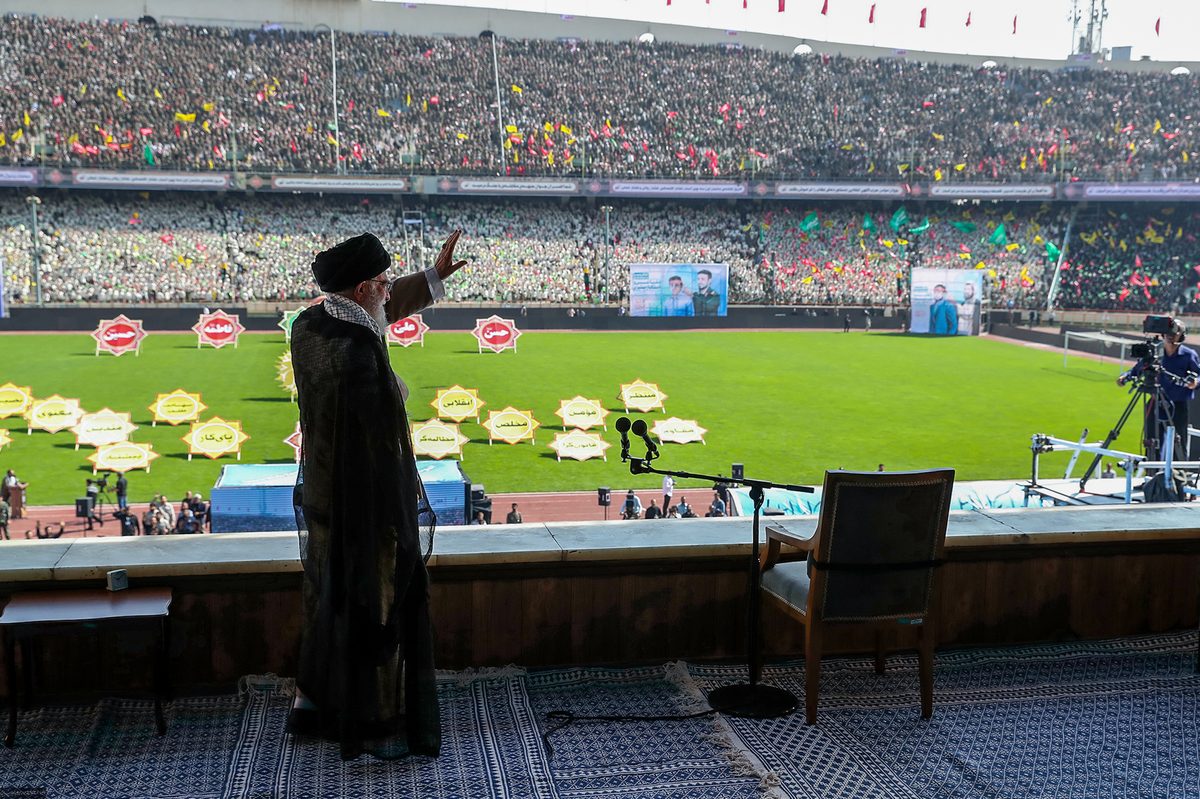
Bazaar merchants bankrolled Iran's 1979 Islamic Revolution. Now they're in the streets demanding its end.
What began December 28 as protests over the rial's collapse to record lows escalated into the largest uprising in the Islamic Republic's 46-year history. It spread to all 31 provinces and united working-class laborers, students, and merchants in calls for regime change. The death toll remains highly disputed: activist groups have verified at least 6,100 killed, while leaked government documents suggest 27,500-36,500 deaths.
By January 17, the regime had reestablished control, killing an estimated 147 security personnel in the process. Supreme Leader Khamenei acknowledged January 17 that 'thousands' have been killed, blaming the U.S. and Israel, even as internet connectivity remained severely restricted. President Trump escalated threats on January 28-29, warning Iran that 'time is running out' as a 'massive Armada' including the USS Abraham Lincoln positioned near Iranian waters.
The EU designated the Islamic Revolutionary Guard Corps (IRGC) as a terrorist organization on January 29. At least two protesters have been executed, with thousands more facing capital charges. There is no scenario in which the Islamic Republic emerges from 2026 with its power intact.
Questions about this story
Free account needed to ask — your question is kept and asked for you right after sign-up. Answers are public.
No questions yet — be the first to ask.
Key Indicators
6,100-36,500
Estimated protesters killed
HRANA verified 6,100+; leaked government docs suggest 27,500-36,500; regime admits 3,117 total deaths
24,669+
People detained
Arrests since protests began; thousands face capital charges of 'moharebeh'
Severely Limited
Internet access
SMS partially restored Jan 17; connectivity remains heavily restricted nationwide
31/31
Provinces with protests
Complete nationwide spread across 185+ cities, now suppressed through mass killings
1.5M
Rial to dollar (record low)
Currency collapsed 40% since June 2025 war with Israel
33 events
Latest: January 30th, 2026 · 9 months ago
Showing 8 of 33
JK to step
Tap a bar to jump to that date
Jump to
January 2026
U.S. sanctions Iran's interior minister over protest crackdown
LatestSanctions
Treasury Department targets Interior Minister Eskandar Momeni, accusing him of overseeing law enforcement forces responsible for thousands of protester deaths. EU imposes parallel sanctions.
EU designates IRGC as terrorist organization
Diplomatic
European Council adopts largely symbolic measure designating Islamic Revolutionary Guard Corps as terrorist group, adding pressure on Tehran. Iran condemns 'selective outrage.'
Trump warns Iran 'time is running out' for nuclear deal
Diplomatic
President declares 'massive Armada' heading to Iran, prepared to move 'with speed and violence, if necessary.' Warns of attack 'far worse' than previous strikes unless Tehran agrees to new nuclear deal.
HRANA verifies 6,100+ protester deaths
Investigation
Human Rights Activists News Agency updates verified count: 5,993 adult protesters, 113 minors, 214 security force members killed. An additional 17,091 deaths under investigation.
Leaked government documents suggest 27,500-36,500 killed
Investigation
Iran International reports multiple leaked Ministry of Health and Intelligence reports showing death tolls of 30,000+ (Jan 20), 27,500 (Jan 21), 33,000 (Jan 22), and 36,500 (Jan 24)—far exceeding public estimates.
USS Abraham Lincoln arrives in Middle East waters
Military
Aircraft carrier strike group reaches Gulf of Oman/Arabian Sea operating in 'ghost mode' with transponders off. Iran warns arrival 'will not affect determination to defend the nation.'
First protester execution reported
Legal
Ali Rahbar, 33, reportedly executed in Mashhad, though Iran's judiciary denies the execution occurred. Would mark first confirmed execution of 2026 protest participant.
19-year-old sentenced to death by hanging
Legal
Amirhossein Ghaderzadeh sentenced to death with execution scheduled for January 21. Part of accelerated death penalty proceedings against protesters.
Partial internet restoration begins; Khamenei admits 'thousands' killed
Crackdown
SMS service restored after 9-day blackout. Supreme Leader acknowledges death toll for first time, blaming U.S. and Israel for violence. Connectivity remains below 2%.
Doctors' network estimates 16,500-18,000 killed
Investigation
Sunday Times reports Iranian medical sources provide significantly higher death toll estimates than official figures.
Iran says 3,000 arrested as protests subside
Crackdown
Authorities announce arrest figure as Tehran streets grow quiet under heavy security presence. Human rights groups report over 18,400 detained.
Diaspora rallies in Washington and Berlin
International
Iranian Americans gather at White House; freedom protesters rally outside Bundestag in solidarity with uprising.
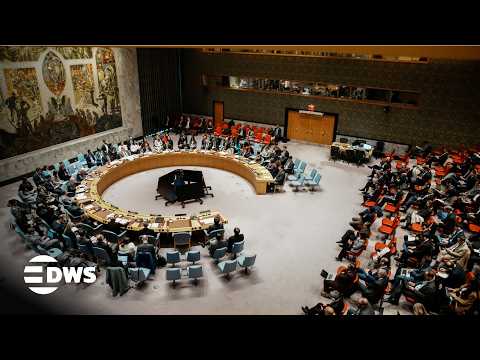
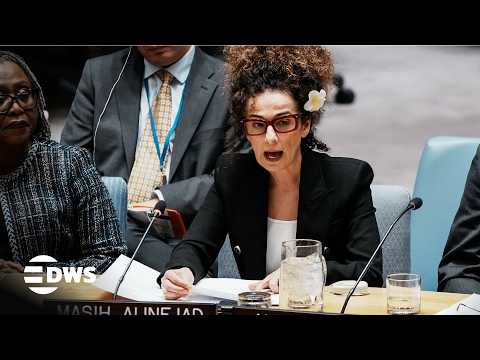
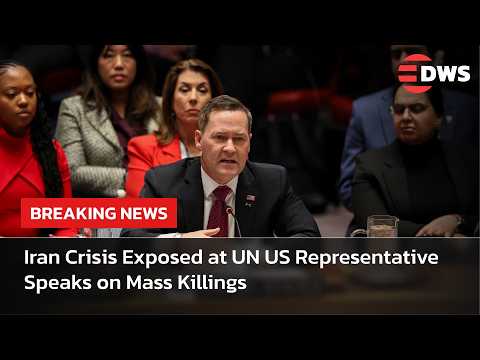
UN Security Council meets; Guterres urges 'maximum restraint'
Diplomatic
U.S. Ambassador Waltz declares 'all options on the table.' Iranian dissidents Alinejad and Batebi brief Council.
U.S. sanctions Iranian security chief Larijani
Sanctions
Treasury designates 18 individuals including Supreme National Security Council secretary and IRGC commanders.
USS Abraham Lincoln strike group redirected to Persian Gulf
Military
Carrier group ordered from South China Sea to Middle East. Expected arrival: late January.
Trump decides against immediate strikes
Diplomatic
After days weighing military options, president holds off following regional ally appeals and Iran's postponement of Erfan Soltani execution. White House says all options remain on table.
Arab and Israeli allies urge Trump to delay strikes
Diplomatic
Egypt, Saudi Arabia, Qatar, Oman, and Israel counsel restraint. Netanyahu asks for more time to prepare for retaliation.
Iran closes airspace for five hours
Military
Tehran FIR closed to most flights amid strike fears. Major airlines suspend Iran service. Airspace reopens early January 15.
G7 threatens 'additional restrictive measures'
Diplomatic
Group of Seven condemns 'brutal crackdown' and warns of further economic measures. EU prepares new sanctions package.
Erfan Soltani execution postponed
Legal
Family says 26-year-old protester's hanging delayed. Iranian judiciary disputes he faced death penalty. Development cited as key factor in Trump's strike delay.
Iran International: 12,000 killed on January 8-9
Investigation
Multi-stage investigation based on government sources, hospitals, and leaked documents estimates mass casualty toll.
Trump tells Iranians 'help is on its way'
Statement
U.S. president urges protesters to 'take over' government institutions. Iranian officials accuse him of incitement.
Tehran prosecutor threatens death sentences for protesters
Legal
Undisclosed number of detainees to be charged with 'moharebeh' (waging war against God), a capital offense. UN calls for halt to executions.
Reports: 2,000+ killed in 48 hours
Crackdown
Eyewitnesses describe 'hundreds of bodies' in Tehran despite blackout. Iran International estimates 2,000 dead over weekend.
Protests reach all 31 provinces amid mass killings
Crackdown
Millions in streets. At least 217 killed in Tehran alone. Hospitals overwhelmed. Thousands arrested.
Internet blackout begins; massacres reported
Crackdown
Near-total shutdown at 8:30 p.m. Reports emerge of security forces using machine guns against crowds in Fardis and Karaj.
Crown Prince Pahlavi calls for coordinated protests
Opposition
Exiled prince urges Iranians to chant simultaneously at 8 p.m. on January 8-9 and seize city centers.
Khamenei: 'Rioters must be put in their place'
Statement
Supreme Leader's remarks signal escalation. IRGC provincial commanders declare 'period of tolerance is over.'
December 2025
Protests spread to 17 provinces
Protest
Government declares 'holiday' closing offices and schools. Oil workers and truckers join strikes. At least 28 killed.
Protests erupt as rial hits record low
Protest
Tehran bazaar merchants close shops over currency collapse (1.45 million rial to dollar). Central Bank governor resigns.
Assad regime collapses in Syria
Geopolitical
Iran's key regional ally falls. Tehran loses $50 billion investment, Mediterranean access, and Hezbollah supply routes.
September 2025
UN 'snapback' sanctions reimposed on Iran
Diplomatic
E3 (UK, France, Germany) triggered mechanism over nuclear violations. Arms embargo, enrichment prohibitions, and asset freezes restored.
June 2025
Israel launches 'Operation Rising Lion' against Iran
Military
Israel's surprise attack destroyed nuclear facilities and killed military leaders. The 12-day war ended with U.S.-brokered ceasefire on June 24.
Scenarios
1
U.S. Strikes Iran; Regional War Erupts
Possible
Discussed by: CNN, Axios, Arab diplomats, Israeli officials
Trump orders strikes on IRGC facilities and security force targets. Iran retaliates against U.S. bases in Qatar and Iraq, and launches missiles at Israel. Oil prices spike. The regime uses external threat to rally nationalist support, potentially surviving strengthened.
2
Regime Crushes Protests; Isolated Survival
Possible
Discussed by: Atlantic Council, analysts skeptical of regime collapse predictions
Security forces maintain loyalty, continue mass arrests and killings. International condemnation but no military intervention. Internet restored after weeks. Protests subside as in 2019. Regime survives but emerges 'even weaker, more isolated, and more reliant on force.'
3
Security Forces Fracture; Regime Collapses
Uncertain
Discussed by: Hudson Institute, Brookings, German Chancellor Merz
Defections within IRGC or army units create opening for protesters to seize key institutions. Khamenei flees or is removed. Power vacuum leads to turbulent transition with competing factions. Pahlavi returns. Nuclear facilities secured by U.S. or international forces.
4
Negotiated Transition; Khamenei Exits
Unlikely
Discussed by: Some Iranian economists close to regime
Regime insiders convince Khamenei to step down to preserve some system stability. New leadership offers economic reforms and limited political opening. Protests continue but violence decreases. International sanctions remain contentious.
Historical Context
3 moments from history that rhyme with this story — and how they unfolded.
1 of 3
January 1978 – February 1979
1979 Iranian Revolution
Economic grievances and political repression united bazaar merchants, students, workers, and clerics against Shah Mohammad Reza Pahlavi. After months of escalating protests and strikes, the Shah fled on January 16, 1979. Ayatollah Khomeini returned from exile and established the Islamic Republic.
Then
Revolutionary committees seized state institutions. Mass purges of military and civil service. U.S. embassy hostage crisis began November 1979.
Now
Islamic Republic consolidated power under clerical rule. Bazaar merchants who financed the revolution became economic partners of the new regime—until now.
Why this matters now
The current uprising's merchant-led origins mirror 1979's coalition. Protesters now carry pre-revolutionary flags and chant pro-Pahlavi slogans, explicitly seeking to reverse what that revolution created.
2 of 3
November 2019
2019 November Protests (Bloody November)
After the government tripled fuel prices overnight, protests erupted across Iran within hours. Security forces killed over 1,500 people in what became known as 'Bloody November.' The government imposed a near-total internet blackout lasting 163 hours.
Then
Protests suppressed within two weeks. No senior officials held accountable. Economic grievances unaddressed.
Now
Set precedent for regime's willingness to use mass lethal force. Current blackout and crackdown follow the 2019 playbook—but at larger scale.
Why this matters now
The 2019 crackdown killed 1,500; the January 8-9, 2026 massacres may have killed 12,000 in two days. The regime is applying the same tactics at unprecedented intensity, suggesting it perceives this threat as qualitatively different.
3 of 3
November 1989 – December 1991
Fall of the Berlin Wall and Eastern Bloc (1989)
Economic stagnation, loss of Soviet backing, and mass protests toppled communist regimes across Eastern Europe. Security forces in East Germany, Czechoslovakia, and Romania faced choices about firing on crowds. Some regimes collapsed bloodlessly; Romania's ended violently with Ceaușescu's execution.
Then
Rapid political transitions. Some countries moved quickly toward democracy; others saw former communists retain power in new forms.
Now
Demonstrated that seemingly permanent authoritarian systems can collapse suddenly when economic legitimacy fails and security forces waver.
Why this matters now
Iran's economic collapse, regional isolation (Syria lost, proxies weakened), and mass protests echo conditions that preceded Eastern Bloc collapses. The key variable: whether IRGC loyalty holds.