



Pull to refresh
Logo
Japan tightens permanent residency rules for foreign workers

Japan tightens permanent residency rules for foreign workers

Rule Changes

Income, language, and pension hurdles reshape Japan's path to long-term settlement

Yesterday: Al Jazeera reports foreign workers reconsidering Japan

Overview

Updated 1 hour ago

Japan starts enforcing stricter permanent residency rules October 1, requiring applicants to earn above the average household income (about 5.8 million yen), pass a Japanese language test around JLPT N2 level, and hold pension credits equal to 30 years of payouts. The application fee jumps twentyfold to 200,000 yen.

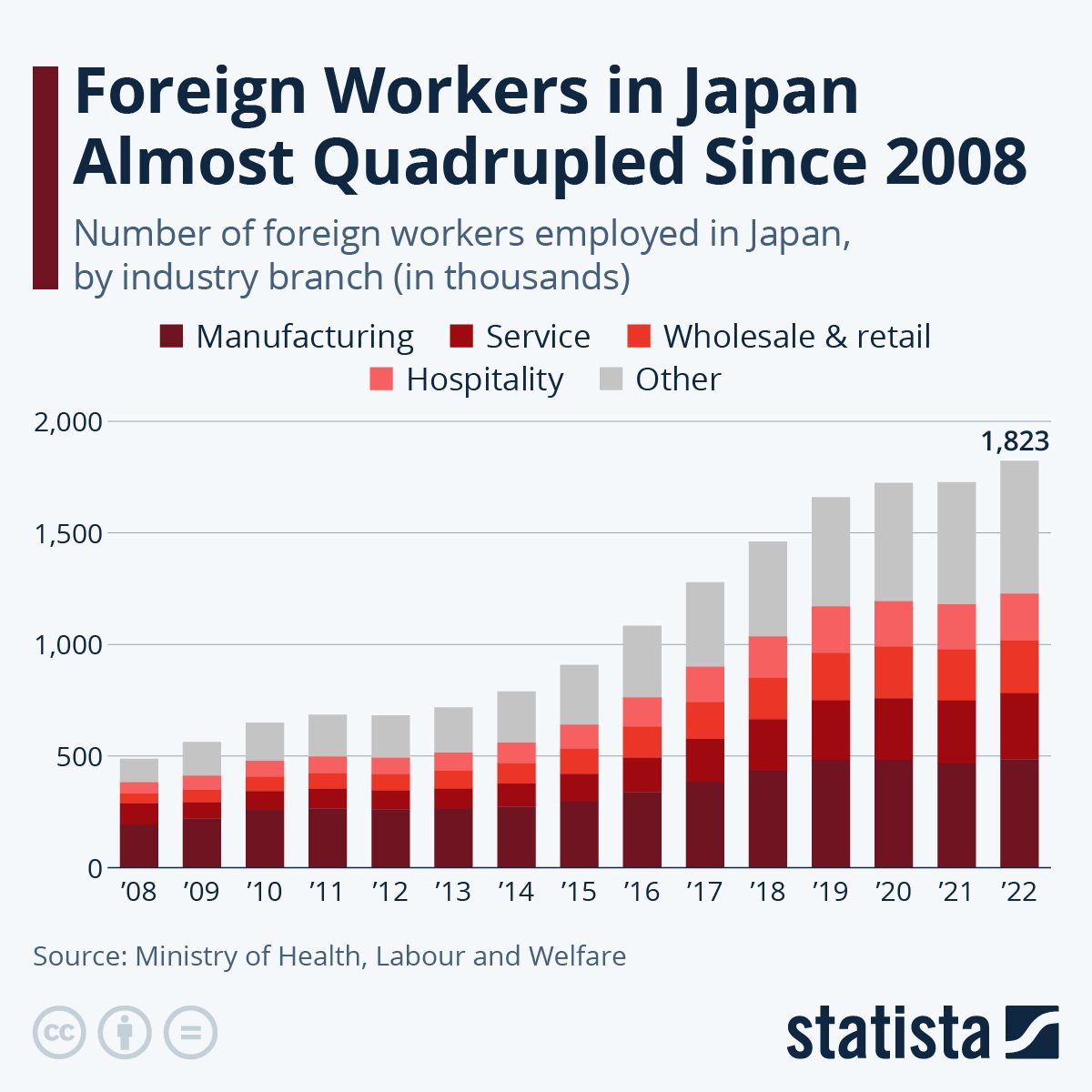
The policy arrives as Japan's foreign population hits a record 4.12 million (about 3% of residents), yet the share of Japanese opposing more immigration has climbed from 35.6% to 56.3% in a year. Some skilled workers are already scouting job markets outside Japan.

Why it matters

Japan's shrinking workforce needs immigrant labor, but the new rules may drive away the skilled workers the economy depends on most.

Questions about this story

Free account needed to ask — your question is kept and asked for you right after sign-up. Answers are public.

No questions yet — be the first to ask.

Key Indicators

4.12M
Foreign residents in Japan
Record high as of end of 2025, about 3% of total population.
56.3%
Japanese opposing more immigration
Up from 35.6% in 2024, per University of Tokyo Institute of Social Science survey.
20x
Permanent residency fee increase
Fee rises from 10,000 to 200,000 yen starting October 2026.
5.8M yen
Average household income threshold
PR applicants must earn above this level; roughly $36,000.

Voices

Curated perspectives — historical figures and your fellow readers.

Ever wondered what historical figures would say about today's headlines?

Sign up to generate historical perspectives on this story.

People Involved

Organizations Involved

Timeline

November 2025 October 2026

7 events Latest: Yesterday
Tap a bar to jump to that date
  1. New permanent residency rules take effect

    Upcoming Regulation

    Income and pension requirements apply; fee rises to 200,000 yen. Retroactive income check for April 2026 applications.

  2. Al Jazeera reports foreign workers reconsidering Japan

    Latest Report

    Coverage highlights skilled workers weighing exits and the tension between labor needs and public sentiment.

  3. Foreign Policy analyzes PR rule impact on key sectors

    Analysis

    Report notes income threshold disqualifies workers in care, hospitality, agriculture, and manufacturing sectors.

  4. Immigration Services Agency details PR rule changes

    Regulation

    Agency publishes revised PR requirements: income above household average, pension credits, language proficiency in phases.

  5. Cabinet agrees on stricter immigration measures

    Policy

    Takaichi administration approves a package of stricter measures for foreign nationals, including longer naturalization residency requirements.

  6. Japan establishes Headquarters for Foreign Nationals Policy

    Policy

    Government creates a coordinating body for foreign national policy under the Takaichi administration.

Scenarios

1

PR applications plummet after new rules take effect

Likely Resolves by Q3 2027

Discussed by: Foreign Policy; Meikai University economist Risa Hagiwara

The income threshold above 5.8 million yen excludes workers in care, hospitality, agriculture, fishing, tourism, and manufacturing, where average salaries run under 5 million yen. The 200,000 yen fee adds another barrier. If FY2026 applications fall sharply, Japan's rural labor shortage deepens and employers in affected sectors begin lobbying for exemptions.

2

Japan relaxes PR requirements after labor complaints

Possible Resolves by Oct 1, 2027

Discussed by: Bloomberg Opinion; DW reporting on labor needs

If labor shortages in care, manufacturing, or agriculture become acute, employers and prefectural governments could press the Immigration Services Agency to ease the income or language tests. The government might also expand Highly Skilled Professional exemptions, which already cover the language requirement.

3

Foreign resident growth stalls below 1%

Possible Resolves by Q1 2028

Discussed by: Al Jazeera; University of Tokyo survey data

New restrictions could deter new arrivals and push some current residents to leave. If the foreign population growth rate falls below 1% annually, Japan's dependency on immigrant labor becomes a binding constraint, forcing a national debate about the tradeoff between immigration limits and economic capacity.

Historical Context

3 moments from history that rhyme with this story — and how they unfolded.

1955–1973

Germany's Gastarbeiter program (1955–1973)

Germany recruited Turkish, Italian, and southern European workers to fill industrial labor gaps, expecting them to rotate home after fixed stints. The program halted with the 1973 oil crisis, but hundreds of thousands of guest workers stayed.

Then

Many guest workers formed permanent communities despite their temporary status, creating immediate integration challenges.

Now

Germany spent decades debating citizenship policy, ultimately reforming its nationality law in 2000 and adopting a points-based immigration system in 2005.

Why this matters now

Japan's guest worker programs face the same unresolved question: whether temporary recruits become permanent residents or leave, and what happens when the policy shifts.

2011–2015

Singapore tightens foreign worker policies (2011–2015)

After the 2011 general election, in which immigration dampened the ruling party's vote share, Singapore raised foreign worker levies and reduced dependency ratio ceilings across multiple industries.

Then

Some labor-intensive businesses automated or relocated; construction and marine sectors adapted to smaller foreign workforces.

Now

Singapore retained a selective foreign worker system that prioritized higher-skilled migrants while tightening access for lower-skilled labor.

Why this matters now

Shows how a government can tighten foreign worker rules without immediately losing its entire foreign workforce, but only by accepting economic adjustments.

February 2014

Switzerland's anti-immigration referendum (2014)

Swiss voters narrowly approved a constitutional amendment limiting immigration through quotas, rejecting the EU free-movement framework. Roughly a quarter of Switzerland's residents were foreign nationals at the time.

Then

Switzerland negotiated with the EU to soften implementation, introducing local hiring preferences while avoiding direct quota violations.

Now

The referendum strained EU relations and created persistent institutional friction that shaped Swiss politics for years.

Why this matters now

Japan's rightward shift mirrors this tension: voters expressing hostility to immigration while employers and the economy depend on immigrant labor.

Sources

(10)