

Pull to refresh
Logo
Switching off brainstem neurons lets mice sleep nearly 70% less

Switching off brainstem neurons lets mice sleep nearly 70% less

New Capabilities

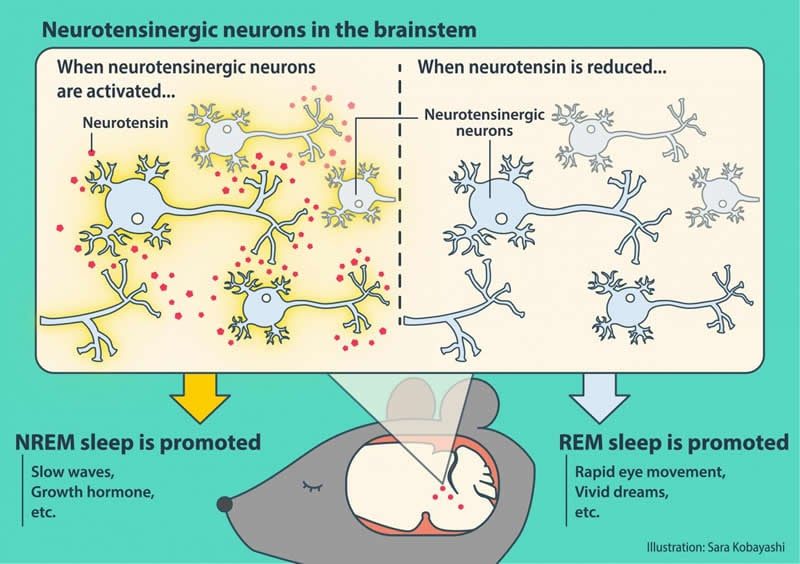
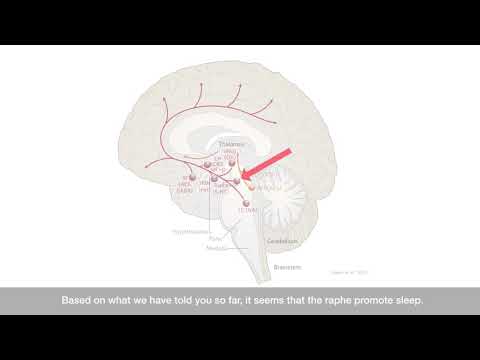
Two cell populations in the median raphe appear to build sleep pressure, not just keep animals awake

Overview

Updated 8 minutes ago

Silencing two small populations of neurons in the mouse brainstem cut the animals' sleep by nearly 70% for weeks on end. The mice stayed awake more than 6.5 extra hours a day and mostly behaved normally.

The result points to a narrow job for these cells. They appear to register how long an animal has been awake and convert that into sleep pressure, rather than simply holding wakefulness in place.

Why it matters

If humans carry the same circuit, sleepiness becomes adjustable rather than fixed, changing how insomnia, shift work and stimulant withdrawal are handled.

Questions about this story

Free account needed to ask — your question is kept and asked for you right after sign-up. Answers are public.

No questions yet — be the first to ask.

Key Indicators

~70%
Drop in NREM sleep
Chronic silencing of both cell populations cut non-rapid-eye-movement sleep by nearly 70% against controls.
17%
Deaths during chronic inhibition
About one in six mice died while both populations were suppressed, probably from still greater sleep loss.
6.5+ hours
Extra daily wake time
Surviving mice were awake more than 6.5 hours longer per day than controls.
~115%
Peak delta power in inhibited mice
Controls reached roughly 150% of baseline after sleep loss; inhibited mice peaked near 115%.
2
Neuron populations involved
Serotonergic cells and a separate GABAergic population in the median raphe act together to promote sleep.
More than double
Length of wake bouts
Under chronic inhibition the average wake bout more than doubled in length.

Voices

Curated perspectives — historical figures and your fellow readers.

Sign up to generate historical perspectives on this story.

People Involved

Organizations Involved

Timeline

August 2026 November 2026

2 events Latest: 2 days ago
  1. Findings reach ScienceDaily's release feed

    Latest Report

    ScienceDaily describes mice sleeping roughly 70% less after the neurons were switched off, and notes most avoided the usual consequences of sleep deprivation.

  2. Basel lab announces sleep-drive paper in Nature

    Publication

    The Schier Lab congratulates Will, Clare and Vassilis on a Nature paper reporting that long-term inhibition of two neuron populations cut mouse sleep by about 70%.

Scenarios

1

Independent labs reproduce the sleep cut

Likely Resolves by Q2 2028

Discussed by: Cell Research commentary and the paper's authors, who call for follow-up work on the circuit

The strongest test of the result is replication outside Basel. If a second group silences the same median raphe populations and sees sleep fall by a similar margin, the cells become a standard target for sleep-pressure research.

2

The signal that builds sleep pressure is named

Possible Resolves by End of 2028

Discussed by: The Cell Research commentary, which notes the study does not identify what activates these cells

The paper shows the cells become more excitable during deprivation but does not say what switches them on. Finding that molecular or synaptic signal would turn sleep pressure from a description into a mechanism.

3

Hidden costs surface in the surviving mice

Possible Resolves by End of 2027

Discussed by: Cell Research, which flags the 17% mortality as an uncharacterized physiological cost

Most mice lived through weeks of 70% less sleep, but the deaths suggest the manipulation is not free. A study showing immune, metabolic or cognitive damage in survivors would limit how far the finding can be pushed toward human use.

4

An equivalent circuit turns up in people

Uncertain Resolves by End of 2029

Discussed by: New Scientist, which notes it is unknown whether the same neuron populations exist in humans

The obvious long-term payoff is a human counterpart. Imaging or post-mortem work showing wake-activated cells in the human median raphe or preoptic area would open the door to sleep-pressure drugs; their absence would confine the finding to rodents.

Historical Context

3 moments from history that rhyme with this story — and how they unfolded.

1980s

Disk-over-water sleep deprivation in rats (1980s)

Allan Rechtschaffen's group at the University of Chicago kept rats awake for weeks using a disk that swept them into water when they dozed. The animals ate more, lost weight, developed skin lesions and died.

Then

The experiments established that sustained sleep loss can kill a mammal.

Now

They set the benchmark against which partial sleep loss has been judged ever since.

Why this matters now

The Basel mice lost about 70% of their sleep for weeks and mostly lived, which cuts against the assumption that severe sleep loss is inherently fatal.

1996

Ventrolateral preoptic nucleus identified (1996)

Researchers reported that a cluster of neurons in the ventrolateral preoptic area became active during sleep and was needed for normal sleep amounts in rats.

Then

It gave sleep research its first clear sleep-promoting cell group.

Now

The region became a fixture in models of how the brain flips between sleep and wake.

Why this matters now

The new study's second hotspot, the anterior medial preoptic area, sits in the same neighborhood, but this work describes cells that track sleep debt rather than execute sleep.

1999-2000

Orexin and narcolepsy (1999-2000)

Two groups reported a new hypothalamic peptide, orexin or hypocretin. Within a year, researchers linked lost orexin neurons to narcolepsy in dogs and mice, and to most human narcolepsy.

Then

A devastating sleep disorder got a molecular explanation.

Now

Drugs that block orexin receptors, starting with suvorexant in 2014, became insomnia treatments.

Why this matters now

It shows the timeline from a sleep-regulating neuron population to a prescription drug is roughly 15 years, which is the path these median raphe cells would have to travel.

Sources

(7)