

Pull to refresh
Logo
Brain's 'blue spot' sends targeted messages, not broadcasts

Brain's 'blue spot' sends targeted messages, not broadcasts

New Capabilities

Allen Institute study in Nature overturns decades-old view of the locus coeruleus

Today: Nature publishes Allen Institute study on locus coeruleus

Overview

Updated 1 hour ago

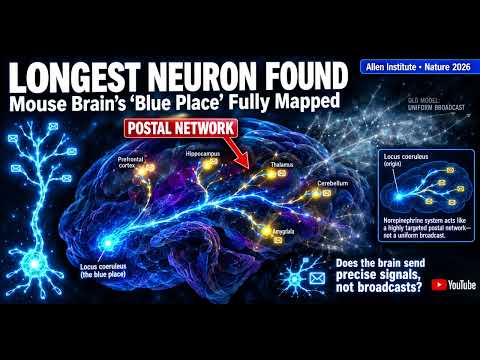
For decades, neuroscientists assumed the brain's 'blue spot' (a tiny cluster of cells in the brainstem) worked like a foghorn, blasting the same chemical signal everywhere. New research from the Allen Institute shows it's actually a targeted postal network, sending specific messages to specific brain regions.

The finding, published in Nature, could reshape how doctors treat depression, anxiety, and ADHD, since norepinephrine drugs currently affect the whole brain at once. It also matters for Alzheimer's research, where these cells are among the first to die.

Why it matters

If norepinephrine drugs can target specific brain circuits, millions on antidepressants and ADHD medications could get treatments with fewer side effects.

Questions about this story

Free account needed to ask — your question is kept and asked for you right after sign-up. Answers are public.

No questions yet — be the first to ask.

Key Indicators

35,000
Neurons imaged
Whole-brain imaging of locus coeruleus neurons in mice.
400,000
Cells' genetic profiles analyzed
Single-cell genetic analysis of the locus coeruleus region.
70.32 cm
Longest axon measured
One of the longest single neurons ever measured in a mouse.
35 cm
Average axon length
Locus coeruleus axons average about 35 centimeters.

Voices

Curated perspectives — historical figures and your fellow readers.

Ever wondered what historical figures would say about today's headlines?

Sign up to generate historical perspectives on this story.

People Involved

Organizations Involved

Timeline

1 event Latest: Today
  1. Nature publishes Allen Institute study on locus coeruleus

    Today Publication

    Study reveals the brain's locus coeruleus sends targeted norepinephrine signals to specific brain regions, not a single broadcast signal.

Scenarios

1

Targeted norepinephrine drugs enter clinical trials

Possible Resolves by End of 2029

Discussed by: Study authors note that current norepinephrine treatments affect multiple brain circuits at once, and the new map could enable more selective therapies.

Pharmaceutical researchers use the locus coeruleus subcircuit map to design drugs that target specific neural pathways. A drug candidate targeting a particular LC circuit (for example, the dorsal pathway involved in learning) advances to a registered clinical trial. This would mark the first time a norepinephrine drug is designed around the LC's targeted architecture rather than its whole-brain effects.

2

Human studies confirm the LC's targeted architecture

Likely Resolves by Q2 2028

Discussed by: The researchers note the findings are from mice but could help understand human brain function.

Independent research groups use brain imaging and post-mortem tissue analysis to test whether the human locus coeruleus shows the same dorsal-ventral division seen in mice. A peer-reviewed study in humans demonstrating distinct LC pathways with different functions would confirm the mouse findings translate to our species.

3

LC mapping approach extends to other neuromodulator systems

Possible Resolves by End of 2028

Discussed by: The study draws parallels between the norepinephrine system and dopamine signaling, suggesting the mapping approach could apply broadly.

Researchers apply the same whole-brain mapping techniques to other neuromodulator systems, such as serotonin or acetylcholine, and find similar targeted architectures. This would suggest that the brain's chemical signaling systems are universally organized as targeted networks rather than broadcast systems, potentially reshaping how neuroscientists model brain function.

Historical Context

2 moments from history that rhyme with this story — and how they unfolded.

2012

Glymphatic system discovery (2012)

Researchers led by Maiken Nedergaard at the University of Rochester discovered a previously unknown system in the brain that clears waste products. The glymphatic system uses cerebrospinal fluid to flush toxins from brain tissue, a function scientists had assumed happened through other mechanisms.

Then

The discovery opened a new field of research into how the brain cleans itself and linked sleep to waste clearance.

Now

The glymphatic system is now studied in connection with Alzheimer's disease, stroke, and other neurological conditions.

Why this matters now

Like the locus coeruleus discovery, it revealed a previously unknown brain-wide system that overturned long-held assumptions and opened new research directions.

1954-1970s

Dopamine reward pathway mapping (1954-1970s)

In 1954, James Olds and Peter Milner discovered that rats would repeatedly press a lever to stimulate certain brain regions, identifying a 'reward center.' Over the following decades, researchers mapped this to specific dopamine-producing neurons in the midbrain.

Then

The mapping of dopamine circuits led to the understanding that Parkinson's disease involves dopamine loss, enabling L-DOPA treatment.

Now

Dopamine research now underpins treatments for Parkinson's, schizophrenia, and addiction.

Why this matters now

The locus coeruleus study explicitly draws parallels to dopamine signaling, and the dopamine story shows how mapping a neuromodulator system can lead to clinical applications.

Sources

(3)