



Pull to refresh
Logo
Japan launches mission to bring back the first samples from Mars's moon

Japan launches mission to bring back the first samples from Mars's moon

New Capabilities

JAXA-led MMX spacecraft heads to Phobos, aiming to return 10 grams of moon dust to Earth by 2031

Yesterday: MMX spacecraft launches from Japan

Overview

Updated 1 hour ago

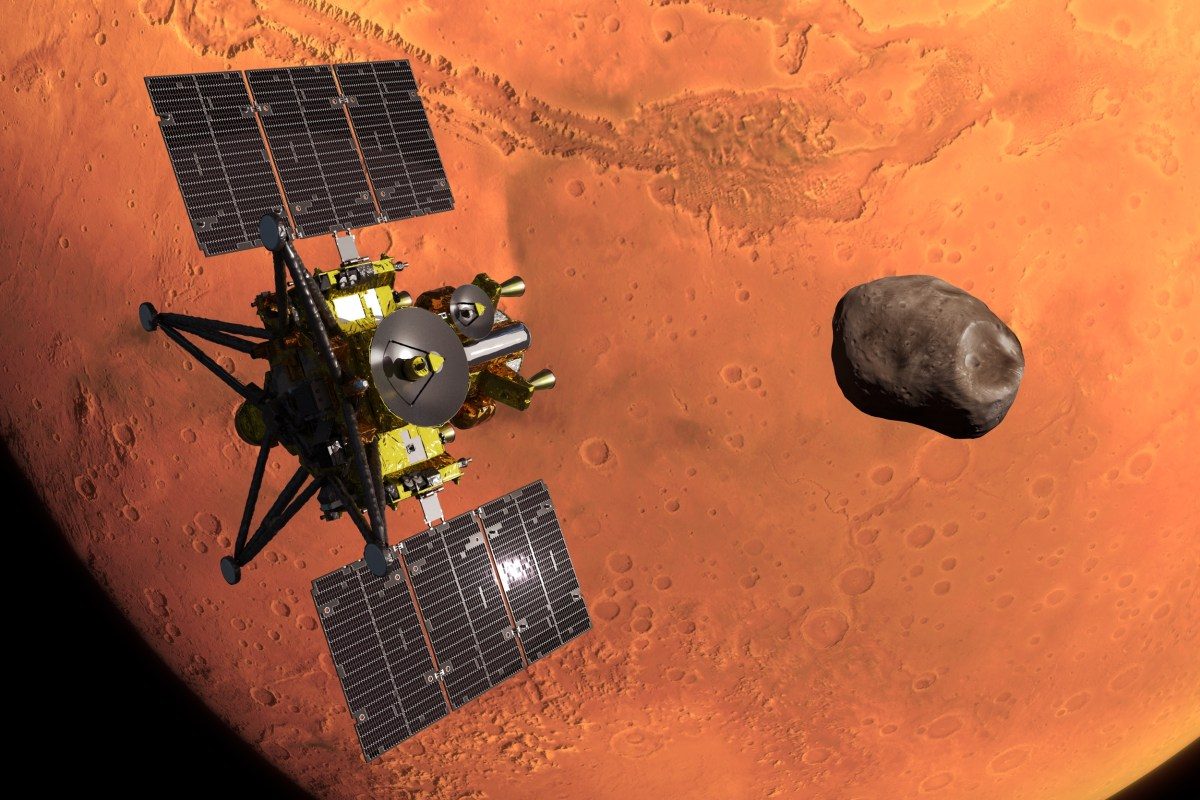
Japan's Mars Moons eXploration (MMX) spacecraft lifted off from Tanegashima Space Center on October 19, beginning a five-year round trip that would return the first samples ever collected from another planet's moon. The target is Phobos, the larger of Mars's two moons.

If the capsule lands in South Australia in 2031 carrying at least 10 grams of Phobos dust, scientists say it could settle a decades-old question: are Mars's moons captured asteroids, or debris from a giant impact on Mars? The sample may also contain grains of Mars itself, ejected by impacts, giving Earth labs a direct look at the Red Planet's composition.

Why it matters

MMX would be the first to return material from another planet's moons, potentially settling how Mars's moons formed and revealing Mars's composition.

Questions about this story

Free account needed to ask — your question is kept and asked for you right after sign-up. Answers are public.

No questions yet — be the first to ask.

Key Indicators

10 grams
Target sample mass from Phobos
MMX aims to collect at least 10 grams (one-third ounce) of surface and subsurface material in 2030.
2031
Year the sample capsule returns to Earth
Capsule lands in Woomera, South Australia; first return from another planet's moons.
15%
NASA's share of the returned sample
NASA will curate about 15% of returned Phobos material at the Johnson Space Center in Houston.
2
Competing theories for Mars's moons' origin
Captured asteroids from the outer solar system vs. debris from a giant impact on early Mars.

Voices

Curated perspectives — historical figures and your fellow readers.

Ever wondered what historical figures would say about today's headlines?

Sign up to generate historical perspectives on this story.

People Involved

Organizations Involved

Timeline

October 2026 2031

6 events Latest: Yesterday
Tap a bar to jump to that date
  1. Sample capsule returns to Earth

    Upcoming Return

    Capsule lands in Woomera, Australia — first sample return from another planet's moons.

  2. MMX lands and collects Phobos sample

    Upcoming Landing

    Spacecraft touches down and collects at least 10 grams with robotic and pneumatic samplers.

  3. Idefix rover lands on Phobos

    Upcoming Landing

    MMX deploys the Idefix rover to scout a landing site on Phobos.

  4. MMX begins orbiting Phobos

    Upcoming Orbit

    First spacecraft to orbit Phobos, surveying it from a quasi-satellite orbit.

  5. MMX arrives at Mars

    Upcoming Arrival

    Spacecraft enters orbit around Mars after about a year in cruise.

  6. MMX spacecraft launches from Japan

    Latest Launch

    JAXA-led spacecraft lifts off on an H3 rocket, starting a five-year round trip to Phobos.

Scenarios

1

MMX sample returns to Earth in 2031

Likely Resolves by End of 2031

Discussed by: JAXA and mission partners; BBC, AP, and ESA coverage of the launch

If the 2030 landing on Phobos succeeds, the return module will separate, head to Earth, and land in Woomera, South Australia in 2031. JAXA would then confirm recovery of at least 10 grams of Phobos material, making it the first sample return from another planet's moons.

2

Sampling attempt fails, no Phobos material returned

Unlikely Resolves by End of 2030

Discussed by: ESA notes the extreme difficulty of robotically landing and sampling in Phobos's very low gravity

Phobos's gravity is so low that landing and sampling are risky. If the lander crashes, topples, or the samplers fail, the mission could return nothing to Earth. No previous mission has ever reached Phobos; both Soviet Phobos probes in 1988 failed.

3

Sample shows Phobos is a captured asteroid

Uncertain Resolves by End of 2032

Discussed by: Sara Russell and other mission scientists quoted in BBC coverage

If Phobos's chemistry matches meteorite classes from the outer solar system, the captured-asteroid hypothesis wins. Scientists say the two origin theories produce very distinct chemical and mineral signatures, so identification could come quickly after analysis begins.

Historical Context

3 moments from history that rhyme with this story — and how they unfolded.

1988–1989

Soviet Phobos 1 and 2 (1988)

The Soviet Union launched twin spacecraft to study Mars and Phobos, including landers meant to touch the moon. Phobos 1 was lost en route after a command error; Phobos 2 reached Mars orbit and imaged Phobos before contact was lost just before its lander deployment.

Then

Neither probe reached the Phobos surface; the program ended without returning data from the moon.

Now

Phobos remained untouched for 38 years, making MMX the first serious attempt to sample it.

Why this matters now

Ars Technica notes 'MMX is not the first mission to attempt a sample return from Phobos.' The Soviet failures show why reaching and sampling the tiny moon is so difficult.

December 2014 – December 2020

Hayabusa2 asteroid sample return (2014–2020)

JAXA's Hayabusa2 spacecraft rendezvoused with asteroid Ryugu, fired an impactor to expose subsurface material, and collected samples in two touch-and-go touchdowns. The capsule parachuted to South Australia in December 2020.

Then

Japan retrieved the first subsurface asteroid samples ever collected, confirming its touch-and-go sampling technique.

Now

JAXA became the world's leading small-body sample-return agency, the foundation for MMX.

Why this matters now

MMX extends JAXA's proven sampling method to a much harder target: another planet's moon, reached after a year of travel and landed on in extremely low gravity.

2020s

NASA/ESA Mars Sample Return cancellation (2020s)

NASA's Perseverance rover has been caching Mars rock cores since 2021, intended for pickup by a joint NASA/ESA Mars Sample Return mission. US Congress halted the program's funding, effectively cancelling it.

Then

No US or European mission can now return Martian material; China is planning its own Mars sampling launch for 2028.

Now

MMX may be the only near-term route to material from the Mars system, since Phobos likely contains impact-ejected Martian grains.

Why this matters now

Because Perseverance's samples have no ride home, the Phobos dust MMX will bring back could be the first Mars-system material analyzed on Earth.

Sources

(9)