
Pull to refresh
Logo
MIT pairs a delivery tag with an antidote to turn a toxic drug into an antibiotic

MIT pairs a delivery tag with an antidote to turn a toxic drug into an antibiotic

New Capabilities

In mice, the modified calicheamicin cleared pneumonia from two pathogens while reducing the liver damage that has always disqualified it

Overview

Updated 8 minutes ago

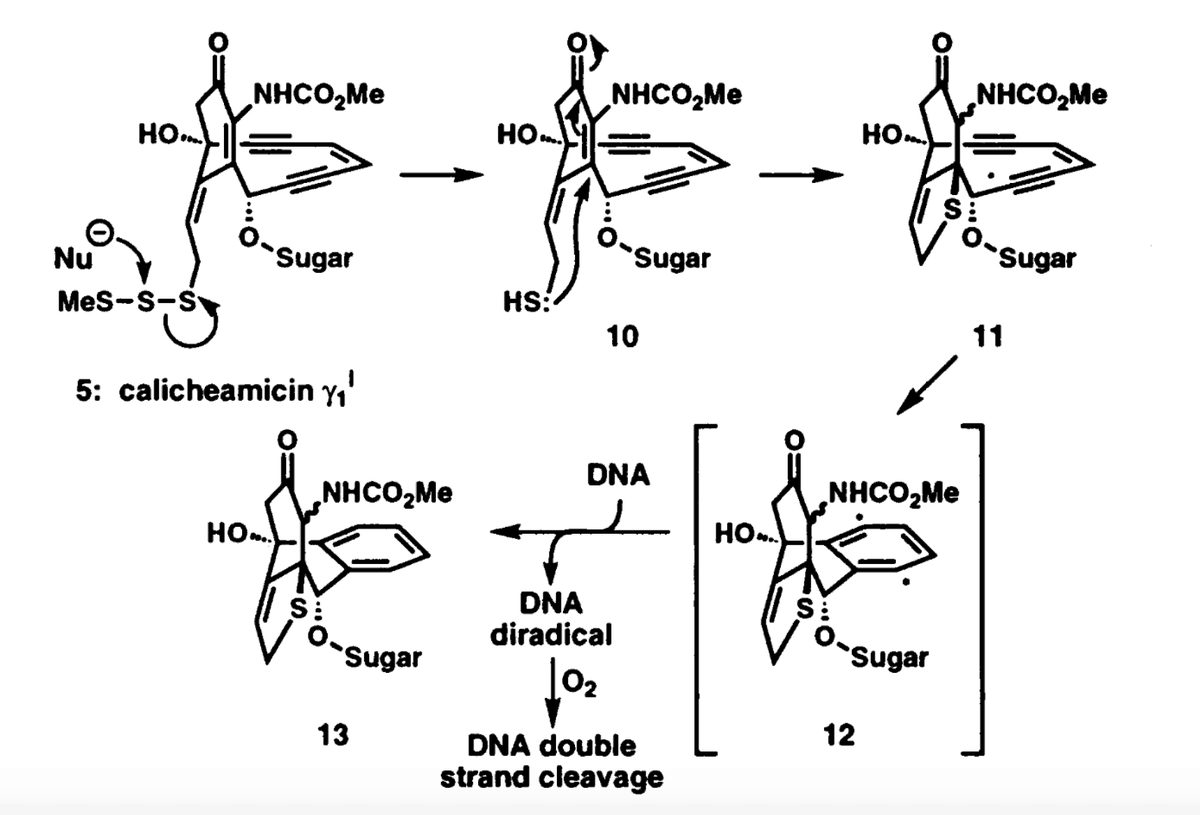
Calicheamicin tears apart DNA. It is potent enough to kill bacteria, and potent enough to wreck a liver at the doses an infection would need, which is why it has spent its commercial life hitched to a tumor-seeking antibody rather than used as an antibiotic. On November 27, MIT researchers reported a two-part fix: a delivery tag that confines the drug to infected tissue, plus a circulating antidote protein that neutralizes whatever leaks out.

In mice with pneumonia caused by Staphylococcus aureus or Pseudomonas aeruginosa, the modified drug cut lung bacteria by 100-fold to 10,000-fold, and the antidote lowered the liver enzyme markers that signal organ damage. It has not been tested in people. The point is not calicheamicin itself. It is that toxicity, the reason most promising antimicrobial compounds die in development, can be engineered around rather than selected for.

Why it matters

Potent compounds have been thrown out over organ damage. If the trick generalizes, they return to the antibiotic pipeline.

Questions about this story

Free account needed to ask — your question is kept and asked for you right after sign-up. Answers are public.

No questions yet — be the first to ask.

Key Indicators

4-log
Drop in S. aureus lung burden at 6 hours
Conjugate alone or with antidote, versus untreated mice. Vancomycin produced 1 to 2 log.
2-log
Drop in P. aeruginosa lung burden at 6 hours
At the higher dose used for Gram-negative infection; ciprofloxacin also cleared more than 2 log.
2
Parts in the strategy
An infection-triggered drug conjugate and a long-circulating antidote enzyme.
7
Years calicheamicin's cancer drug spent off the US market
Approved in 2000, withdrawn over toxicity, reapproved in 2017 at lower doses.
1M+
Annual deaths from drug-resistant infections worldwide
Global estimate cited in a 2026 Nature Reviews Microbiology review of antibiotic discovery.

Voices

Curated perspectives — historical figures and your fellow readers.

Sign up to generate historical perspectives on this story.

People Involved

Organizations Involved

Timeline

2000 November 2026

5 events Latest: Today
Tap a bar to jump to that date
  1. Peer review confirms pneumonia results in mice

    Today Research

    Nature Communications published the study, showing 4-log and 2-log lung burden cuts and reduced liver enzymes with the antidote.

  2. Preprint describes the two-part design

    Research

    The MIT team posted a bioRxiv preprint on the albumin-bound conjugate and the CalU19 antidote.

  3. Reapproved at lower doses

    Drug approval

    The drug returned with lower doses and a different dosing schedule.

  4. The drug leaves the market over toxicity

    Drug withdrawal

    The calicheamicin conjugate was taken off the market, in part because of toxicity.

  5. Calicheamicin reaches patients, bolted to an antibody

    Drug approval

    The FDA approved gemtuzumab ozogamicin, which uses calicheamicin to kill leukemia cells, for acute myeloid leukemia.

Scenarios

1

A second discarded compound gets the same treatment

Possible Resolves by Q2 2028

Discussed by: The MIT authors, who say they have started looking for antidotes to pair with other drugs, including antibiotics avoided because of kidney damage

The paper's claim is generality, not calicheamicin. If the lab or another group repeats the formula on a different toxic antimicrobial, the strategy starts to look like a platform rather than a one-off. The trigger is a peer-reviewed report of a second compound delivered as an albumin-bound conjugate with a matching antidote and in vivo efficacy data.

2

Repeat dosing triggers an immune response and stalls the antidote

Uncertain Resolves by Q2 2029

Discussed by: The study's own authors, who flag that microbial proteins may be immunogenic when given repeatedly, as infection treatment requires

Bacterial enzymes are foreign proteins. A course of antibiotics means multiple doses, and multiple doses mean the immune system gets repeated looks at the antidote. If repeat-dose animal studies or early human testing show antibodies neutralizing CalU19, the second half of the strategy loses its effect and the program needs a redesign.

3

An antibiotic built this way reaches a first human trial

Unlikely Resolves by End of 2029

Discussed by: No sponsor has announced one; the milestone would mark the strategy's move from mouse models to people

The path runs through investigational new drug enabling studies: manufacturing the conjugate and the antidote to clinical standards, toxicology in a second species, and a dosing plan that keeps drug release tied to infected tissue. A filed and accepted application is the concrete marker that someone is paying for that work.

Historical Context

3 moments from history that rhyme with this story — and how they unfolded.

2000-2017

Gemtuzumab ozogamicin's withdrawal and return (2000-2017)

The first US-approved antibody-drug conjugate used calicheamicin to carry a DNA-damaging payload into leukemia cells. Regulators and the manufacturer pulled it from the market in 2010, citing toxicity among other problems.

Then

Patients and oncologists lost a treatment option, and calicheamicin's reputation became its side effects.

Now

A 2017 reapproval at lower, differently spaced doses kept the drug in cancer care, where some toxicity is tolerated in exchange for killing tumor cells.

Why this matters now

The MIT team's premise is that infection treatment should not have to accept the same trade-off, and that a drug already through preclinical and regulatory review is faster to repurpose than a new molecule.

1970s-2000s

Colistin: shelved for kidney damage, then recalled as a last resort (1970s-2000s)

Colistin killed hard-to-treat Gram-negative bacteria but could damage kidneys and nerves, so clinicians largely set it aside once safer options existed. As multidrug-resistant infections spread and alternatives ran out in the 2000s, it came back into use.

Then

Doctors prescribed a drug they had abandoned, often at doses that again strained kidneys.

Now

Colistin remains a last-resort antibiotic, used because the infection is worse than the risk.

Why this matters now

Toxicity disqualifies a drug only until the alternatives run out. The MIT approach tries to change the trade-off directly instead of waiting for desperation to change it.

1950s-1970s

Leucovorin rescue for high-dose methotrexate (1950s-1970s)

Methotrexate's cancer-killing doses were limited by damage to bone marrow and the gut lining. Researchers found that folinic acid, later called leucovorin, could bypass the drug's metabolic block in healthy tissue without undoing its effect on tumors.

Then

Clinicians could give far higher methotrexate doses, then 'rescue' the patient with a second drug.

Now

Leucovorin rescue became standard in regimens for osteosarcoma and other cancers.

Why this matters now

The antidote half of the MIT design is the same idea with a different mechanism: a second molecule given alongside a toxic drug to protect tissue the drug is not supposed to reach.

Sources

(6)