

Pull to refresh
Logo
Parker Solar Probe finds paired magnetic twists in the solar wind

Parker Solar Probe finds paired magnetic twists in the solar wind

New Capabilities

Two counter-rotating patterns appear exactly where the solar wind shifts from fluid behavior to particle behavior

Overview

Updated 1 hour ago

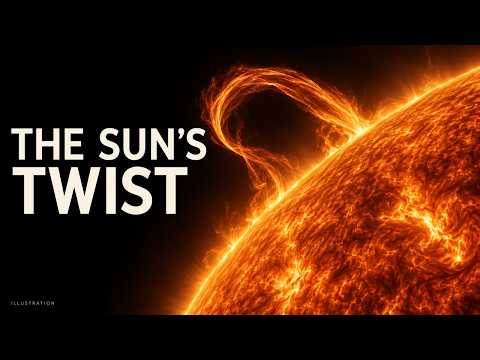
Since the 1980s, the magnetic twist in the solar wind's largest ripples has looked like noise. Clockwise and counterclockwise turns showed up in roughly equal measure, which is what randomness looks like. Parker Solar Probe sampled fast enough to find two sharp, opposite twists sitting side by side.

The pair sits exactly where the solar wind stops behaving like a flowing fluid and starts behaving like a crowd of individual particles. Both peaks drift toward longer wavelengths as the wind travels outward, and they drift faster than the gas's own expansion can explain.

Why it matters

A measurable pattern inside solar-wind turbulence gives forecasters a new test for the models behind geomagnetic storm warnings.

Questions about this story

Free account needed to ask — your question is kept and asked for you right after sign-up. Answers are public.

No questions yet — be the first to ask.

Key Indicators

2
Counter-rotating helicity peaks
One peak carries the twist clockwise, the other counterclockwise, at adjacent frequencies.
10 / 20
Ripples per second at the two peaks
Measured close to the Sun, at about a tenth of the Earth-Sun distance.
0.1–0.78 AU
Distance range sampled
The drift toward longer wavelengths held from 0.1 out to about 0.4 of the Earth-Sun distance.
10
Countries on the research team
Institutions in Germany, Japan, Italy, the United States and elsewhere contributed.

Voices

Curated perspectives — historical figures and your fellow readers.

Sign up to generate historical perspectives on this story.

People Involved

Organizations Involved

Timeline

August 2018 November 2026

3 events Latest: Yesterday
  1. Paired magnetic twists reported in the solar wind

    Latest Publication

    Iizawa and colleagues report two counter-rotating helicity peaks near the ion kinetic scale, drifting outward faster than gas expansion predicts.

  2. Probe samples the inner solar wind

    Observation

    From late September to late November 2021, Parker records magnetometer data between 0.1 and 0.78 times the Earth-Sun distance.

  3. Parker Solar Probe launches

    Mission

    The spacecraft begins its campaign to fly closer to the Sun than any previous probe.

Scenarios

1

Solar Orbiter confirms the twist outside the ecliptic

Possible Resolves by End of 2029

Discussed by: Iizawa's team, which proposed the test in the paper

Parker's orbit stays within a few degrees of the plane the planets share, and past roughly half the Earth-Sun distance the two peaks faded out. The team cannot tell whether the fade is real or an accident of where the spacecraft was. Solar Orbiter flies above and below that plane, so a repeat measurement there would settle it.

2

Independent team traces the peaks to current-sheet crossings

Unlikely Resolves by Q2 2028

Discussed by: The authors themselves, who list the current sheet as an alternative explanation for the fade

Parker repeatedly crosses the sheet dividing the Sun's magnetic field in two, and those crossings could scramble the signal. A reanalysis that controls for crossing geometry would either kill the result or strengthen it.

3

A simulation reproduces the paired peaks from first principles

Likely Resolves by End of 2028

Discussed by: Plasma turbulence modelers, including co-author Axel Brandenburg's circle

One recent theory holds that magnetic twist jams the turbulent cascade at the fluid-to-particle boundary, forcing energy back up to larger scales. A pile-up of twist at scales larger than the local proton scale is what that jam would produce. The observation fits, but it arrived as a measurement rather than a simulation.

Historical Context

2 moments from history that rhyme with this story — and how they unfolded.

1942

Alfvén waves predicted (1942)

Hannes Alfvén argued that a magnetized conducting fluid should support a new kind of transverse wave. The idea was poorly received at first, in part because it seemed to contradict established thinking about how fields move through plasma.

Then

Alfvén's waves were treated as a curiosity for years.

Now

They became the foundation of magnetohydrodynamics and the standard explanation for how energy moves through the solar wind. Alfvén won the 1970 Nobel Prize in Physics for the work.

Why this matters now

The paired helicity peaks were also predicted by theory before data could show them. The gap between prediction and measurement is the normal shape of this field.

1962

Mariner 2 confirms the solar wind (1962)

Eugene Parker had argued in 1958 that the Sun continuously emits a stream of charged particles. Critics doubted it. Mariner 2, on its way to Venus, measured a steady flow of plasma moving past the spacecraft for months.

Then

The measurement ended the debate and made the solar wind a measured phenomenon rather than a theoretical one.

Now

Solar wind monitoring became the basis of space weather forecasting, which now underpins warnings for satellites, radio communication and power grids.

Why this matters now

A single spacecraft's readings turned a contested prediction into accepted physics. Parker Solar Probe is doing the same job at a tenth of the distance.

Sources

(5)