The White House ballroom rush hits court: preservationists ask judge to freeze Trump’s build
Built World
Judge Questions Trump's Authority as Loyalist Commissioners Raise Design Concerns: The $400 Million Build Faces Skepticism in Court and on Review Panels
Judge Questions Trump's Authority as Loyalist Commissioners Raise Design Concerns: The $400 Million Build Faces Skepticism in Court and on Review Panels
At a January 22 hearing on the National Trust's preliminary injunction request, Judge Richard Leon signaled deep skepticism about Trump's authority to tear down "an icon that's a national institution" using $400 million in private donations. Leon called the funding mechanism a "Rube Goldberg contraption" and is expected to rule in February; Trump declared on Truth Social that "IT IS TOO LATE" to stop the project, claiming structural steel, marble, and bulletproof glass are already lined up.
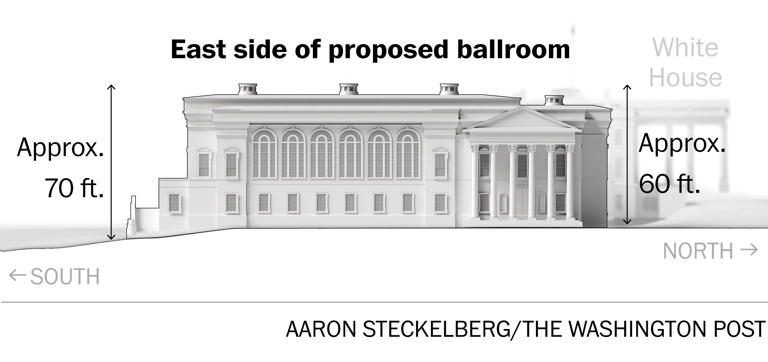
Meanwhile, the approval process produced an unexpected twist: even commissioners Trump appointed to replace the fired Fine Arts panel raised design concerns at their January 22 informational session. They questioned the ballroom's "immense" scale, requested 3D models, and noted that renderings show a structure more reminiscent of the Treasury Department than the White House itself.
The National Capital Planning Commission held its first public presentation on January 8, revealing a 22,000-square-foot ballroom with 40-foot ceilings plus new proposals for a second-story West Wing colonnade and underground security facilities. Formal votes are scheduled for February 19 (CFA) and March 5 (NCPC), but the project now faces skepticism from the judge, new commissioners, and public comments that were "almost all" negative.
Questions about this story
Free account needed to ask — your question is kept and asked for you right after sign-up. Answers are public.
No questions yet — be the first to ask.
Key Indicators
$400M
Latest reported project price tag
The cost doubled from the original $200M estimate and rose from $300M in October to $400M in December 2025.
22,000 sq ft
Ballroom size (within 89,000 sq ft total addition)
Ballroom with 40-foot ceilings accommodates 1,000 seated guests; total project nearly 90,000 sq ft including offices, theater, and security facilities.
Feb 2026
Expected court ruling on preliminary injunction
Judge Leon signaled deep skepticism of Trump's authority at Jan 22 hearing; ruling expected in February.
Feb 19, 2026
Commission of Fine Arts vote
Reconstituted panel with Trump appointees will vote on design after raising scale concerns at Jan 22 informational session.
March 5, 2026
National Capital Planning Commission vote
Final approval vote needed before aboveground construction can begin in April.
53%
Public disapproval of East Wing demolition (YouGov)
A key political tailwind for challengers: the optics remain unpopular.
21 events
Latest: January 25th, 2026 · 8 months ago
Showing 8 of 21
JK to step
Tap a bar to jump to that date
Jump to
January 2026
Trump declares on Truth Social: 'IT IS TOO LATE' to stop ballroom
LatestStatement
President Trump posts on Truth Social that the ballroom project cannot be reversed, claiming materials including 'All of the Structural Steel, Windows, Doors, A.C./Heating Equipment, Marble, Stone, Precast Concrete, Bulletproof Windows and Glass, Anti-Drone Roofing, and much more' have been lined up. The statement contradicts Justice Department lawyers who told the judge three days earlier that plans can be modified.
Commission of Fine Arts informational session: Commissioners raise design concerns
Governance
At their first meeting with a quorum of Trump appointees, CFA commissioners question architect Shalom Baranes about the ballroom's 'immense' scale and request 3D models for future in-person review. Commissioners note the south-facing design resembles the Treasury Department more than the White House. Public comments received ahead of the meeting were 'almost all' negative.
Judge Leon signals deep skepticism of Trump's legal authority at preliminary injunction hearing
Legal
At hearing on the National Trust's request for a preliminary injunction, Judge Richard Leon questions whether the president can tear down 'an icon that's a national institution' and calls the $400M private-funding mechanism a 'Rube Goldberg contraption.' He tells the Justice Department he sees 'no basis' in law for using gift authority to raise $400 million for the ballroom—'None. Zero.' Leon says he'll likely rule in February, not January.
Trump appoints four loyalists to Commission of Fine Arts
Governance
President Trump quietly appoints four new members to the CFA: Mary Anne Carter (National Endowment for the Arts chair and close friend of chief of staff Susie Wiles), conservative art critic Roger Kimball, architect James McCrery (who led the ballroom project until replaced in late 2025), and White House official Matthew Taylor. The appointments are revealed in court filings.
NCPC holds first public presentation, reveals detailed plans
Governance
The National Capital Planning Commission receives informational presentation showing a 22,000-square-foot ballroom with 40-foot ceilings within an 89,000-square-foot addition, plus first-time proposals for a second-story West Wing colonnade and underground security facilities. D.C. Council Chairman Phil Mendelson criticizes the scale as 'disturbing.'
Trump personally shops for Italian marble in Florida
Built World
President Trump visits Arc Stone & Tile near Mar-a-Lago to select marble and onyx for the ballroom, spending over an hour at the store. The White House states the purchase will be made at Trump's personal expense.
2026
White House considers reappointing allies to Commission of Fine Arts
Governance
The administration is expected to appoint new members to the CFA shortly, after firing all six sitting members in October. The reconstituted panel will review the ballroom design on January 15 and vote on February 19.
December 2025
White House lays out nine-week approval timeline through March 2026
Governance
The administration unveils an aggressive schedule: informational presentations at NCPC (Jan 8) and CFA (Jan 15), followed by design votes at CFA (Feb 19) and NCPC (Mar 5), aiming for final approval by early March to allow construction to begin in spring 2026.
NCPC schedules first public presentation for January 8, 2026
Governance
The National Capital Planning Commission announces it will hold an informational presentation on the 'East Wing Modernization Project' at its January 8 meeting—the first formal public review session, though no vote will be taken.
Judge Leon issues written order denying temporary construction halt
Legal
Following the December 16 hearing, Judge Richard Leon formally denies the National Trust's request for a temporary restraining order, ruling that irreparable harm was not established, but warns against underground construction that could predetermine the ballroom's footprint. Sets mid-January hearing for broader preliminary injunction arguments.
Judge set to hear bid for emergency construction halt
Legal
A federal judge is scheduled to consider whether to temporarily freeze construction while the lawsuit proceeds.
Judge declines emergency halt but imposes construction limits
Legal
Judge Richard Leon hears arguments and signals he will deny the temporary restraining order, ruling the National Trust has not shown sufficient irreparable harm. However, he warns the administration that any below-ground construction over the next two weeks that could determine the ballroom's final size must be 'prepared to be taken down,' and orders plans submitted to NCPC and CFA by year-end.
Trump announces cost has risen to $400 million
Statement
President Trump states at a White House Hanukkah reception that the ballroom project will cost approximately $400 million—double the original $200 million estimate—emphasizing it will be funded by himself and donors 'free of charge for nothing.'
National Trust sues and seeks an immediate work stop
Legal
The National Trust files a federal lawsuit seeking to halt construction and compel environmental review, consultations, and congressional authorization.
October 2025
White House fires the Fine Arts Commission members
Governance
The Commission of Fine Arts is cleared out as it was expected to review major Trump-era construction projects, including the ballroom.
Poll shows backlash as donors and influence questions grow
Public Opinion
Polling shows majority opposition to the East Wing demolition, turning the project into a political liability as well as a legal one.
Private citizens try an emergency court stop
Legal
A Virginia couple files an emergency bid to block demolition, underscoring how hard standing can be for ordinary opponents.
Trump says the project is now about $300 million
Statement
Trump defends the expanded demolition scope and raises the price tag, amplifying scrutiny of funding sources and oversight.
National Trust warns agencies: pause and review
Statement
The National Trust sends a formal letter urging a halt and initiation of required reviews by NCPC, CFA, and other entities.
Demolition begins on the East Wing site
Built World
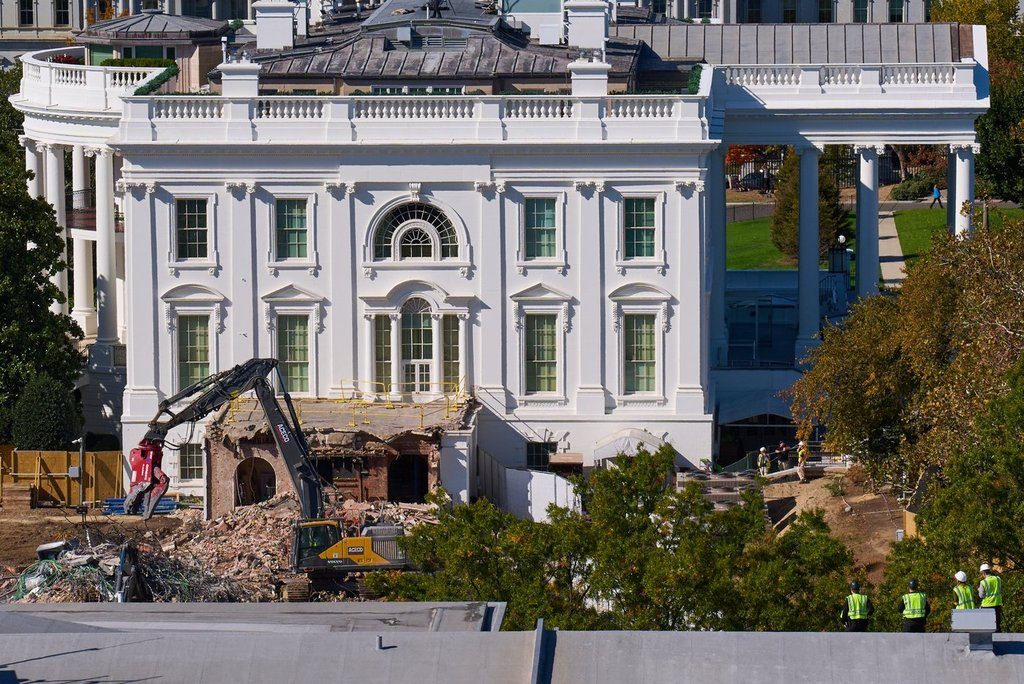
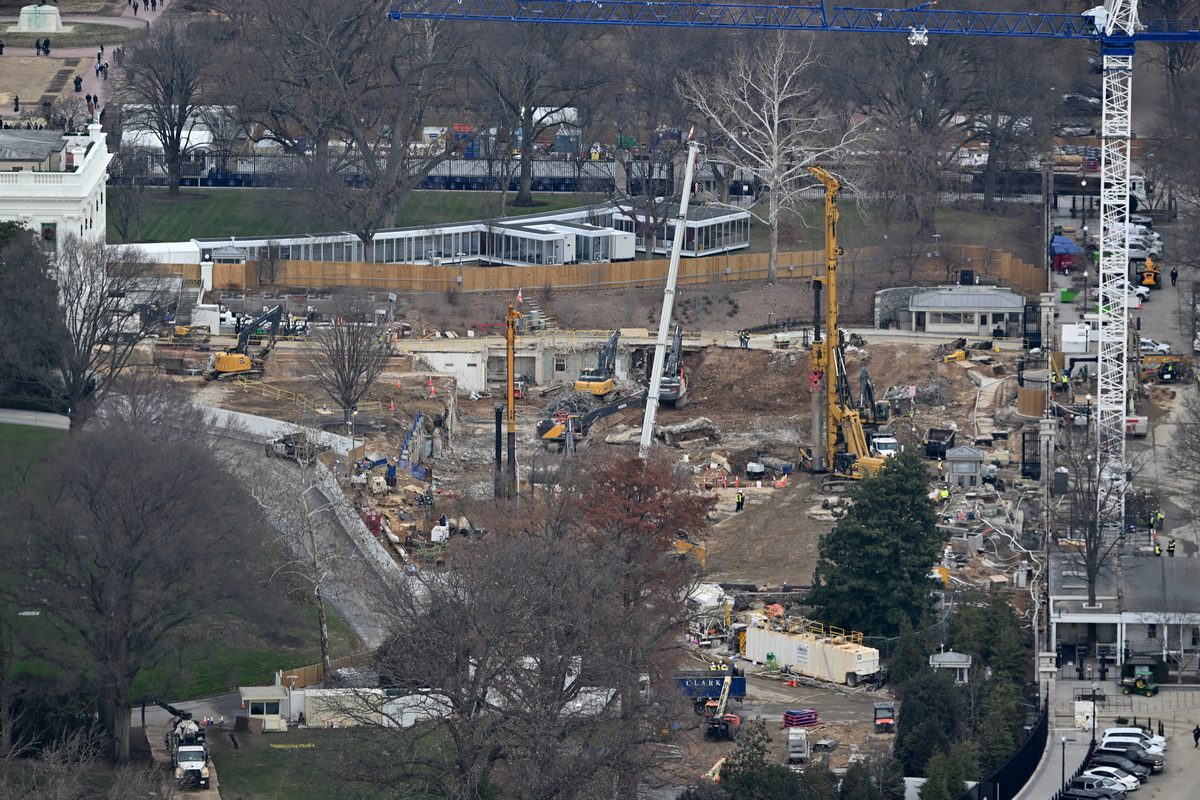
Demolition work starts to clear space for the new ballroom, escalating the fight over process and permanence.
July 2025
White House unveils ballroom plan
Announcement
The administration announces a ~90,000 sq ft ballroom, names architect and builders, and pegs cost at ~$200M funded by Trump and donors.
Scenarios
1
Judge Orders a Work Freeze: Reviews and Congress Move From Theory to Requirement
Possible
Discussed by: Reuters, AP, The Washington Post legal coverage framing the TRO and review claims
If the judge grants a temporary restraining order or fast-tracks an injunction, construction pauses and the fight shifts to process: environmental assessment, design review, and a political question with teeth—does Congress have to explicitly authorize a new structure on federal grounds? That outcome turns a fast build into a slow-motion legitimacy battle, with every delay raising costs and turning donor influence and agency reshuffling into a bigger part of the record.
2
Court Declines to Stop Work: The Ballroom Becomes a Done Deal Before the Merits Are Litigated
Likely
Discussed by: WSJ and Reuters reporting on the administration’s authority arguments and exemptions
The most common way these disputes end is not with a dramatic ruling—but with time. If emergency relief is denied, the administration keeps building while it argues exemptions, discretion, and precedent. Opponents may still win procedural points later, but courts are often reluctant to order demolition of a nearly finished structure, which makes the “no stop now” decision the difference between a real check on power and a symbolic lawsuit.
3
Congress Steps In: Authorization, Conditions, and a Political Bargain Replace Pure Litigation
Uncertain
Discussed by: AP and Washington Post references to congressional authority questions and historical precedent
A legislative deal becomes plausible if lawsuits, donor optics, and public backlash converge. Congress could authorize the project with conditions—transparency rules on donors, preservation requirements, limits on footprint, or mandates for future review processes. This is the “everyone claims a win” off-ramp: Trump keeps a ballroom; critics get guardrails and a precedent that future presidents can’t bulldoze first and explain later.
4
Reviews Become Rubber-Stamp Exercises: Reconstituted Panels Fast-Track Approval by March
Likely
Discussed by: Washington Post and CBS News reporting on the nine-week timeline and reconstituted Commission of Fine Arts
The administration's aggressive timeline—informational presentations in early January, votes in mid-February and early March—suggests it expects cooperative review bodies. With Trump allies likely appointed to the CFA to replace the fired members, and NCPC chaired by White House aide Will Scharf, both panels may approve the design quickly. If so, the lawsuit's procedural victories—forcing formal review—won't translate into substantive constraints, and the ballroom advances largely as planned.
5
Panels Demand Changes: Scope, Height, or Footprint Reduced as Approval Price
Possible
Discussed by: Architectural Press and preservation community commentary on review process leverage
Even a reconstituted Commission of Fine Arts may push back on aesthetics, scale, or historical compatibility—not to kill the project, but to extract concessions that let commissioners claim they imposed professional standards. NCPC could condition approval on limiting the footprint or building height. The result: Trump gets his ballroom, but smaller or redesigned, and the process becomes a negotiation rather than a formality.
6
Judge Issues Preliminary Injunction: Construction Halts While Legal Authority Question Gets Full Hearing
Possible
Discussed by: Legal analysts following Judge Leon's January 22 skepticism (Washington Post, NBC News, CBS News)
If Judge Leon's February ruling converts his skepticism into an injunction, construction pauses until the court resolves whether a president can demolish and rebuild parts of the White House using private donations without congressional authorization. This would transform the fight from a race-against-time into a full merits battle over presidential power, likely headed for appeals and potentially reaching the Supreme Court. The administration's 'too late' argument collapses if a judge orders a halt before aboveground construction begins in April.
7
Commissioner Skepticism Forces Design Compromises: Scale Reduced to Win February Vote
Possible
Discussed by: Commission of Fine Arts commissioners' January 22 questions about 'immense' scale (PBS, U.S. News)
Even Trump-appointed commissioners raised design concerns and requested 3D models, suggesting they may demand changes before voting yes on February 19. If the CFA conditions approval on reducing the footprint, lowering the height, or redesigning the south facade to better match White House architecture, Trump faces a choice: accept a smaller ballroom or risk a 'no' vote that derails the March timeline and strengthens the lawsuit's argument that the project lacks proper authorization.
Historical Context
3 moments from history that rhyme with this story — and how they unfolded.
1 of 3
1947-11 to 1948-03
Truman Balcony fight (1947–1948)
Harry Truman pushed to add a second-floor balcony despite objections from the Commission of Fine Arts and public critics. The project moved forward and the balcony was completed in March 1948.
Then
The addition was built and, over time, became accepted as part of the White House.
Now
It became a case study in how aesthetics boards can lose to presidential determination.
Why this matters now
It’s the precedent Trump-world points to: presidents change the house, even when experts protest.
2 of 3
1949-04 to 1952-10
Truman-era White House reconstruction and congressional commission (1949–1952)
After structural dangers became undeniable, Truman urged Congress to create a commission to oversee major renovation. A law created the Commission on the Renovation of the Executive Mansion, which managed reconstruction while preserving the exterior.
Then
The White House was evacuated and rebuilt with a stronger interior structure.
Now
It set a high-profile model of Congress asserting a formal oversight role in White House construction.
Why this matters now
The National Trust is implicitly asking for the Truman-reconstruction model: big changes demand Congress, not just presidential will.
3 of 3
1961-03 to 1962-09
Jacqueline Kennedy’s restoration and Congress declaring the White House a museum (1961–1962)
First Lady Jacqueline Kennedy professionalized preservation inside the White House, created expert advisory structures, and won congressional authorization that protected historically significant objects and emphasized the building’s museum character.
Then
The restoration gained legitimacy through experts, donations, and public visibility.
Now
Congressional action strengthened the norm that the White House is public heritage, not private property.
Why this matters now
This is the moral spine of the lawsuit: the White House belongs to the public, and the public gets a process.