

Pull to refresh
Logo
Ocean biology naturally brightens marine clouds, new research confirms

Ocean biology naturally brightens marine clouds, new research confirms

New Capabilities

Phytoplankton-produced aerosols are emerging as a major natural source of cloud condensation nuclei — the same process geoengineering projects aim to amplify

May 1st, 2026: Sea-to-air DOC transfer quantified during phytoplankton blooms

Overview

Updated 1 hour ago

A wave of 2026 studies shows that ocean biology — not just wind and sea salt — is seeding marine clouds. Phytoplankton blooms release organic compounds that turn into cloud condensation nuclei (CCN), particles that water vapor needs to form droplets. More CCN means more, smaller droplets, and clouds that reflect more sunlight back to space. This is natural cloud brightening, operating at planetary scale.

The work spans three frontiers: CERN's CLOUD experiment finding that methanesulfonic acid (MSA) from algal dimethyl sulfide (DMS) drives new particle formation as effectively as sulfuric acid below -10°C; modeling showing DMS and ammonia can nucleate particles in the marine boundary layer after rain events; and field measurements attributing 56–66% of organic carbon in West Pacific aerosols to marine primary sources. Together these close a long-standing gap between observed and modeled marine aerosol budgets.

Why it matters

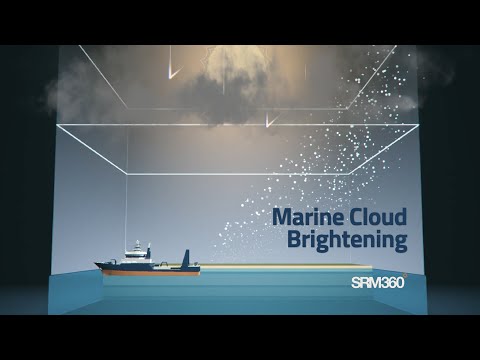
The same biological process that naturally brightens clouds could partially offset warming as human pollution aerosols decline — and it validates marine cloud brightening as a climate lever.

Questions about this story

Free account needed to ask — your question is kept and asked for you right after sign-up. Answers are public.

No questions yet — be the first to ask.

Key Indicators

56–66%
Share of total organic carbon in West Pacific aerosol samples from marine primary sources
Field measurements over the West Pacific Ocean attributed a majority of collected organic carbon to protein-like substances transferred from seawater into sea spray aerosols.
10–30x
Enrichment of dissolved organic carbon in sea spray aerosols during phytoplankton blooms
The enrichment resulted from coupling between biological activity and the 'DOC bubble–SSA interaction' in the sea-to-air transfer pathway.
10x
Acceleration of particle nucleation rates when methanesulfonic acid is present with sulfuric acid and ammonia
CLOUD experiment findings indicate MSA and sulfuric acid nucleate synergistically, boosting growth rates up to 2x compared with sulfuric acid and ammonia alone.
3–4 days
Time for DMS-derived new particles to grow into CCN-active size range
Modeling shows nucleated particles reach the upper Aitken and accumulation mode within 3–4 days, becoming capable of acting as cloud condensation nuclei.

Voices

Curated perspectives — historical figures and your fellow readers.

Ever wondered what historical figures would say about today's headlines?

Sign up to generate historical perspectives on this story.

People Involved

Organizations Involved

Timeline

March 1987 May 2026

6 events Latest: May 1st, 2026 · 5 months ago
Tap a bar to jump to that date
  1. Sea-to-air DOC transfer quantified during phytoplankton blooms

    Latest Research publication

    Study finds dissolved organic carbon enrichment in sea spray aerosols increases 10–30 times during blooms, driven by biological activity.

  2. Modeling shows DMS and ammonia nucleate particles in marine boundary layer

    Modeling study

    Advanced simulations demonstrate DMS-derived new particle formation occurs in the marine boundary layer after precipitation events, with particles growing to CCN-active sizes in 3–4 days.

  3. West Pacific field study quantifies marine primary organic carbon share

    Research publication

    Atmospheric Chemistry and Physics paper reports marine primary organic carbon averages 0.33 µgC m⁻³, accounting for 56–66% of total organic carbon in collected aerosols.

  4. CLOUD experiment shows MSA drives marine new particle formation

    Scientific discovery

    CLOUD results show methanesulfonic acid is as effective as sulfuric acid at nucleating particles below -10°C, with MSA and sulfuric acid nucleating synergistically.

  5. Northwest Pacific biogenic marine aerosol preprint released

    Research publication

    Preprint attributes marine organic aerosol production to photochemical oxidation of seawater organics, linking biological activity to boundary-layer cloud formation.

  6. CLAW hypothesis proposes phytoplankton–DMS–cloud feedback

    Scientific hypothesis

    Charlson, Lovelock, Andreae and Warren proposed that marine phytoplankton emit DMS that forms sulfate aerosols seeding clouds, creating a climate feedback loop.

Scenarios

1

Biological marine aerosols enter global climate models as a major buffer

Likely Resolves by End of 2027

Discussed by: CERN CLOUD Collaboration, Copernicus journal authors, IPCC modelers

Synthesis of MSA nucleation rates, DMS modeling, and field measurements on marine primary organic carbon gets incorporated into Earth system models. Projections of warming under carbon-neutral scenarios are revised downward as natural marine aerosol production compensates for declining anthropogenic sulfate. This scenario requires the field-measured 56–66% primary organic carbon share to replicate across other ocean basins.

2

Natural cloud brightening findings bolster MCB geoengineering proposals

Possible Resolves by Q2 2028

Discussed by: Communications Earth & Environment, Science Advances authors

Demonstrated natural cloud brightening from wildfire smoke (the 2019–2020 Australian event) and modeled marine stratocumulus responses lends credibility to deliberate marine cloud brightening. A national research program (for example NOAA or a European agency) formalizes funding for MCB field trials. The natural aerosol forcing trend of -0.04 W m⁻² decade⁻¹ measured at Mace Head becomes a benchmark for intervention targets.

3

Effect proves regionally significant but globally marginal

Possible Resolves by Jan 31, 2028

Discussed by: npj Climate and Atmospheric Science modeling study authors

Warming weakens aerosol-cloud interactions in subtropical marine stratocumulus — a doubling of CO2 attenuates aerosol-induced cooling by more than 30% — and sporadic cloud cover suppresses new particle formation. Ocean-basin variability in primary organic carbon enrichment limits global upscaling. The marine biological contribution stays a regional phenomenon concentrated in productive upwelling zones.

Historical Context

3 moments from history that rhyme with this story — and how they unfolded.

March 1987

CLAW hypothesis (1987)

Atmospheric chemists Robert Charlson, James Lovelock, Meinrat Andreae, and Stephen Warren proposed that marine phytoplankton emit dimethyl sulfide, which oxidizes into sulfate aerosols that seed clouds. The clouds shade the ocean, cooling it and regulating phytoplankton growth — a self-regulating climate feedback loop. The hypothesis was elegant but controversial; direct evidence proved hard to obtain.

Then

DMS became a major research target, and measurements confirmed it is the dominant natural sulfur source in the marine atmosphere. But the proposed feedback loop could not be verified at scale.

Now

The hypothesis remains unconfirmed as a true feedback, yet it set the research agenda for marine aerosol-cloud interactions for four decades — the agenda today's papers are finally closing.

Why this matters now

The 2026 MSA and DMS findings provide the mechanistic evidence that CLAW lacked, connecting ocean biology to particle nucleation through measurable pathways.

December 2019 – February 2020

2019–2020 Australian bushfire cloud brightening

Megafires in southeast Australia injected unprecedented smoke into the stratosphere and free troposphere. Aerosol particles from the smoke drifted over the Pacific and brightened marine clouds by increasing cloud droplet number concentrations — effectively a natural, uncontrolled cloud brightening experiment. The resulting cooling over the southeast Pacific coincided with La Niña-like conditions.

Then

Scientists documented cloud droplet number concentration increases and negative shortwave forcing over the region the smoke crossed.

Now

The Science Advances study used this natural event as a proxy to test whether deliberate targeted marine cloud brightening could weaken El Niño events — showing MCB initiated during El Niño growth phases disrupts the Bjerknes feedbacks that amplify El Niño.

Why this matters now

The wildfire event proved cloud brightening works at regional scale. Today's biological aerosol research reveals ocean biology performs a milder version of the same process continuously.

January 2020

IMO 2020 sulfur emission cap

The International Maritime Organization cut the sulfur content of ship fuel from 3.5% to 0.5%. This removed massive quantities of reflective sulfate aerosols from shipping lanes, reducing the cooling haze over the world's busiest ocean routes. Measurements at Mace Head, Ireland showed declining anthropogenic sulfate aerosol concentrations against a background of rising natural marine aerosols.

Then

Shipping pollution aerosols dropped sharply, and studies attributed part of the subsequent ocean warming and cloud changes to this loss of reflective aerosol.

Now

The Mace Head record shows natural marine aerosols — biogenic sulfate, sea salt, and organic aerosols — now dominate the direct aerosol forcing budget over the region, with a combined negative forcing of -0.04 W m⁻² decade⁻¹ from 2008–2019.

Why this matters now

As sulfur caps and other pollution controls phase out anthropogenic aerosols, natural biological marine aerosol production becomes the key remaining lever on cloud reflectivity.

Sources

(11)