Anchor

New Mexico's largest reservoir falls to lowest level in 55 years
Built WorldElephant Butte Reservoir hit 1.4 percent capacity in July as drought and record-early snowmelt drained the Rio Grande
2 days ago: Slow refill beginsNew here? Follow stories to track developments over time. Create a free account to get updates when stories you care about change.
Overview
Updated 2 hours agoBoat ramps at Elephant Butte Lake State Park sit buried in sediment. In late July the lake dropped to 1.4 percent of capacity, its lowest level since 1971.
Elephant Butte is New Mexico's largest reservoir, storing water for farms in New Mexico and Texas and part of El Paso's drinking supply. Years of drought and the earliest snowmelt on record at the Rio Grande's headwaters drained it. Agricultural releases stopped on July 28, letting the lake begin a slow refill.
Why it matters
About 15 million people depend on the Rio Grande for drinking water; this reservoir's low shows how fast that supply can run out.
Questions about this story
Free account needed to ask — your question is kept and asked for you right after sign-up. Answers are public.
No questions yet — be the first to ask.
Key Indicators
1.4%
Capacity at July low point
Elephant Butte's conservation capacity is about 1.96 million acre-feet; 1.4 percent was the July 28 low.
27,278 acre-feet
Water in storage at the low point
Stored water on July 28, 2026, against a conservation capacity of about 1.96 million acre-feet.
55 years
Time since the reservoir was this low
The reservoir last sat near this level in 1971, before the current drought and heavy upstream use.
77%
Drop in a lakeside business's revenue, July to August
A business owner told KFOX14 that revenue fell 77 percent as boat access collapsed.
Related Media
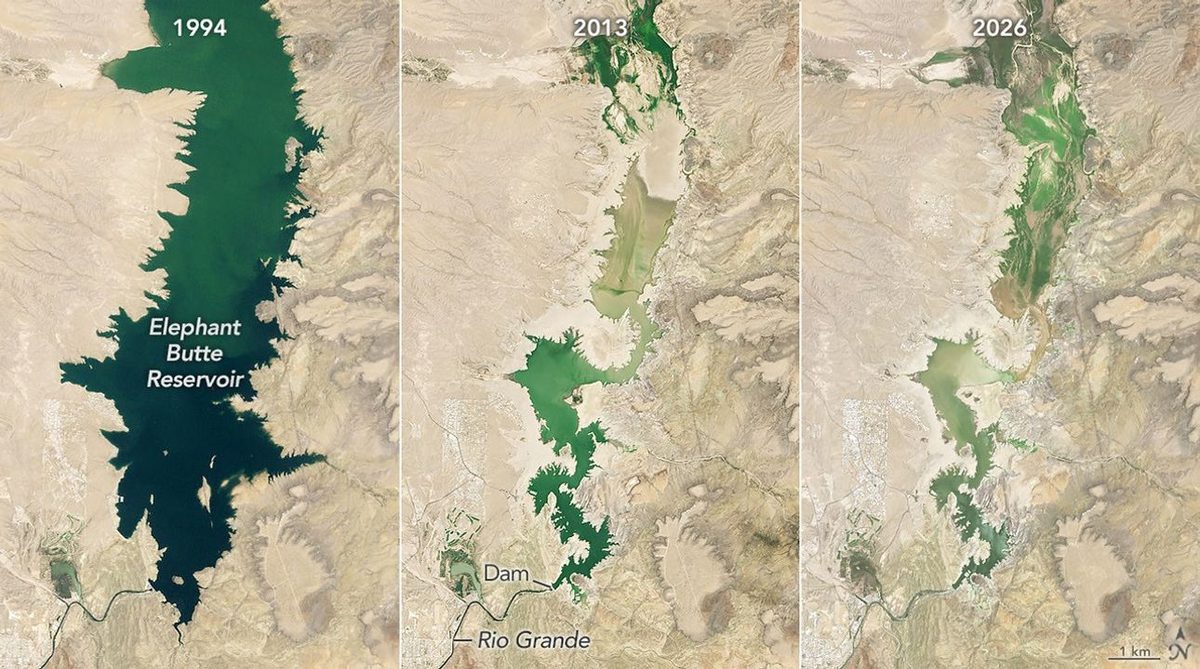
Elephant Butte Reservoir Runs Low - NASA Science
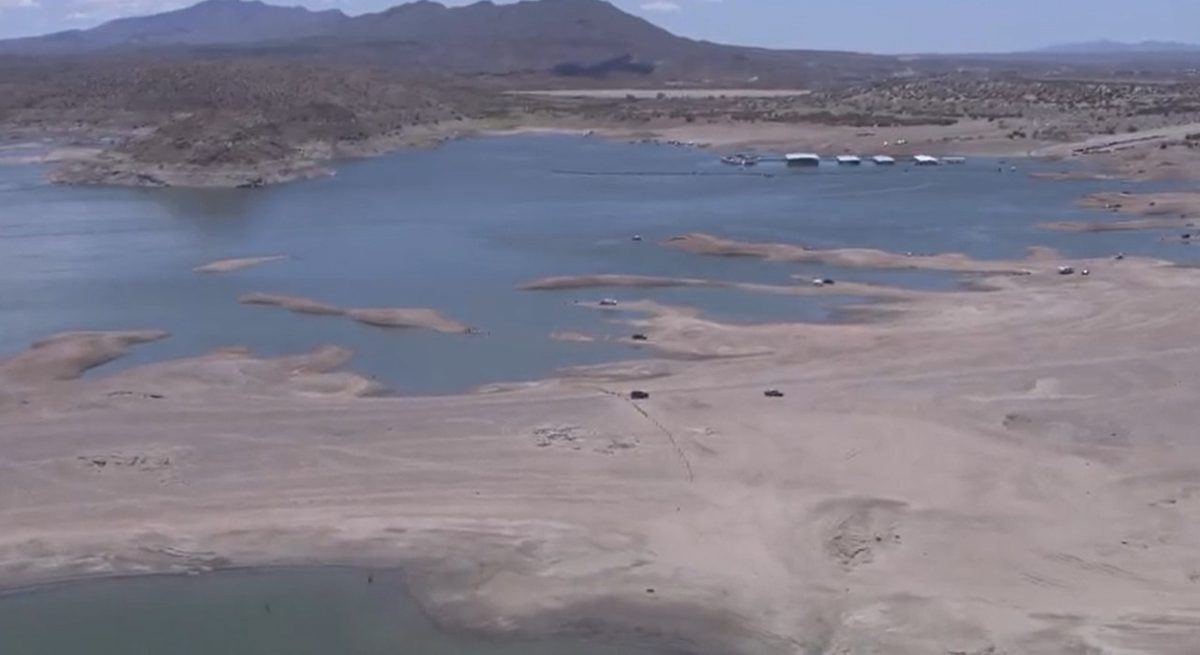
Low water levels at Elephant Butte leaves visitors concerned
Images from Openverse under Creative Commons licenses.
Voices
Curated perspectives — historical figures and your fellow readers.
Play
Exploring all sides of a story is often best achieved with Play.
Most of these play right now — no account needed. Sign up to save scores, keep a streak, and unlock Debate and Predict.
Log in
Sign Up
Higher or Lower
A number from this story, against one from elsewhere in the news — guess which is bigger, then keep the chain going. 5 rounds, 3 strikes; a miss costs a strike and resets your streak.
Example
Anchor
EU tariff revenue
$52B
Big for this kind of number
Mystery
Pentagon AI contract
?
Round 1
Streak: 0
Mystery
?
Keyboard: ↓/L lower · ↑/H higher
0 pts
Best streak: 0 · Rounds: 0
0 points — sign up to put that on the leaderboard.
Now try on this story
Timeline
New Mexico's largest reservoir falls to lowest level in 55 years
Order five events from this story, oldest at top. Each in the right slot scores 1 — neighbours within one slot count too. Your previous result — green ✓ for exact slots, yellow ~ for off by one. Cards now in true chronological order.
Loading puzzle…
Tap 💡 Free hint to lock the oldest into slot 1 — that leaves just four to order. Type pills are clues.
0/5
Exact slot
0/5
Within 1
Sign up to save your score and track a streak across stories.
Now try on this story
Connections
Sixteen names from the news. Find the four hidden groups of four. Four mistakes max.
Loading today's puzzle…
0/4 groups
Mistakes
Sign up to keep a daily streak — a new puzzle lands every day.
Now try on this story
Exit debate?
Your progress in this debate will be lost.
How it works
- 1 Two AI personas square off on this story.
- 2 You predict who'll win each round — correct picks earn XP.
- 3 One crossfire question is yours to fire. Pick it carefully.
Couldn't generate a topic
Select Your Champions
Choose one persona for each side of the debate
DEBATE TOPIC
Choose personas with different perspectives for a more dynamic debate.
SIDE A (PRO)
Select debater for this side:
No debate personas available right now.
SIDE B (CON)
Select debater for this side:
No debate personas available right now.
VS
Get ready to make your prediction...
Round of
Claim
Evidence
Stakes
Crossfire Answer
Closing Statement
Claim
Evidence
Stakes
Crossfire Answer
Closing Statement
Your Crossfire Question
Generating arguments...
Who's Got This Round?
Make your prediction before the referee scores
The referee scores both sides on
Correct predictions earn +20 XP
· Press 1 or 2 to pick
Evidence
40%
Logic
30%
Detail
20%
Style
10%
Round Results
Your Pick
Not this time
(%)
Overall Score
/10
Your Pick
Not this time
(%)
Overall Score
/10
Set the Crossfire
Pick the question both personas must answer in the final round
Crafting crossfire questions...
Choosing a question earns +10 XP crossfire bonus
🏆
Total XP Earned
Cred Change
Predictions
Debate Oracle! You called every round!
Sharp Instincts! You know your debaters!
The Coin Flip Strategist! Perfectly balanced!
The Contrarian! Bold predictions!
Inverse Genius! Try betting the opposite next time!
XP Breakdown
Base completion
+20 XP
Rounds played ( rounds x 5 XP)
+ XP
Correct predictions ( correct x 20 XP)
+ XP
Crossfire bonus
+10 XP
Accuracy
%
Prediction History
Round
You picked:
✓
✗
Now try on this story
Keep debating to level up your credibility and unlock achievements
People Involved
T
Trager
Owner of a lakeside business in Elephant Butte
Reported a 77 percent revenue drop from July to August 2026
JH
Jack Herrera
Journalist, Texas Monthly contributor
Spent a year traveling the Rio Grande from source to delta
H
Holcomb
City official in Elephant Butte, New Mexico
Pushed for a local disaster declaration and state aid
Organizations Involved
U.S. Bureau of Reclamation
Federal agency
Operates Elephant Butte Reservoir and manages Rio Grande water releases
Builds and operates dams and reservoirs across the western United States, including Elephant Butte.
New Mexico State Parks
State agency
Manages Elephant Butte Lake State Park amid falling water levels
Runs Elephant Butte Lake State Park, where falling water left boat ramps covered in sediment.
WW
NASA Western Water Action Office
Federal research program
Provides satellite data tools to water managers on the Rio Grande
Supports projects that give water managers satellite data on soil moisture, evapotranspiration, and river heights.
RG
Rio Grande Compact
Interstate water compact
Governs how Colorado, New Mexico, and Texas divide Rio Grande water
Signed in 1938 by Colorado, New Mexico, and Texas, dividing the Rio Grande's waters among the three states.
Timeline
July 2025 September 2026
9 events
Latest: 2 days ago
Tap a bar to jump to that date
-
Slow refill begins
Latest ContextBy September 4 the reservoir held about 27,621 acre-feet, up slightly from 27,278 at its low, as releases stayed off.
-
Report: reservoir at 1.4 percent, lowest since 1971
ReportScienceDaily reports Elephant Butte at 1.4 percent capacity, the lowest since 1971, as drought and record-early snowmelt strain Rio Grande supplies.
-
Local disaster declaration approved
Government ActionElephant Butte leaders approve a local disaster declaration and request state funds. The state emergency agency says the situation does not currently meet its disaster standard.
-
Reservoir hits 1.4 percent; releases stop
Critical EventElephant Butte reaches 1.4 percent capacity, its lowest since 1971. Agricultural water releases end that day, beginning a slow refill.
-
State Parks warns boat ramps hazardous
StatementNew Mexico State Parks announces debris clearing and adjusted ramp access. Bureau of Reclamation confirms releases continue through July 28.
-
Reservoir at 1.8 percent
ContextElephant Butte fell to 1.8 percent capacity, a week before its modern low.
-
Reservoir drops to 4.1 percent
ContextBy late June the reservoir had fallen to 4.1 percent capacity.
-
Spring runoff lifts reservoir to 12.8 percent
ContextSnowmelt raised the reservoir to about 12.8 percent capacity in late April, the seasonal high.
-
A year ago: reservoir at 3.7 percent capacity
ContextElephant Butte sat at 3.7 percent capacity, already near record lows after years of drought.
Historical Context
3 moments from history that rhyme with this story — and how they unfolded.
1930–1939
The Dust Bowl (1930s)
A decade of severe drought across the Southern Plains met decades of over-plowing and poor land management. Dust storms buried farms, crops failed, and millions left the region in the largest migration in U.S. history.
Then
Congress created the Soil Conservation Service, and federal water projects reshaped the West.
Now
The era fixed arid-land water law and dam-building policy that still govern reservoirs like Elephant Butte.
Why this matters now
It is the clearest precedent for drought and overuse compounding into crisis, and for how policy built in the aftermath still shapes western water today.
2000–present
Lake Mead's twenty-year decline (2000s–present)
Lake Mead, the largest reservoir in the United States, sat nearly full in 2000. A two-decade drought and over-allocation on the Colorado River drained it to about 27 percent capacity by 2022, exposing old boats, bodies, and a sunken town.
Then
Mandatory cuts hit Arizona, Nevada, and Mexico as the federal government declared shortages.
Now
The Colorado River crisis pushed states into renegotiating water rights and showed that even the largest reservoirs can run out faster than supply agreements assume.
Why this matters now
Elephant Butte faces the same forces on a smaller river: aridification plus legal over-allocation. The Colorado's slow collapse is a preview of what the Rio Grande's largest reservoir is now living through.
2012–2016
California drought and Lake Oroville (2012–2016)
California's worst drought on record drained Lake Oroville, its second-largest reservoir, to about 32 percent of capacity in 2016. The state ordered cities to cut water use by 25 percent.
Then
Farmers took land out of production, cities imposed conservation, and the state passed groundwater rules.
Now
A wet 2017 refilled Oroville, showing how quickly one good winter can reverse years of decline.
Why this matters now
It is the model for the optimistic Elephant Butte scenario: one wet winter across the Rockies could refill the reservoir and end the crisis within a season.
Sources
(8)Related Stories
US finalizes Colorado River plan forcing steep water cuts on three states
Rule Changes
Updated Aug 23
New Mexico builds out its renewable energy transmission grid
Built World
Updated Jun 12
Utah adds 450 elk hunting permits as drought strains herds
Rule Changes
Updated Yesterday
Army Corps grants permit for Louisiana's new deepwater container port
Built World
Updated Aug 26
Rhine water levels rebound at Kaub, easing barge load restrictions
Built World
Updated Aug 25
SunZia wind and transmission project
Built World
Updated May 27