How many births went through the program
In 2025, the first full year of Rx Kids, there were 980 live births in Flint — the denominator for the new mortality rate — and the program has enrolled essentially all eligible families, about 98% of them.
The mortality drop is measured against births in the city, so the number of births tells you how many families the program actually reached.
4 details3 sources2 disagreements
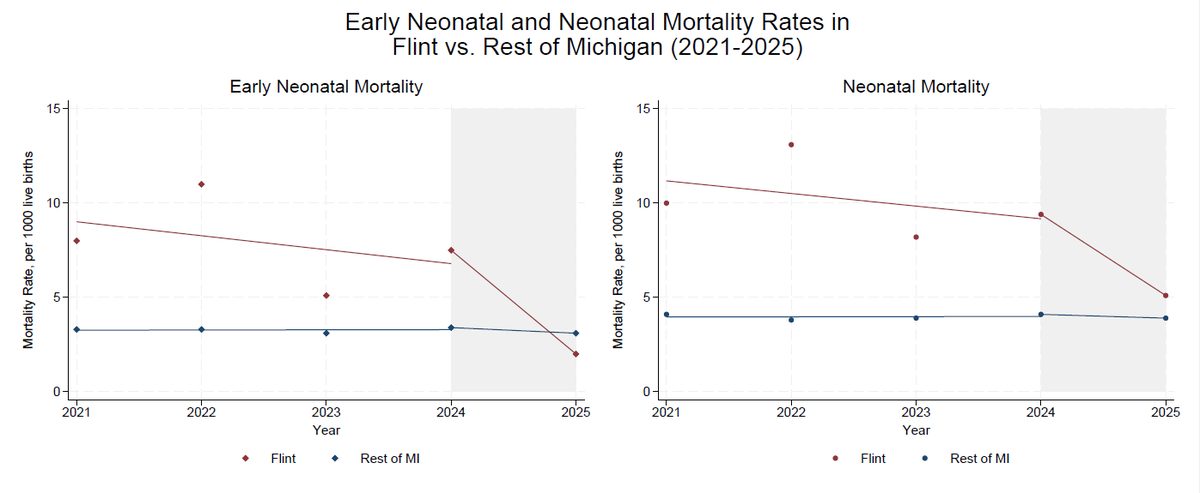
- Flint recorded 980 live births in 2025, per the JAMA Pediatrics analysis; among them were 5 neonatal deaths and 2 early neonatal deaths.
- From 2021 through 2024, before and during the program's first year, Flint had 4,036 births, with 41 neonatal deaths.
- Program uptake is near-universal: an estimated aggregate uptake rate of 100% and a prenatal uptake rate of 93%, per a Public Health Reports case study.
- Births in Flint rose about 9.7% in 2024 (94 additional babies) compared with 2023, the city's largest year-over-year increase in more than 25 years, while Michigan overall saw continued declines.
- The 2025 birth and death counts are provisional, and one or two deaths more or fewer would shift the rate noticeably, so the exact birth count and mortality decline may be revised, as Medical Daily notes.
- The 980 figure is births to Flint residents, not necessarily every birth covered by the program; the program's own uptake estimate is based on comparing participant counts with birth certificates and could not be matched at the individual level.
That doesn’t seem like enough to be statistically significant
You're right to be suspicious — with only 5 deaths in 980 births, the 50% drop is fragile; the study's real statistical claim is narrower: the gap with the rest of Michigan is no longer significant, meaning the remaining difference could easily be chance.
The headline number is real but the precision is low, so the public-health case for cash transfers rests as much on the bigger, more robust birth-outcome study as on the mortality count.
4 details4 sources2 disagreements
- Five deaths in 980 births puts the 95% confidence interval around Flint's 2025 neonatal rate at roughly 1.7 to 12 per 1,000 — a range that includes both zero and rates worse than Flint's pre-program average.
- The 2025 Flint-vs-state comparison came back not significant (early neonatal p=0.78, neonatal p=0.57), which is exactly what the researchers report: the disparity "lost statistical significance," not that the drop itself was proven.
- The first-week finding is the more striking one: 2 deaths versus an expected ~7.7 based on the 2021–2024 baseline, a decline that is statistically significant on its own (p≈0.04 for the Poisson comparison).
- A separate Lancet Public Health analysis of the same program — using birth records, not just deaths — found an estimated 18% reduction in preterm birth and 27% reduction in low birthweight, which is a much larger sample and gives the mortality result a plausible mechanism.
- The study authors argue the timing and size of the drop are consistent with a causal effect of the cash payments, but Nigel Paneth, an MSU epidemiologist not involved in the study, says the design can't rule out some other factor and the effect needs to be shown as generalizable before it's treated as real.
- With five deaths in the year, one or two fewer deaths would make the result much stronger and one or two more would erase it; the researchers call the finding preliminary and note the 2025 records are still provisional.