
Student reading and math scores hit record lows in PISA 2025
Rule ChangesOECD average reading and math scores fall to lowest levels ever recorded
Today: PISA 2025 results show record lowsNew here? Follow stories to track developments over time. Create a free account to get updates when stories you care about change.
Overview
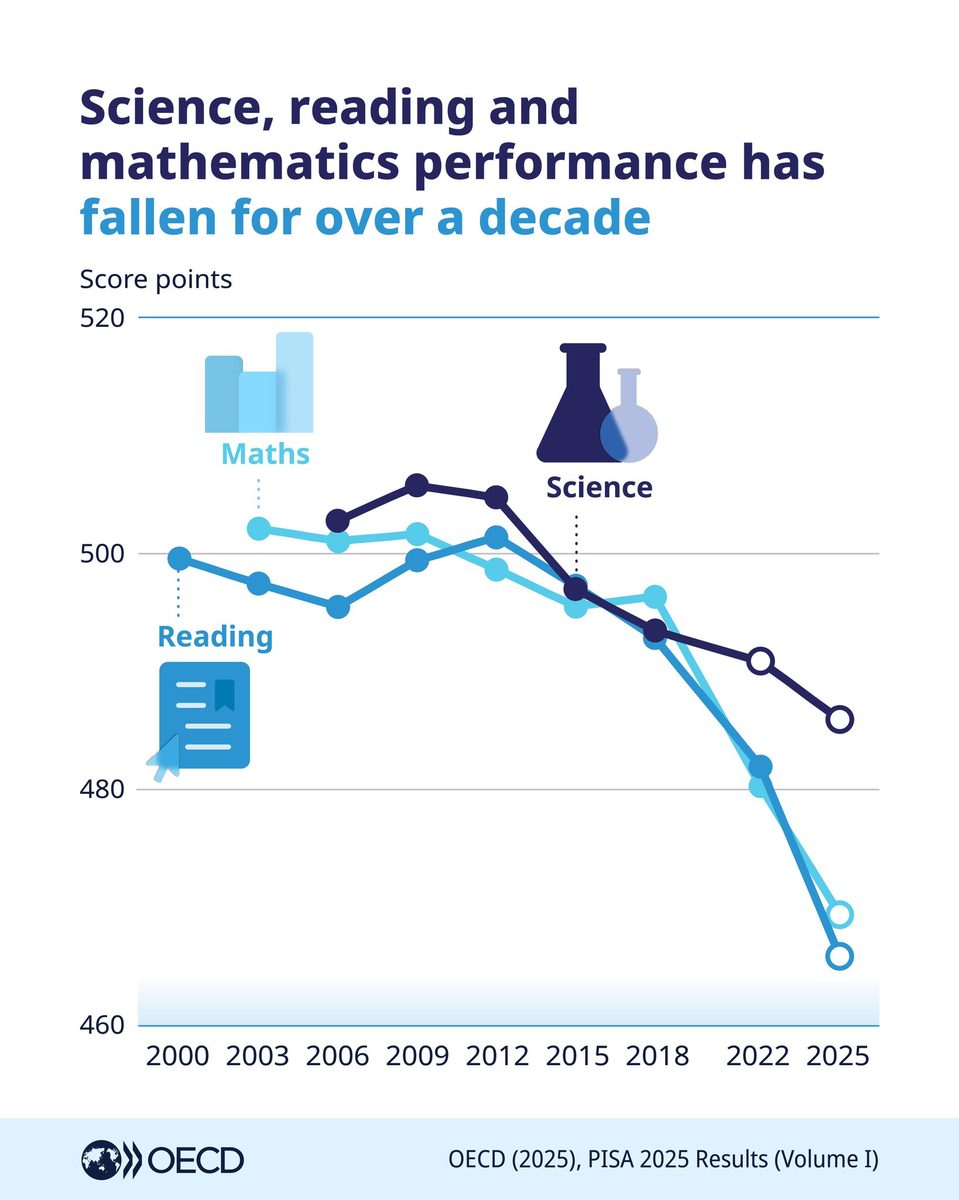
Updated 2 hours agoFifteen-year-olds across the developed world are reading and doing math worse than any cohort the OECD has measured. The 2025 PISA results, released Tuesday, show average reading scores fell 28 points across OECD countries since 2015, about a year and a half of learning. Math fell 22 points, just over a year.
The decline is broad but not universal. Singapore topped reading and placed second in math and science. Across the OECD, one in five students is now a low performer in all three subjects, up from 16% in 2022.
Digital distraction is a growing factor. More than one in four students said classmates were distracted by digital devices in most or every science lesson. The share of 'hasty readers' who rush through texts and answer quickly but incorrectly almost doubled between 2018 and 2025.
Why it matters
A generation of students is entering adulthood with weaker reading and math skills than their parents.
Questions about this story
Free account needed to ask — your question is kept and asked for you right after sign-up. Answers are public.
No questions yet — be the first to ask.
Key Indicators
Voices
Curated perspectives — historical figures and your fellow readers.
Play
Exploring all sides of a story is often best achieved with Play.
Higher or Lower
A number from this story, against one from elsewhere in the news — guess which is bigger, then keep the chain going. 5 rounds, 3 strikes; a miss costs a strike and resets your streak.
Keyboard: ↓/L lower · ↑/H higher
0 points — sign up to put that on the leaderboard.
Connections
Sixteen names from the news. Find the four hidden groups of four. Four mistakes max.
Sign up to keep a daily streak — a new puzzle lands every day.
Exit debate?
Your progress in this debate will be lost.
- 1 Two AI personas square off on this story.
- 2 You predict who'll win each round — correct picks earn XP.
- 3 One crossfire question is yours to fire. Pick it carefully.
Couldn't generate a topic
Select Your Champions
Choose one persona for each side of the debate
DEBATE TOPIC
Choose personas with different perspectives for a more dynamic debate.
Select debater for this side:
No debate personas available right now.
Select debater for this side:
No debate personas available right now.
Who's Got This Round?
Make your prediction before the referee scores
The referee scores both sides on
Round Results
Set the Crossfire
Pick the question both personas must answer in the final round
Debate Oracle! You called every round!
Sharp Instincts! You know your debaters!
The Coin Flip Strategist! Perfectly balanced!
The Contrarian! Bold predictions!
Inverse Genius! Try betting the opposite next time!
XP Breakdown
Prediction History
People Involved
Organizations Involved
The OECD is an intergovernmental organization of 38 member countries that promotes policies to improve economic and social well-being.
PISA measures 15-year-olds' skills in reading, math, and science every three years across dozens of countries.
Timeline
January 2000 September 2026
-
PISA 2025 results show record lows
Today AssessmentOECD average reading and math scores hit lowest levels ever recorded. Science stabilizes after a decade of decline.
-
PISA 2022 results show continued declines
AssessmentPrevious PISA cycle shows further drops, with pandemic disruptions cited as a factor.
-
Hasty readers begin to rise
TrendShare of students who rush through texts and answer quickly but incorrectly starts climbing.
-
Reading and math scores begin sharp decline
TrendOECD average reading and math scores start falling, a decline that accelerates over the next decade.
-
Science scores begin downward trend
TrendOECD science scores start a decline that continues through 2022 before stabilizing.
-
First PISA assessment launched
MilestonePISA measures reading, math, and science in 43 countries for the first time.
Historical Context
3 moments from history that rhyme with this story — and how they unfolded.
Germany's PISA shock (2000)
Germany's first PISA results placed it below the OECD average in reading, math, and science. The mediocre showing triggered a national debate about education quality and led to major reforms.
Germany introduced national education standards, expanded all-day schooling, and increased early childhood education funding.
German PISA scores improved in subsequent cycles, showing that assessment-driven reform can work.
Shows how PISA results can drive policy change when they shock the public and policymakers.
East Asian dominance in PISA 2012
Shanghai, Singapore, Hong Kong, and other East Asian systems dominated the top of PISA rankings, while OECD averages remained relatively stable.
The results sparked debates about education reform in Western countries and highlighted the success of East Asian education systems.
East Asian systems have maintained their lead, though even they show some declines in the 2025 cycle.
Contrasts with the current cycle, where even top performers show declines and OECD averages have fallen sharply.
US NAEP declines (2019-2022)
The National Assessment of Educational Progress showed the largest-ever drop in 9-year-old reading and math scores between 2019 and 2022, largely attributed to pandemic school closures.
The declines prompted federal and state responses, including tutoring programs and literacy initiatives.
Scores have not fully recovered, suggesting the losses may be persistent.
Parallels the PISA findings and suggests the decline is not limited to one assessment or country.
