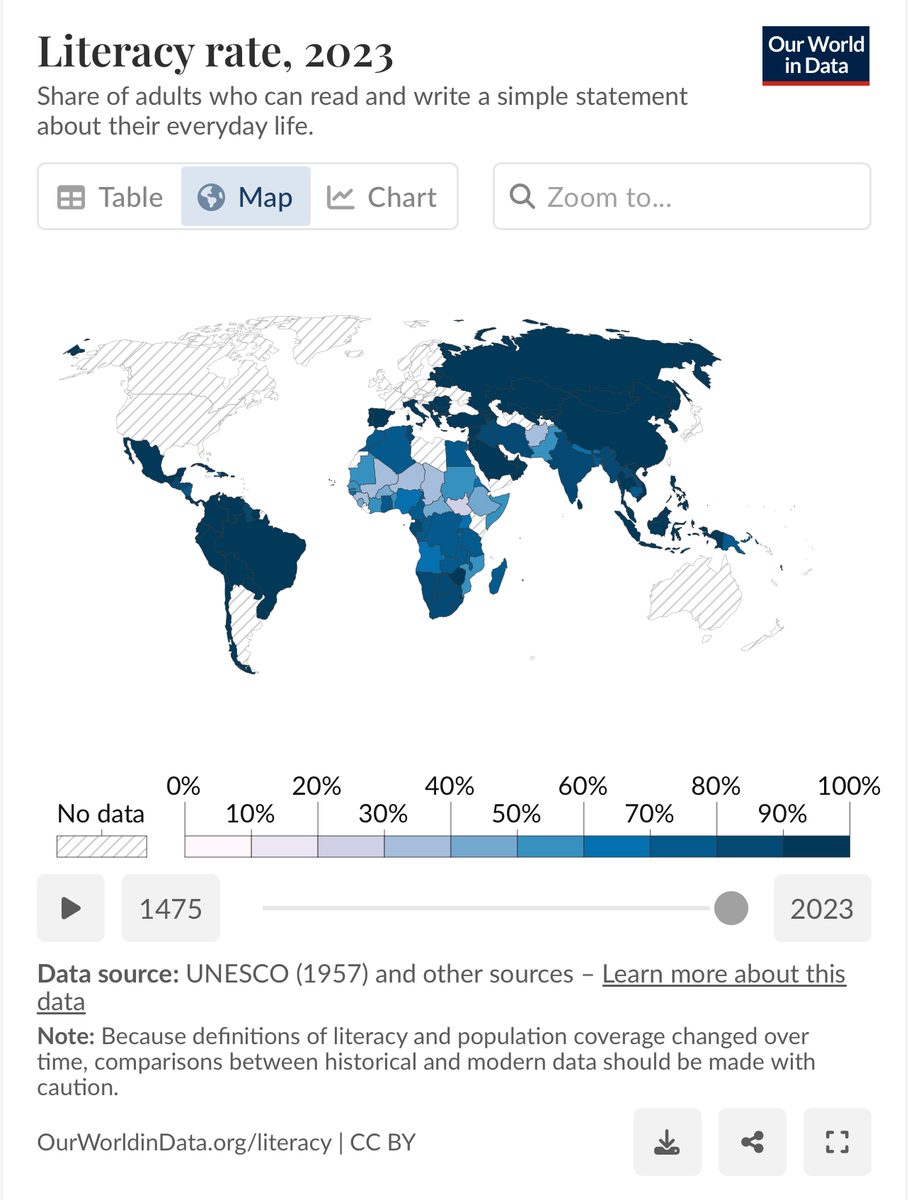
In 1820, roughly 88% of humanity could not read; today roughly 87% can. This shift, driven by two centuries of compulsory schooling laws, cheap printing, and global campaigns, gave more than 5 billion people a skill fewer than 100 million possessed then.
The transformation was neither inevitable nor uniform. Prussia pioneered mandatory education in the 1760s; the model spread through Europe, then globally after World War II when newly independent nations and international bodies made mass literacy a development priority. Yet 739 million adults remain illiterate today, concentrated heavily in sub-Saharan Africa and South Asia, where population growth outpaces educational expansion.
Questions about this story
Free account needed to ask — your question is kept and asked for you right after sign-up. Answers are public.
No questions yet — be the first to ask.
Key Indicators
12%
Global literacy rate in 1820
Roughly one in ten adults worldwide could read at the start of the industrial era.
87%
Global literacy rate in 2024
Nearly nine in ten adults can now read—a complete inversion from 200 years ago.
739M
Adults still illiterate
77% live in sub-Saharan Africa (225M) and Central/Southern Asia (347M).
93%
Youth literacy rate (2024)
Higher than adults, reflecting recent expansion of basic education.
UNESCO's founding program adopts combating illiteracy as a central mission, beginning coordinated international efforts.
August 1945
Korea's Literacy Transformation Begins
Case Study
South Korea starts with 22% adult literacy. Through aggressive school expansion, it reaches 72% by 1960—a model for rapid development.
January 1900
Global Literacy Reaches ~20%
Milestone
Literacy doubles from 1820 levels but remains concentrated in Europe and North America.
January 1882
France Implements Ferry Laws
Policy
Following defeat in the Franco-Prussian War, France mandates eight years of free, secular primary education.
January 1880
Britain Makes Schooling Compulsory
Policy
The UK completes its shift to mandatory education, following the Forster Act of 1870 and subsequent reforms.
January 1852
Massachusetts Enacts First U.S. Compulsory Education Law
Policy
Inspired by Prussian model, Massachusetts mandates attendance for children aged 8-14. All U.S. states follow by 1918.
January 1820
Global Literacy Estimated at 12%
Baseline
OECD estimates place worldwide literacy at roughly one in ten adults, with fewer than 100 million people able to read.
January 1763
Frederick the Great Expands Compulsory Education
Policy
The Generallandschulreglement mandates tax-funded schooling for all children aged 5-13, establishing a model that spreads across Europe.
January 1717
Prussia Mandates School Attendance
Policy
Frederick William I orders compulsory attendance at state schools—the first national system in Europe.
October 1517
Protestant Reformation Begins
Religious/Cultural
Luther's 95 Theses launch a movement that emphasizes individual Bible reading, creating theological demand for mass literacy.
January 1450
Gutenberg Develops Movable-Type Printing
Technology
Johannes Gutenberg's printing press enables mass book production, dropping costs dramatically and making texts accessible beyond elites.
Scenarios
1
Universal Literacy Achieved by 2050
Possible
Discussed by: UNESCO, World Bank, optimistic development economists
If current trends continue—literacy rising about 2 percentage points per decade—and if proven interventions like structured pedagogy (which boosts literacy rates by 46%) are scaled across sub-Saharan Africa and South Asia, the world could approach universal literacy within a generation. This scenario requires sustained international funding and political commitment in high-population, low-literacy regions.
2
Progress Stalls, Illiterate Population Grows
Possible
Discussed by: UNESCO data analysts, education researchers studying sub-Saharan Africa
Population growth in low-literacy regions could outpace educational expansion, as happened between 2015 and 2024 when sub-Saharan Africa's literacy rate rose from 65% to 69% but the absolute number of illiterate adults increased from 196 million to 225 million. Debt crises—African nations now spend 19% of GDP on debt servicing versus education—could accelerate this outcome.
3
Digital Leapfrog Accelerates Learning
Uncertain
Discussed by: Education technology advocates, development organizations
Mobile technology and AI-powered tutoring could enable developing regions to skip traditional school infrastructure, similar to how mobile banking leapfrogged traditional banking in Africa. Early evidence from programs like Teaching at the Right Level shows technology-assisted instruction can deliver 2.5 years of learning in one year. Widespread smartphone access could accelerate gains.
4
Regional Divergence: Two-Track World
Likely
Discussed by: World Bank analysts, comparative education researchers
Most regions achieve near-universal literacy while sub-Saharan Africa lags permanently, creating a bifurcated world. With 272 million children out of school globally—more than half in sub-Saharan Africa—and learning quality so poor that children gain only three years of learning from six years of schooling, the region could remain stuck while others advance.
Historical Context
3 moments from history that rhyme with this story — and how they unfolded.
1 of 3
1945-1970
South Korea's Literacy Miracle (1945-1970)
South Korea began 1945 with 22% adult literacy—a legacy of Japanese colonial education policy that restricted Korean-language instruction. The new government launched the 'Five-Year Project to Eradicate Illiteracy' (1954-58) and expanded schools rapidly: primary enrollment tripled and secondary enrollment grew eightfold between 1945 and 1960.
Then
Adult literacy reached 72% by 1960 and 88% by 1970. By 1961, South Korea had the highest educational attainment of any country at its income level.
Now
The educated workforce enabled the 'Miracle on the Han River'—South Korea's rapid industrialization. The country is now a high-income OECD member with 99% literacy.
Why this matters now
Demonstrates that rapid literacy transformation is possible within a single generation with sufficient political commitment and investment, even in very poor countries.
2 of 3
1763-1900
The Prussian Education Model (1763-1900)
Frederick the Great's 1763 decree mandated tax-funded schooling for all Prussian children aged 5-13, with state certification of teachers by 1810. The system emphasized standardized curriculum, trained teachers, and compulsory attendance enforced by the state.
Then
Prussia achieved near-universal primary education decades before other European nations, contributing to its military and industrial rise.
Now
The model spread globally: Austria adopted it in 1774, France after 1871, Britain by 1891, and the United States starting in 1852. It remains the template for public education systems worldwide.
Why this matters now
Shows how state-mandated universal education, once considered radical, became the global norm—and that institutional models can spread across political systems over time.
3 of 3
1450-1650
The Printing Press Revolution (1450-1650)
Gutenberg's press dropped the cost of a Bible from the equivalent of $10,000-$20,000 (hand-copied) to two to three weeks' wages for a skilled worker. Book production exploded from perhaps tens of thousands of volumes in 1450 to 15-20 million by 1500. European literacy rose from roughly 30% in 1440 to 47% by 1650.
Then
The Protestant Reformation spread rapidly via printed pamphlets—Luther's works alone accounted for a quarter of the 6-7 million pamphlets printed between 1520 and 1526.
Now
Printing democratized knowledge access, enabled the Scientific Revolution, and created the infrastructure for mass education. The technology remained dominant until digital media.
Why this matters now
Illustrates how a technology that reduces the cost of information distribution can trigger cascading social changes—relevant to current debates about digital tools for literacy.