


Pull to refresh
Logo
New Amazon killifish is named from three forest pools and proposed as endangered

New Amazon killifish is named from three forest pools and proposed as endangered

New Capabilities

Researchers describe Laimosemion laranja from southern Amapá and ask Brazil to widen a reserve to cover its habitat

Overview

Updated 1 hour ago

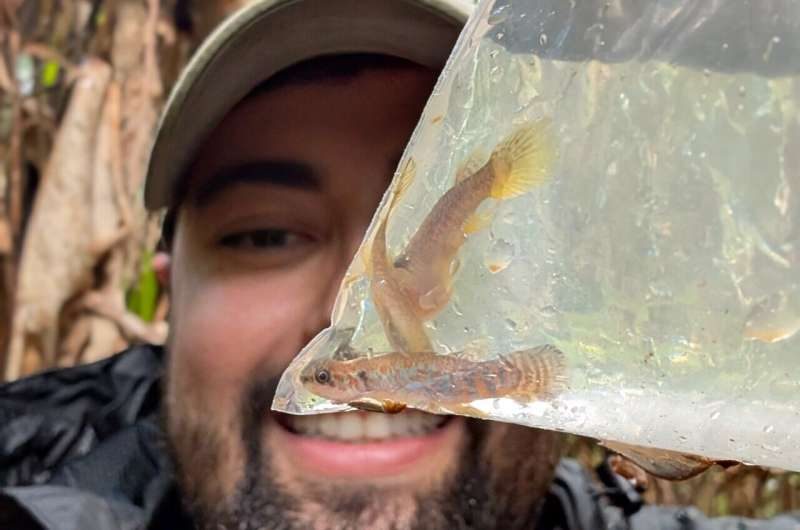
In three forest pools near Laranjal do Jari, in Brazil's Amapá state, researchers found a killifish less than three centimeters long with rows of orange spots along its front and bold chevrons near its tail. They named it Laimosemion laranja and, in the same paper, proposed that it be classified as endangered.

Its entire known range covers about 25 square kilometers. One pool sits near water discolored by mining sediment, another lies inside the city limits, and the third is about 180 meters from an electrical substation, so the fish's survival depends on decisions about a reserve boundary and a mining frontier rather than on anything the fish does.

Why it matters

Its known range is 25 square kilometers, so one road, mining pit or drained pool can decide whether the species survives.

Questions about this story

Free account needed to ask — your question is kept and asked for you right after sign-up. Answers are public.

No questions yet — be the first to ask.

Key Indicators

25 km²
Extent of occurrence
The total area spanned by the three known localities, as calculated by the study authors.
12 km²
Area of occupancy
The smaller footprint the authors used when applying International Union for Conservation of Nature criteria.
3
Known localities
All three sites show signs of human disturbance, from mining sediment to plastic pollution.
5.3%
Genetic distance from nearest relatives
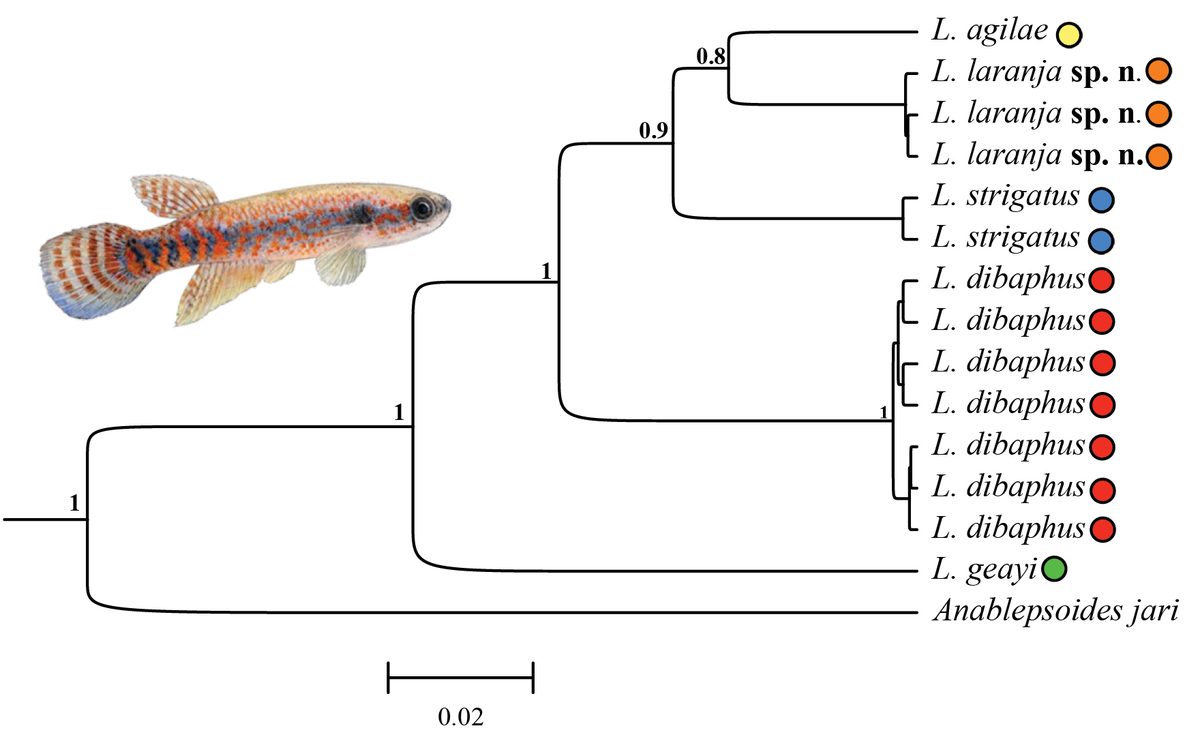
Divergence in the mitochondrial cox1 gene from Laimosemion agilae and L. strigatus.

Voices

Curated perspectives — historical figures and your fellow readers.

Sign up to generate historical perspectives on this story.

People Involved

Organizations Involved

Timeline

August 2026 November 2026

3 events Latest: Yesterday
  1. Pensoft summary of the discovery published

    Latest Publication

    Pensoft Publishers, which publishes Zoosystematics and Evolution, distributes an English-language summary of the paper.

  2. New species named in a taxonomy journal

    Research

    Morphology, skeleton and mitochondrial DNA separate the orange-marked fish from its closest relatives, formally naming Laimosemion laranja.

  3. Authors propose endangered status and a reserve extension

    Conservation

    Using a 25 square kilometer range and ongoing habitat decline, the team proposes listing the fish as endangered and widening the Rio Cajari Extractive Reserve.

Scenarios

1

Brazil expands the Rio Cajari Extractive Reserve to cover the fish's pools

Possible Resolves by End of 2028

Discussed by: The study authors, in their conservation recommendations

The authors recommend redrawing the reserve boundary to include the three known localities, but the decision belongs to Brazil's federal government and no proposal has been formally submitted. An expansion would put the pools under a protected regime that limits clearing and mining while allowing resident communities to keep extracting resources. Nothing in the record shows a decree in preparation.

2

Laimosemion laranja is formally listed as endangered in Brazil

Unlikely Resolves by End of 2028

Discussed by: The study authors, who applied International Union for Conservation of Nature criteria

The endangered classification in the paper is the authors' assessment, not an official listing. Formal inclusion would require Brazil's environment ministry to add the species to the national threatened species list during a review cycle. Listing brings legal protection on paper but no automatic habitat safeguards without an enforcement mechanism.

3

Surveys find the killifish inside the reserve, widening its known range

Possible Resolves by End of 2027

Discussed by: The study authors, who call for sampling inside and outside the reserve

The researchers recorded the fish on the reserve's edge but never collected inside it, and they consider it possible the population extends into protected territory. Follow-up sampling would either confirm that buffer or show the species is confined to the three disturbed pools. A wider range would soften the endangered case; a narrower one would harden it.

Historical Context

2 moments from history that rhyme with this story — and how they unfolded.

1973–1979

Snail darter and Tellico Dam (1973–1979)

Biologists found a small fish, the snail darter, in the Little Tennessee River in 1973. It was listed as endangered two years later, putting the Tennessee Valley Authority's nearly finished Tellico Dam in legal jeopardy. In 1978 the Supreme Court ruled 6-3 that the dam could not proceed while the fish's only known habitat would be destroyed.

Then

A federal committee created to weigh economic cost against extinction risk reviewed the case and allowed the dam; Congress then exempted Tellico by statute.

Now

The dam was completed in 1979, but other snail darter populations were later found and the fish was downlisted. The case established that a small, obscure species could stall a major federal project.

Why this matters now

It is the clearest precedent for what happens when a newly described fish with a tiny range meets infrastructure already moving.

November 2015

Fundão tailings dam failure (2015)

The Fundão tailings dam at the Samarco iron ore mine in Minas Gerais collapsed on November 5, 2015, releasing tens of millions of cubic meters of mining waste into the Doce River. The flood killed 19 people and buried the village of Bento Rodrigues.

Then

Sediment traveled hundreds of kilometers downstream to the Atlantic, and water supplies along the river were cut off.

Now

Fish and water quality in the Doce basin were affected for years, and the mine's owners faced billions of dollars in damages and litigation.

Why this matters now

The pools holding Laimosemion laranja already show reddish water and high suspended solids from mining, the same signature at a much smaller scale.

Sources

(6)