
Pull to refresh
Logo
Scientists reconstruct movies from mouse brain activity alone

Scientists reconstruct movies from mouse brain activity alone

New Capabilities

UCL team decodes 10-second clips from visual cortex neuron firing

Today: News outlets report the results

Overview

Updated 1 hour ago

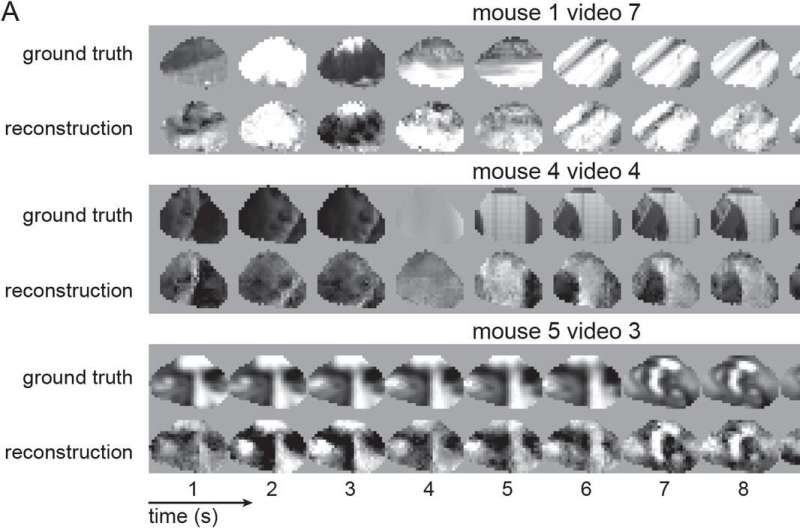
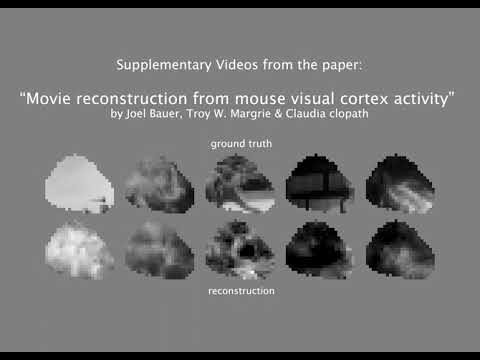
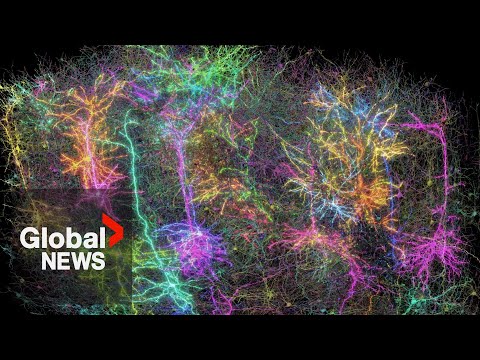
A team at University College London rebuilt 10-second videos of what mice watched, using only the firing of neurons in their visual cortices. The reconstructed clips run at 30 frames per second and match the originals at a pixel correlation of 0.57 — roughly double the accuracy of earlier single-trial reconstructions in awake mice.

The method inverts a neural encoding model trained to predict neuron activity from video. Starting from a blank movie, the team optimizes it until the model's predicted activity matches what was actually recorded from about 8,000 neurons per mouse. Because it works neuron-by-neuron, the technique offers a direct way to study how the brain reshapes visual input before it becomes perception.

Why it matters

Decoding what a brain sees from neuron firing gives researchers a direct tool to study perception — and another step toward brain-reading technology.

Questions about this story

Free account needed to ask — your question is kept and asked for you right after sign-up. Answers are public.

No questions yet — be the first to ask.

Key Indicators

0.57
Pixel correlation with original movies
Measured across all pixels and frames of 10-second clips; prior awake-mouse static reconstructions reached 0.238
8,000
Neurons recorded per mouse
Two-photon calcium imaging across a 630-by-630-micron area of visual cortex V1
28%
Quality gain from ensembling seven model instances
Averaging reconstructions across models removed high-frequency noise; most of the gain came from just two models
10 s at 30 Hz
Reconstructed movie length and frame rate
Ten natural movies reconstructed from five mice

Voices

Curated perspectives — historical figures and your fellow readers.

Ever wondered what historical figures would say about today's headlines?

Sign up to generate historical perspectives on this story.

People Involved

Organizations Involved

Timeline

August 2023 September 2026

3 events Latest: Today
  1. News outlets report the results

    Today News

    ScienceDaily and other science outlets cover the reconstruction of 10-second movies from mouse brain activity alone.

  2. eLife publishes the reconstruction study

    Publication

    Peer-reviewed paper reports single-trial reconstructions of 10-second movies at 30 Hz from mouse visual cortex activity, reaching 0.57 pixel correlation.

  3. Sensorium 2023 competition releases mouse V1 dataset

    Data Release

    The competition publishes paired natural movies and two-photon calcium recordings from roughly 8,000 neurons per mouse across 10 mice.

Scenarios

1

UCL team publishes findings on how mouse vision warps reality

Likely Resolves by Sep 16, 2027

Discussed by: The study authors themselves in the eLife paper, which names understanding deviations between neural representation and ground truth as the next goal

The team plans to use the reconstruction method to study how the visual processing pipeline skews and warps sensory input. A follow-up paper could quantify where the brain's representation diverges from the actual stimulus — for example, how arousal, running speed, or attention change what is encoded in V1.

2

Higher-resolution and wider-field reconstructions arrive

Likely Resolves by Sep 16, 2027

Discussed by: The eLife paper, which states the team plans to improve resolution and visual coverage of reconstructions

The team says the next technical step is data that supports higher resolution and wider coverage of the visual scene. This could involve recording more neurons across a larger area or improving the encoding model, pushing pixel correlation well above 0.57.

3

Approach extends to human single-cell recordings

Unlikely Resolves by Sep 16, 2028

Discussed by: Not directly predicted by the authors; speculative but supported by the eLife paper's emphasis on single-cell fidelity versus fMRI

The method requires single-neuron recordings, which are routine in mice but rare in humans. If applied to human single-cell or high-density recordings during surgery, it could offer far finer decoding than fMRI-based approaches. This faces clear regulatory and technical hurdles and is the most speculative outcome.

Historical Context

3 moments from history that rhyme with this story — and how they unfolded.

March 2008

Kay et al. identifying natural images from fMRI (2008)

Gallant's Berkeley lab showed that a computational encoding model could identify which of a set of natural images a person was viewing from their fMRI response. It was the first rigorous proof that visual content could be decoded from brain activity.

Then

Established the encoding-model-plus-inversion framework now used across visual decoding.

Now

Laid the methodological foundation that later movie reconstructions in both fMRI and single-cell settings built on.

Why this matters now

The UCL method follows the same framework — train a model to predict brain responses, then invert it — applied at the much finer scale of individual neurons.

October 2011

Nishimoto et al. movie reconstruction from fMRI (2011)

Jack Gallant's lab at UC Berkeley reconstructed continuous movie clips from human fMRI activity using voxel-wise encoding models. Participants watched Hollywood trailers in the scanner, and the team rebuilt approximate moving images from the brain scans.

Then

The Nature paper established that natural visual experiences, not just contrived stimuli, could be decoded from brain activity.

Now

It became the reference point for human fMRI-based visual reconstruction and inspired single-cell approaches.

Why this matters now

The UCL mouse study is the single-cell successor to this fMRI work, trading whole-brain coverage for the far finer detail of neuron-level recording.

2020

Yoshida and Ohki static image reconstruction in mice (2020)

Researchers reconstructed static images from awake mouse V1 neuron responses using two-photon imaging. Single-trial reconstructions reached a pixel correlation of about 0.238 over a roughly 43-degree visual field.

Then

Demonstrated single-cell image decoding in awake mice, though with limited fidelity.

Now

Set the accuracy baseline that later reconstruction work aimed to beat.

Why this matters now

The new movie reconstruction roughly doubles that correlation (0.57) while adding temporal dynamics — a direct, quantifiable advance over the prior state of the art.

Sources

(6)