
Pull to refresh
Logo
Daily Brief
Following
Why Sign Up
Supreme Court rules ISPs not liable for subscribers' copyright infringement

Supreme Court rules ISPs not liable for subscribers' copyright infringement

Rule Changes
By Newzino Staff |

Unanimous decision overturns $1 billion verdict against Cox Communications, redefining the boundaries of secondary copyright liability in the internet age

Yesterday: Supreme Court unanimously rules ISPs not liable

Overview

For more than a decade, major record labels have tried to make internet service providers pay for their subscribers' music piracy. On March 25, 2026, the Supreme Court shut that door unanimously. Justice Clarence Thomas, writing for a 9-0 court, held that a company providing internet service cannot be held liable as a copyright infringer simply because it knows some customers will use that service to download music illegally.

Why it matters

This ruling determines whether your internet provider must monitor and police what you download — and who pays when users pirate content.

Key Indicators

$1B
Jury verdict overturned
The 2019 jury awarded roughly $99,830 per work across more than 10,000 copyrighted songs — one of the largest copyright verdicts in U.S. history.
9-0
Unanimous decision
All nine justices agreed Cox was not liable, though Justices Sotomayor and Jackson wrote separately to criticize the majority's reasoning as overly broad.
10,017
Copyrighted works at issue
The number of songs the record labels claimed Cox subscribers illegally downloaded between 2013 and 2014.
$17.7B
U.S. recorded music industry revenue
The annual size of the domestic recorded music market affected by this ruling on secondary liability.

Interactive

Exploring all sides of a story is often best achieved with Play.

Ever wondered what historical figures would say about today's headlines?

Sign up to generate historical perspectives on this story.

Sign Up

Debate Arena

Two rounds, two personas, one winner. You set the crossfire.

People Involved

Organizations Involved

Timeline

  1. Supreme Court unanimously rules ISPs not liable

    Decision

    In a 9-0 decision, Justice Thomas writes that a company cannot be held liable as a copyright infringer for "merely providing a service to the public with knowledge that it will be used by some to infringe copyrights." The Court reverses the Fourth Circuit and holds that contributory liability requires intent — the provider must have either encouraged infringement or designed the service to facilitate it.

  2. Justices hear oral arguments, probe both sides

    Legal

    During oral arguments, justices from across the ideological spectrum express skepticism of both parties' positions. Justice Sotomayor notes the Court is "being put to two extremes." Justice Alito calls the labels' proposed remedies — such as throttling internet at colleges — unworkable.

  3. Supreme Court agrees to hear the case

    Legal

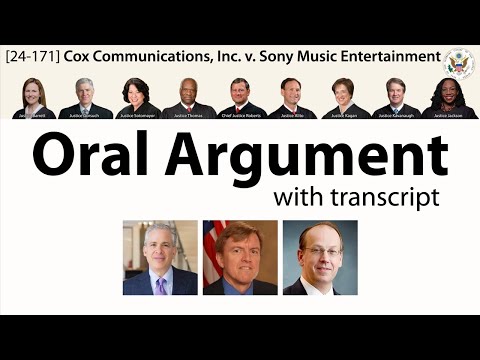
    The Supreme Court grants certiorari in Cox Communications v. Sony Music Entertainment (No. 24-171), agreeing to decide whether providing internet service to known infringers constitutes contributory copyright infringement.

  4. Fourth Circuit affirms liability, vacates damages

    Legal

    The Fourth Circuit Court of Appeals affirms the finding that Cox is contributorily liable but reverses the vicarious liability finding and vacates the $1 billion damages award, ordering a new trial on damages.

  5. Jury awards record labels $1 billion

    Legal

    A Virginia jury finds Cox liable for willful contributory infringement across 10,017 copyrighted works and awards approximately $1 billion in statutory damages — one of the largest copyright verdicts in U.S. history. The jury rejects vicarious liability claims.

  6. Major record labels file $1 billion suit against Cox

    Legal

    Sony Music Entertainment, Warner Music Group, Universal Music Group, and dozens of subsidiary labels sue Cox in the Eastern District of Virginia, alleging contributory and vicarious copyright infringement over more than 10,000 pirated songs.

  7. Fourth Circuit affirms Cox liability in BMG case

    Legal

    The Fourth Circuit Court of Appeals affirms Cox's contributory infringement liability in the BMG case, holding Cox had knowledge of infringement and materially contributed by continuing service. The court vacates the damages award on separate grounds.

  8. Cox loses first piracy trial, owes $25 million

    Legal

    A jury finds Cox liable for willful contributory infringement in the BMG case and awards $25 million. Internal emails reveal Cox employees routinely reinstated subscribers flagged for piracy.

  9. BMG sues Cox in precursor case

    Legal

    BMG Rights Management files suit against Cox Communications in the Eastern District of Virginia, alleging Cox failed to terminate subscribers repeatedly identified as copyright infringers by enforcement firm Rightscorp.

Scenarios

1

Music industry pivots to legislative push for ISP obligations

Discussed by: RIAA leadership, copyright law professors, and music industry trade publications

With the judicial path closed, the RIAA and major labels lobby Congress for legislation requiring ISPs to implement graduated response systems or subscriber-notification regimes. RIAA chairman Mitch Glazier's statement explicitly called on "policymakers" to act, signaling this is the industry's next move. Success depends on whether Congress prioritizes copyright enforcement over the telecom industry's lobbying power and First Amendment concerns raised by the ACLU and similar groups.

2

Labels invest in technological enforcement over legal strategies

Discussed by: Copyright attorney Michael Friedland, technology analysts, and digital rights advocates

As attorney Michael Friedland noted after the ruling, "the copyright infringement problem is a technological problem" and "the industry is going to have to solve the problem itself." Labels accelerate investment in content-identification technology, watermarking, and platform-level enforcement agreements rather than pursuing ISPs. This approach mirrors the industry's post-Napster pivot to licensing deals with streaming platforms, which ultimately proved more profitable than litigation.

3

Future plaintiffs test Sotomayor's 'aiding and abetting' theory

Discussed by: Legal scholars, SCOTUSblog analysts, and intellectual property attorneys

Justice Sotomayor's concurrence explicitly flagged that the Court's precedents "have left open the possibility that other common-law theories, such as aiding and abetting, could apply in the copyright context." Copyright holders may attempt to bring future cases under an aiding-and-abetting theory rather than contributory infringement, potentially targeting ISPs or platforms that take more active steps to facilitate infringement than Cox did. This would require developing new legal arguments not foreclosed by the Thomas majority.

4

Ruling emboldens ISPs to relax repeat-infringer policies

Discussed by: Digital rights organizations, telecom industry analysts, and copyright enforcement firms

With the Supreme Court holding that providing service to known infringers does not create liability, ISPs may feel less pressure to terminate subscribers accused of piracy. The ruling does not affect the separate requirement under the DMCA that ISPs must have a repeat-infringer policy to qualify for safe harbor protection — but with the billion-dollar liability threat removed, the financial incentive to enforce those policies aggressively diminishes significantly.

Historical Context

Sony Corp. v. Universal City Studios — the 'Betamax case' (1984)

January 1984

What Happened

Universal Studios sued Sony, arguing that the Betamax VCR enabled consumers to record copyrighted television programs. In a 5-4 decision, the Supreme Court ruled that Sony was not liable for contributory infringement because the VCR was "capable of substantial noninfringing uses." Justice John Paul Stevens wrote the majority opinion establishing the staple article of commerce doctrine in copyright law.

Outcome

Short Term

The home video recording industry survived, and VCR sales boomed. Studios initially feared revenue losses but soon earned billions from home video sales and rentals.

Long Term

The decision established the foundational principle that technology providers are not liable for users' infringement when the technology has substantial lawful uses — a principle that shaped internet law for decades.

Why It's Relevant Today

Cox's core argument echoed Sony/Betamax: internet service, like a VCR, has overwhelmingly lawful uses and should not create liability simply because some users employ it for infringement. Justice Thomas's opinion built on this foundation, requiring intent to facilitate infringement rather than mere knowledge of it.

MGM Studios v. Grokster (2005)

June 2005

What Happened

The Supreme Court unanimously held that Grokster and StreamCast, makers of peer-to-peer file-sharing software, could be liable for inducing copyright infringement. Unlike the neutral VCR in the Betamax case, evidence showed Grokster actively courted former Napster users, marketed itself as a piracy tool, and derived advertising revenue tied to the volume of infringing downloads.

Outcome

Short Term

Grokster shut down and paid $36 million to settle with the record labels. The peer-to-peer file-sharing era effectively ended as a mainstream consumer phenomenon.

Long Term

The decision created the "inducement" standard for secondary copyright liability — a provider that distributes technology with the object of promoting infringement is liable, regardless of whether the technology has lawful uses.

Why It's Relevant Today

The Thomas majority in Cox v. Sony drew directly on the Grokster inducement standard, holding that contributory liability requires either encouragement of infringement or a service designed to facilitate it. Cox, unlike Grokster, never marketed its internet service as a tool for piracy.

Roadshow Films v. iiNet — Australia's ISP liability ruling (2012)

April 2012

What Happened

Australia's High Court ruled unanimously that ISP iiNet was not liable for "authorizing" subscribers' copyright infringement through BitTorrent. The court found that providing internet access — even with knowledge that some subscribers used it for piracy — did not constitute authorization of infringement under Australian copyright law. iiNet could disconnect users but could not prevent specific infringements.

Outcome

Short Term

Australian ISPs were shielded from copyright damages. The entertainment industry pivoted to seeking site-blocking injunctions against specific piracy websites rather than suing ISPs.

Long Term

Australia passed the Copyright Amendment (Online Infringement) Act in 2015, creating a legislative framework for courts to order ISPs to block foreign piracy websites — addressing infringement through targeted injunctions rather than broad ISP liability.

Why It's Relevant Today

The iiNet ruling is the closest international parallel to Cox v. Sony, reaching the same conclusion through different legal reasoning. Both courts held that merely providing internet connectivity, even to known infringers, does not make the ISP liable. Australia's post-ruling legislative response — site-blocking rather than ISP liability — may preview the path the U.S. music industry now pursues.

Sources

(10)