
Pull to refresh
Logo
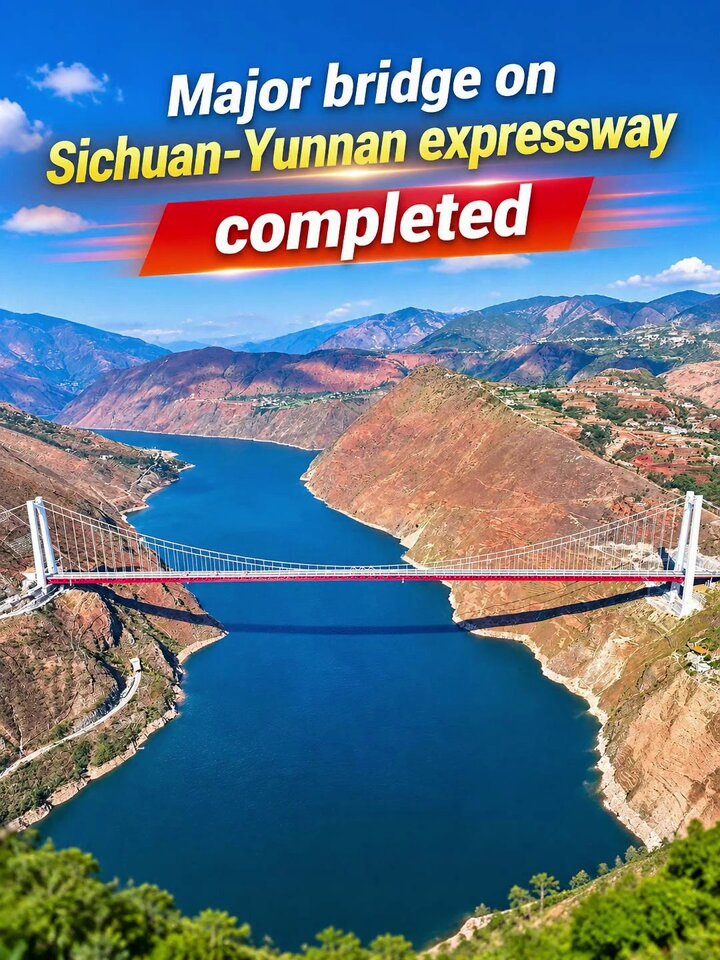
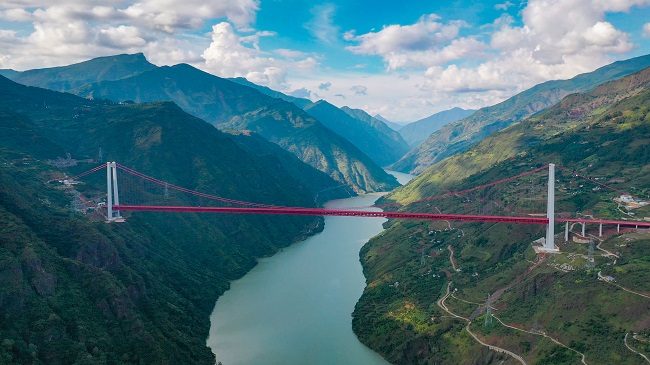
China completes 1,060-meter-span suspension bridge over Jinsha River canyon

China completes 1,060-meter-span suspension bridge over Jinsha River canyon

Built World

The four-lane crossing links Ningnan in Sichuan with Qiaojia in Yunnan and is a control point on the Yibin–Panzhihua Expressway.

Overview

Updated 1 hour ago

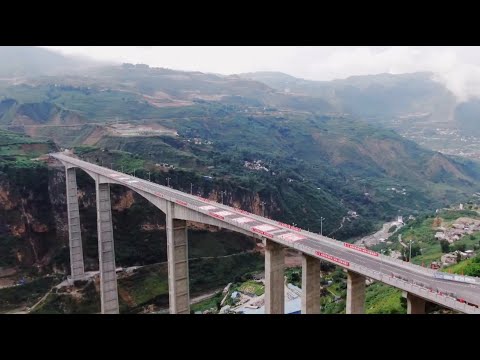
Seventy-two dump trucks, each loaded to 35 tonnes, parked across a new bridge over the Jinsha River on Nov. 20. The deck held, and the 1,140-meter crossing between Ningnan County in Sichuan and Qiaojia County in Yunnan was declared complete.

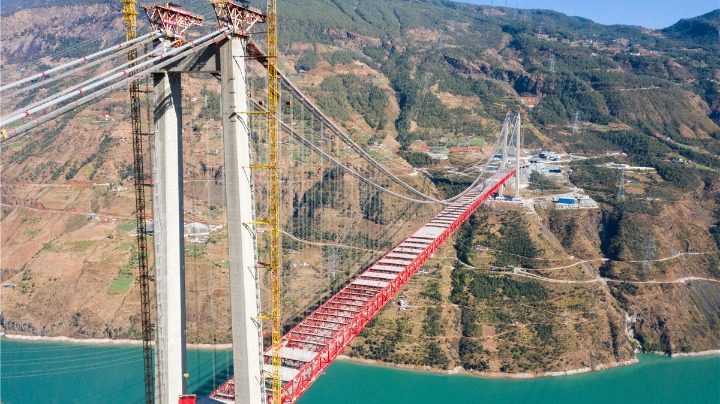
The 1,060-meter main span is the first in China to combine a kilometer-scale steel truss suspension deck with a deep reservoir, a complex canyon wind field and an ultra-high seismic zone. The bridge is a control point on the 446-kilometer Yibin–Panzhihua Expressway, meant to cut the drive between those Sichuan cities from about 10 hours to about 6.

Why it matters

Canyon wind, active faults and deep reservoir water once ruled out 1,000-meter spans in western China. This bridge says they no longer do.

Questions about this story

Free account needed to ask — your question is kept and asked for you right after sign-up. Answers are public.

No questions yet — be the first to ask.

Key Indicators

1,060 m
Main span
The single suspended span between the two towers.
1,140 m
Total bridge length
Full crossing, including the sections beyond the main span.
72
Trucks in the load test
35-tonne dump trucks placed in the maximum-load configuration before completion.
446 km
Yibin–Panzhihua Expressway length
Three sections; the bridge sits on the Jinyang–Ningnan stretch.
16
Patents from the section's bridge and tunnel work
Alongside five specialized construction methods, per the project.
10 hrs → 6 hrs
Projected Yibin–Panzhihua drive time
Expected once the full expressway opens.

Voices

Curated perspectives — historical figures and your fellow readers.

Sign up to generate historical perspectives on this story.

People Involved

Organizations Involved

Timeline

2 events Latest: Today
  1. Jinsha River bridge completed after 72-truck load test

    Today Completion

    Seventy-two 35-tonne trucks loaded the deck in the maximum-load case. The four-lane crossing is the key control point on the Jinyang–Ningnan section.

  2. Ningqiao tunnel breaks through on both bores

    Construction

    The 9,069-meter and 9,103-meter bores finished. The tunnel passes about 17 meters above the rock anchor that holds the bridge's cables.

Scenarios

1

Full Yibin–Panzhihua Expressway opens to traffic by end of 2027

Likely Resolves by End of 2027

Discussed by: Project authorities quoted by Xinhua and China News Service, who describe the bridge as paving the way for the expressway's full opening

The Jinsha crossing and the 9-kilometer Ningqiao tunnel, the two hardest structures on the Jinyang–Ningnan section, are finished. What remains is the rest of the 446-kilometer corridor, including the Ningnan–Panzhihua stretch. Finishing that work and clearing provincial inspections opens the route and delivers the six-hour drive.

2

Jinyang–Ningnan section opens to traffic first, bridge included

Possible Resolves by Q2 2027

Discussed by: Regional transport coverage around the completion, which reports on the section as its own opening milestone

With its bridge and tunnel done, the section could open independently of the full corridor. Drivers would get the new Jinsha crossing years before the expressway is finished, with through-traffic spilling onto local roads at either end of the section.

3

Full opening slips past 2027

Unlikely Resolves by End of 2027

Discussed by: The schedule gap in state coverage, which gives no opening date for the full corridor

Coverage of the completion announces no opening date for the whole expressway, and the Ningnan–Panzhihua stretch has no completion announcement. If that remaining work runs long, the six-hour drive does not arrive in 2027 and the new bridge feeds a road that stops short.

Historical Context

3 moments from history that rhyme with this story — and how they unfolded.

Opened late 2018

Luding Dadu River Bridge (2018)

The 1,411-meter suspension bridge, with a 1,100-meter main span, crosses the Dadu River gorge on the Yakang Expressway. It sits where the Longmenshan and Xianshuihe fault zones meet, and canyon gusts reach 32.6 meters per second, the equivalent of force-12 wind, hitting the deck at steep angles. Designers tested a 1:2000 scale terrain model in a wind tunnel and used hinged, energy-dissipating central buckles plus corrugated steel webs in the concrete towers.

Then

The bridge opened to traffic and cut hours off the route into western Sichuan.

Now

It set the working playbook for kilometer-scale suspension bridges in Sichuan's canyons: terrain-model wind testing, dampers and shear links tuned to both wind and earthquakes.

Why this matters now

The Jinsha River bridge is the next step in the same program, adding a deep reservoir and an even higher seismic design load to the canyon-wind problem.

Steel girder closure October 2020

Lixiang Railway Jinsha River Bridge (2020)

The world's first long-span suspension bridge built only for rail crosses the Jinsha River in the Tiger Leaping Gorge area, 250 meters above the water, with a 660-meter main span and towers to 194.5 meters. Engineers weighed 27 possible crossing sites over roughly a decade. The deck has to carry single-track trains whose weight per meter matches an eight-lane highway, under force-10 canyon winds and an 80-meter reservoir drawdown requirement.

Then

Steel girder closure in October 2020 completed the main structure of the line's key control point.

Now

It showed that suspension spans in this gorge could carry railway loads, widening options for mountain rail routing.

Why this matters now

Same river, same wind and fault conditions, heavier loads. It marks how far canyon suspension design had come before the highway crossing finished this month.

June 2025 (design paper)

Taoyuan Jinsha River Bridge (design published 2025)

On the Dali–Yongsheng Expressway, engineers built a steel box girder suspension bridge 100 to 150 meters from an active Holocene fault, in seismic intensity zone VIII, over a deep reservoir. They put four sets of liquid viscous dampers at the girder ends, rated at 2,000 kilonewton-seconds per meter with a velocity index of 0.3 and plus-or-minus 760 millimeters of travel, and used a lightweight flat steel box girder.

Then

The dampers cut the required expansion joint from 3,200 millimeters to 1,520 millimeters, lowering bearing and joint costs.

Now

The published design gives other canyon crossings a tested template for holding a long deck in place during a nearby earthquake.

Why this matters now

It explains the engineering that makes a 1,060-meter span viable in a high-intensity seismic zone like the Ningnan–Qiaojia crossing.

Sources

(7)