




Pull to refresh
Logo
South Korea test-launches first domestically developed hypersonic glide vehicle

South Korea test-launches first domestically developed hypersonic glide vehicle

New Capabilities

President Lee Jae-myung watched the flight, which comes amid rising inter-Korean tensions after a September land mine blast injured soldiers near the border

Today: South Korea conducts first HGV test launch

Overview

Updated 1 hour ago

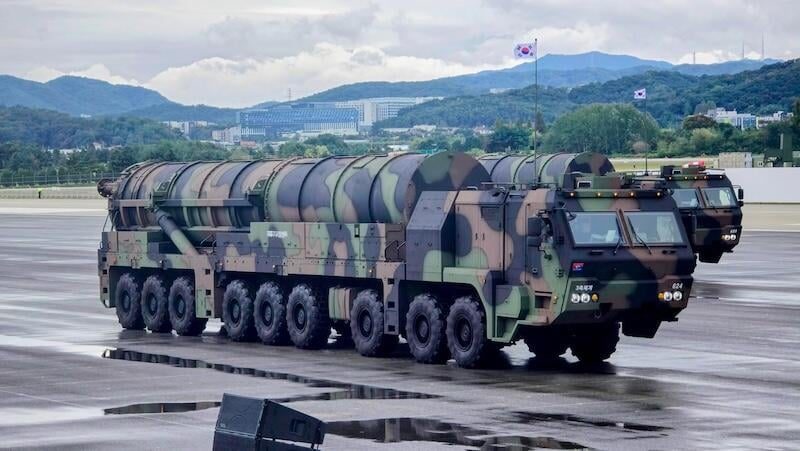
South Korea launched its first domestically developed hypersonic glide vehicle (HGV) on October 8, with President Lee Jae-myung watching from the test site. The weapon climbed to altitude on a booster, separated, then dropped to low altitude and maneuvered both vertically and horizontally before striking its target at more than five times the speed of sound.

The test gives Seoul a new class of weapon that conventional missile defenses struggle to track and intercept. It comes weeks after a land mine explosion on the South Korean side of the border, which Seoul attributed to North Korean mines, injured soldiers and pushed the two Koreas into their sharpest standoff in months.

Why it matters

South Korea can now develop a low-altitude, hypersonic maneuverable weapon, adding a new deterrent against North Korean missile threats on the peninsula.

Questions about this story

Free account needed to ask — your question is kept and asked for you right after sign-up. Answers are public.

No questions yet — be the first to ask.

Key Indicators

Mach 5+
Flight speed threshold
Hypersonic speed (1.7 km/s) achieved during the glide phase; conventional fighter jets top out at Mach 2-3.
1
HGV flight tests completed
First successful test launch of the homegrown system, conducted October 8, 2026.
130 km
Test site distance from Seoul
Launch took place on a barge at the Agency for Defense Development test center in Taean.

Voices

Curated perspectives — historical figures and your fellow readers.

Ever wondered what historical figures would say about today's headlines?

Sign up to generate historical perspectives on this story.

People Involved

Organizations Involved

Timeline

September 2026 October 2026

4 events Latest: Today
Tap a bar to jump to that date
  1. South Korea conducts first HGV test launch

    Today Test

    Domestically developed hypersonic glide vehicle separates from booster, descends to low altitude, maneuvers vertically and horizontally, and strikes target at Mach 5+. President Lee observes in person.

  2. South Korean military detonates blast site during mine clearance

    Military

    The military removes North Korean mines found south of the boundary and detonates the blast site as an initial response. Seoul concludes North Korean mines caused the September explosions.

  3. Lee pushes faster hypersonic weapons development

    Policy

    At a Cabinet meeting, Lee calls for picking up speed on nuclear-powered submarines and hypersonic missiles, calling them key to self-reliant defense.

  4. Land mine explosion injures South Korean soldiers

    Incident

    Explosion on the South's side of the Military Demarcation Line injures soldiers. Seoul later attributes it to North Korean mines planted in violation of the armistice agreement.

Scenarios

1

South Korea advances HGV to weaponization, mass production by late 2030s

Possible Resolves by End of 2037

Discussed by: Shin Jong-woo, secretary-general of the Korea Defense and Security Forum

The successful test confirms the HGV passed exploratory development, moving the program into weaponization. Production could begin in the mid-to-late 2030s. This outcome depends on continued flight testing, integration with launch platforms, and sustained defense budget support for the Lee administration's self-reliant defense push.

2

North Korea escalates missile activity after Seoul's HGV test

Likely Resolves by Q2 2027

Discussed by: Yonhap News Agency reporting on regional hypersonic arms race

North Korea, along with China and Russia, is already devoting full resources to hypersonic missile development. Seoul's test could prompt Pyongyang to respond with additional missile launches, including its own hypersonic tests, raising tensions further after the September land mine incident. The regional missile race accelerates as both Koreas field ever more advanced weapons.

3

HGV deployment slips past projections amid integration hurdles

Unlikely Resolves by End of 2032

Discussed by: Defense analysts tracking South Korea's acquisition programs

Technical challenges in mass production, thermal protection materials, or integration with existing launch platforms could delay deployment beyond current projections. Budget constraints from competing defense priorities, including nuclear submarines and reconnaissance drones, could also slow the program. In this scenario, the HGV remains a development program through the early 2030s without reaching operational forces.

Historical Context

2 moments from history that rhyme with this story — and how they unfolded.

September 2021

North Korea's Hwasong-8 hypersonic test (September 2021)

North Korea announced tests of the Hwasong-8, its first hypersonic glide vehicle, claiming the system would substantially enhance the country's strategic deterrence. The test put Pyongyang among the few nations fielding hypersonic weapon technology.

Then

North Korea continued developing hypersonic weapons through additional tests in 2022, while Seoul and Tokyo accelerated their own missile defense planning.

Now

North Korea's hypersonic program became a central driver of the regional arms race, prompting South Korea to launch its own HGV development effort.

Why this matters now

South Korea's October 2026 HGV test is a direct response to North Korea's earlier hypersonic advances, closing a technological gap that has shaped the peninsula's military balance.

May 2021

End of U.S. missile guidelines for South Korea (2021)

The United States and South Korea agreed to terminate all missile guidelines that had limited Seoul's missile range to 180 kilometers under a 1979 agreement. Subsequent revisions had extended the range to 800 kilometers in 2012 and removed warhead weight limits in 2017.

Then

South Korea gained full freedom to develop and field ballistic missiles without U.S. range or payload restrictions.

Now

The removal of restrictions enabled South Korea's rapid advancement of missile technology, including the hypersonic glide vehicle tested in 2026.

Why this matters now

The HGV test is the culmination of South Korea's post-2021 missile development freedom, a capability that was formally impossible for decades under U.S. restrictions.

Sources

(8)