

Pull to refresh
Logo
Materials built from rods and motors crawl and walk on their own

Materials built from rods and motors crawl and walk on their own

New Capabilities

Two studies from Amsterdam, Cambridge and Sydney show how nonreciprocal buckling makes motion repeat, and why more activity can leave a lattice less responsive

Overview

Updated 19 minutes ago

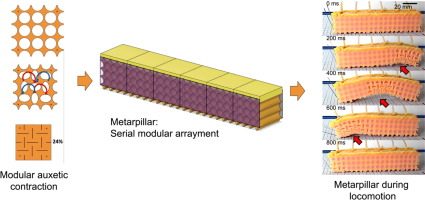
Put small motors at the joints of a chain of rods, and the chain starts to move by itself. It buckles, snaps through, and snaps back, again and again, in a cycle that looks like crawling or digging.

The same team built a second structure, a flat lattice of rods and motors, and found the opposite of what engineering intuition predicts. Making individual elements more active can leave the whole lattice less responsive. Activity only spreads if the active parts form a connected path.

Why it matters

Materials that move on internal energy could let soft robots work where tethers, rigid joints and central controllers do not fit.

Questions about this story

Free account needed to ask — your question is kept and asked for you right after sign-up. Answers are public.

No questions yet — be the first to ask.

Key Indicators

2
Peer-reviewed papers
One in the Proceedings of the National Academy of Sciences, one in Physical Review X.
3
Research institutions
University of Amsterdam, University of Cambridge and University of New South Wales.
3
Locomotion modes demonstrated
Crawling, walking and digging, all produced by self-snapping filaments.

Voices

Curated perspectives — historical figures and your fellow readers.

Sign up to generate historical perspectives on this story.

People Involved

Organizations Involved

Timeline

April 2026 November 2026

3 events Latest: 2 days ago
  1. ScienceDaily reports both studies together

    Latest Coverage

    The report links the buckling and percolation results as one program on active materials.

  2. Nonreciprocal buckling paper appears in PNAS

    Research

    Motors at rod joints break symmetry so a chain keeps buckling and snapping instead of stopping after one flip.

  3. Lattice study finds more activity can mean less response

    Research

    Physical Review X publishes experiments and theory showing macroscale active response can vanish as microscopic activity rises.

Scenarios

1

A self-snapping chain powers an untethered soft robot

Likely Resolves by Q2 2028

Discussed by: The PNAS authors, who describe crawling, digging and walking as uses of self-snapping

The paper demonstrates the motion in free-standing filaments that need no tether and no external controller. The next step is packaging a chain into a robot that carries its own power supply and can be steered.

2

An independent lab reproduces the effect in a three-dimensional lattice

Possible Resolves by End of 2028

Discussed by: The Physical Review X authors, who note the localized modes exist in any dilute periodic structure

The published result comes from flat, two-dimensional networks. Whether the same percolation threshold governs a three-dimensional solid, where localized modes have more room to form, is the obvious test.

3

A material switches between collective response and near-silence

Possible Resolves by Q2 2030

Discussed by: The Amsterdam team, in comments to phys.org about future work

The percolation result suggests a control knob that does not require changing how hard any element pushes. Change the connectivity and the whole material's large-scale response appears or disappears. The team says future studies could switch between the two states.

Historical Context

3 moments from history that rhyme with this story — and how they unfolded.

1884

Le Chatelier's principle (1884)

The French chemist Henri Louis Le Chatelier described how a system at equilibrium shifts in the direction that opposes a disturbance. Engineers extended the same intuition to structures: make the parts stiffer, and the assembly should be stiffer too.

Then

The rule became a standard tool for predicting how chemical equilibria respond to pressure and temperature.

Now

The mechanical analogue held as a rule of thumb in structural design for more than a century.

Why this matters now

The active lattice does the opposite: its parts get more active, and its large-scale response shrinks.

1957

Percolation theory (1957)

Simon Broadbent and John Hammersley introduced percolation to describe how fluid moves through a random medium, asking when a continuous path through the material first exists. Below that threshold, flow stops no matter how permeable individual regions are.

Then

The model gave physicists a way to describe thresholds in disordered materials.

Now

Percolation became a standard tool across materials science, networks and epidemiology.

Why this matters now

The lattice study shows the same threshold governs whether activity propagates: below it, localized modes absorb the response.

2005

Snap-through buckling in the Venus flytrap (2005)

A team including Lakshminarayanan Mahadevan showed in Nature that the Venus flytrap closes by snap-through buckling. The leaf stores elastic energy in a curved shape and releases it in a fast flip, with no muscle.

Then

The paper became a standard example of biology exploiting mechanical instability for speed.

Now

Engineers copied the mechanism for bistable switches and soft robots, each of which still needed an external trigger to fire.

Why this matters now

The Amsterdam chains use the same instability but make it repeat, because motors at the joints break the symmetry between neighbors.

Sources

(5)