


Pull to refresh
Logo
Bank of Thailand holds policy rate at 1% for fourth straight meeting

Bank of Thailand holds policy rate at 1% for fourth straight meeting

Money Moves

Growth improves on tech exports, but benefits stay concentrated and oil and El Niño push inflation up

Overview

Updated 1 hour ago

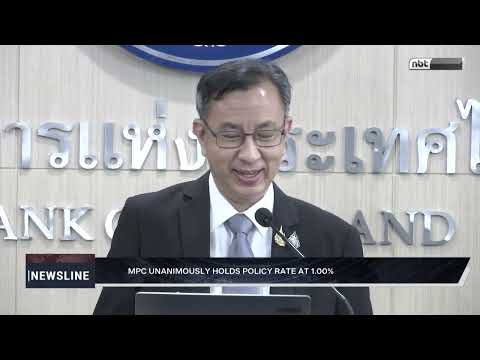
Thailand's central bank held its policy rate at 1.00% on October 28, a fourth straight hold, betting cheap money will support a recovery that remains uneven. The vote was unanimous. The bank raised its 2026 growth forecast to 2.4%, up from 2.3% in June, fueled by a boom in technology and AI-linked exports.

The tension now is inflation. Headline inflation is projected at 2.1% this year on oil prices and the El Niño weather pattern, before easing to 1.3% in 2027. The bank is also guarding its policy space: at 1.00%, it has roughly 50 basis points of room to cut before hitting 0.50%, the historical low. Small business loans keep shrinking even as large corporate lending grows, and the bank says SME debt repayment ability needs watching.

Why it matters

At 1%, Thailand's policy rate leaves little room to cut if growth stalls, while oil and El Niño inflation could force a rate hike.

Questions about this story

Free account needed to ask — your question is kept and asked for you right after sign-up. Answers are public.

No questions yet — be the first to ask.

Key Indicators

1.00%
Policy rate
Held since February 2026 after six consecutive cuts totaling 150 basis points.
2.4%
2026 GDP growth forecast
Up from 2.3% in June, but still below potential with benefits concentrated.
2.1%
2026 headline inflation forecast
Expected to rise on oil and El Niño before easing to 1.3% in 2027.
22%
2026 export growth forecast
Driven by technology and AI-related demand from large corporations.
6
Rate cuts since October 2024
Took the policy rate from 2.50% down to 1.00%.

Voices

Curated perspectives — historical figures and your fellow readers.

Sign up to generate historical perspectives on this story.

People Involved

Organizations Involved

Timeline

October 2024 December 2026

6 events Latest: Today
Tap a bar to jump to that date
  1. Next MPC meeting scheduled

    Upcoming Scheduled Event

    The next rate decision is set for December 23, 2026.

  2. MPC holds rate at 1.00% for fourth straight meeting

    Today Monetary Policy

    Unanimous vote maintains the rate. Bank raises GDP forecasts but flags oil and El Niño inflation risks.

  3. Governor says no rush to raise rates

    Statement

    Vitai Ratanakorn says monetary policy can't fix structural issues; no urgency to hike.

  4. MPC holds rate at 1.00%

    Monetary Policy

    Decision 4/2026 keeps rates unchanged, noting growth remains low and uneven.

  5. Sixth cut brings policy rate to 1.00%

    Monetary Policy

    The final cut in the easing cycle, totaling 150 basis points from 2.50%.

  6. BOT begins rate-cutting cycle

    Monetary Policy

    First of six cuts to support an economy constrained by weak demand and high household debt.

Scenarios

1

Thailand keeps rates at 1% through 2027

Likely Resolves by End of 2027

Discussed by: Reuters poll of 26 economists, all of whom expect no change; most see the rate holding through end-2027.

The bank continues to hold at 1.00% through 2027 as growth stays below potential and inflation eases after the oil and El Niño spike passes. The baht remains under pressure against the dollar, but the BOT sees no reason to move given weak domestic demand and concentrated export benefits. Most economists in a Reuters poll already expect this outcome.

2

Oil and El Niño push the BOT into a rate hike

Possible Resolves by Q2 2027

Discussed by: MPC statement flagged upside inflation risks from the Middle East conflict and limited energy subsidy capacity; headline inflation is projected at 2.1% for 2026.

Oil prices keep climbing and El Niño drives food prices higher, pushing headline inflation well above the 2.1% forecast and feeding core inflation. Cost pass-through by firms intensifies and medium-term inflation expectations drift up. The BOT raises the rate to defend its inflation credibility, accepting a slower recovery.

3

Growth stalls and BOT cuts to 0.50%

Unlikely Resolves by Q2 2027

Discussed by: Don Nakornthab noted the historical low is 0.50%, implying about 50 basis points of room; Deputy Governor Piti Disyatat said policy stays accommodative.

The tech and AI export boom fades faster than expected, SME loan contraction deepens, and household debt keeps consumption weak. The BOT cuts the rate to 0.50%, the historical low, but worries this leaves no ammunition if a new shock hits. Governor Ratanakorn's statement that monetary policy can't fix structural issues would prove prescient.

Historical Context

2 moments from history that rhyme with this story — and how they unfolded.

December 2008 – December 2015

Federal Reserve's zero-rate era (2008–2015)

The Federal Reserve held its policy rate at 0–0.25% for seven years after the 2008 financial crisis. Growth recovered slowly and unevenly, and the Fed repeatedly said the economy was not strong enough to absorb higher rates.

Then

The ultra-low rate supported a gradual recovery but drew criticism as asset prices climbed.

Now

Normalization began in December 2015 with small, widely telegraphed hikes over several years.

Why this matters now

Shows how long a central bank can hold rates near historical lows when growth is weak, and how slow the path back to normal policy can be.

February 1999 – 2010s

Bank of Japan's zero interest rate policy (1999–2010s)

Japan's central bank adopted a 0% policy rate in February 1999 to fight deflation and weak growth. The rate stayed near zero for more than a decade, and the bank eventually resorted to quantitative easing and yield curve control.

Then

The low rate stabilized financial conditions but did not revive growth on its own.

Now

Japan became the case study in running out of conventional policy space, forcing unconventional tools.

Why this matters now

Thailand's MPC explicitly worries about policy space — the room to cut if a crisis hits. Japan shows what happens when that space runs out.

Sources

(7)