Anchor

Star formation across the universe drops sharply while hydrogen fuel holds steady
New CapabilitiesSurvey of 2.5 million galaxies points to a bottleneck in converting hydrogen to stars, not a fuel shortage
3 days ago: Study rules out fuel shortage as star formation declinesNew here? Follow stories to track developments over time. Create a free account to get updates when stories you care about change.
Overview
Updated 2 hours agoThe universe makes stars about 60% less often than it did 4.5 billion years ago. A new survey of 2.5 million galaxies shows the simple explanation, that galaxies ran out of star-making fuel, doesn't hold.
Using China's FAST radio telescope and the DESI optical survey, researchers measured the cosmic supply of neutral hydrogen, the raw material for stars. It has barely declined. The bottleneck appears to be not the fuel supply but the conversion of that hydrogen into dense molecular clouds where stars are born.
Why it matters
The discovery rewrites why galaxies stop forming stars, reshaping every model of how the universe evolved into its present state.
Questions about this story
Free account needed to ask — your question is kept and asked for you right after sign-up. Answers are public.
No questions yet — be the first to ask.
Key Indicators
~59%
Cosmic star formation decline
Star formation rate 4.5 billion years ago was about 2.5 times today's rate.
11–26%
Neutral hydrogen decline
HI density fell far less than star formation, even after conservative corrections.
2.5 million
Galaxies surveyed
Sample covers nearly one-third of the sky, the largest of its kind.
4.5 billion years
Observation window
How far back in cosmic history the decline was traced.
Related Media

China's FAST Telescope, the World's Largest Single Radio Dish Telescope, is Now Fully Operational - Universe Today
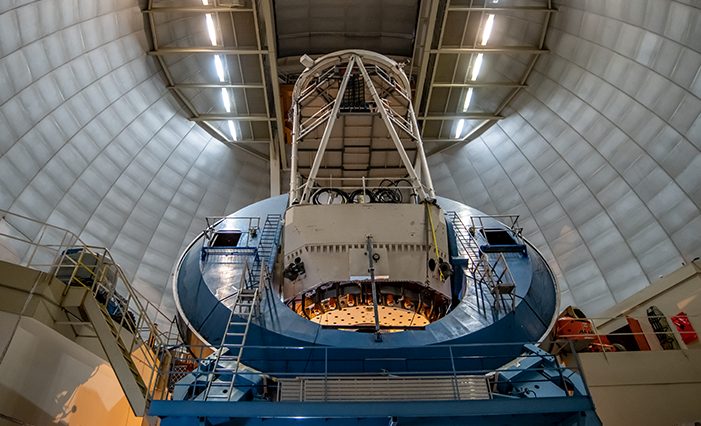
the DESI survey
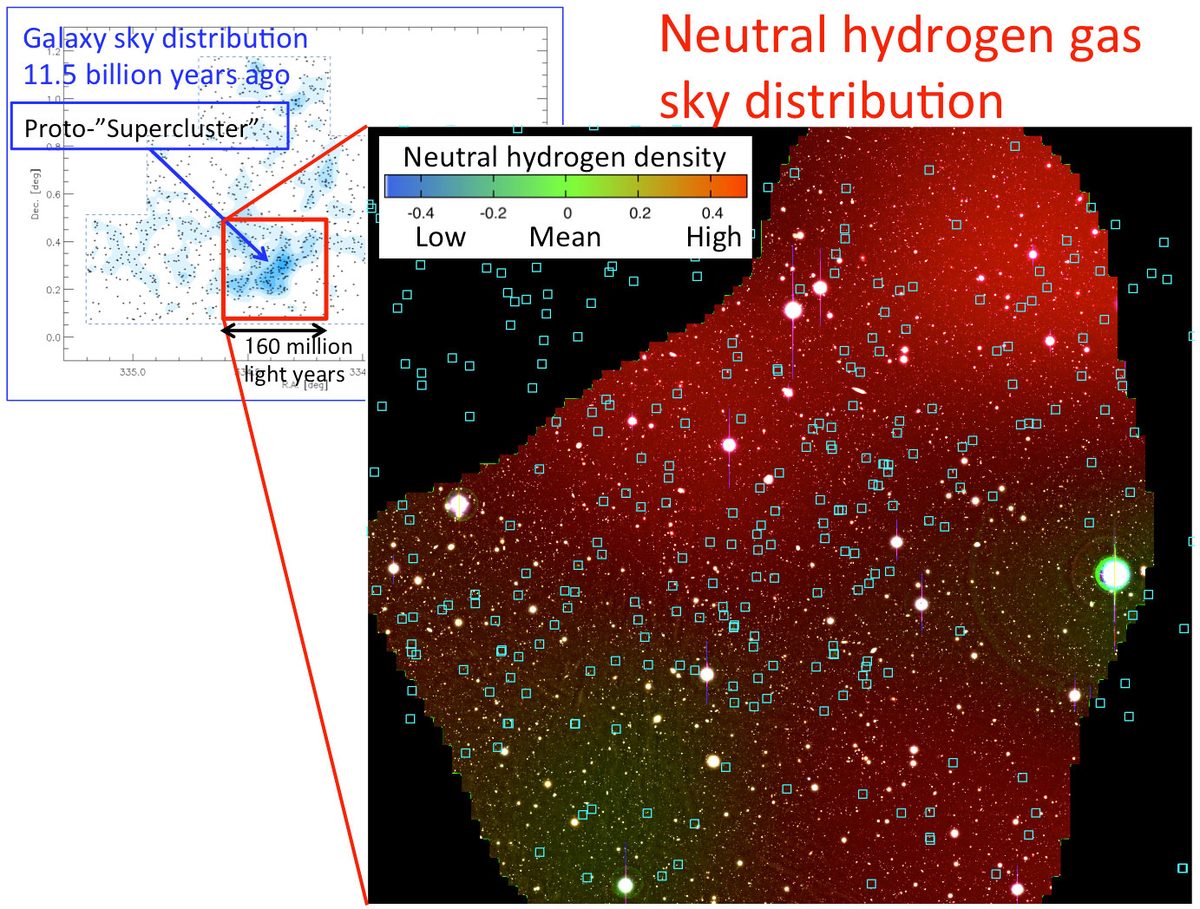
Subaru Telescope Helps Create the Most-Extensive Map of Neutral Hydrogen Gas in the Early Universe
22.0K views
9:52
We Finally Know Why Galaxies Stop Forming Stars
BRIGHT SIDE

7 views
11:32
Ep 184: Radio astronomers have captured hydrogen signals ...
Nerra Network

45 views
6:03
Cosmic Hydrogen Star Formation Mystery & Saturn South Pole ...
The Automated Daily
Images from Openverse under Creative Commons licenses. Videos from YouTube.
Voices
Curated perspectives — historical figures and your fellow readers.
Play
Exploring all sides of a story is often best achieved with Play.
Most of these play right now — no account needed. Sign up to save scores, keep a streak, and unlock Debate and Predict.
Log in
Sign Up
Higher or Lower
A number from this story, against one from elsewhere in the news — guess which is bigger, then keep the chain going. 5 rounds, 3 strikes; a miss costs a strike and resets your streak.
Example
Anchor
EU tariff revenue
$52B
Big for this kind of number
Mystery
Pentagon AI contract
?
Round 1
Streak: 0
Mystery
?
Keyboard: ↓/L lower · ↑/H higher
0 pts
Best streak: 0 · Rounds: 0
0 points — sign up to put that on the leaderboard.
Now try on this story
Connections
Sixteen names from the news. Find the four hidden groups of four. Four mistakes max.
Loading today's puzzle…
0/4 groups
Mistakes
Sign up to keep a daily streak — a new puzzle lands every day.
Now try on this story
Exit debate?
Your progress in this debate will be lost.
How it works
- 1 Two AI personas square off on this story.
- 2 You predict who'll win each round — correct picks earn XP.
- 3 One crossfire question is yours to fire. Pick it carefully.
Couldn't generate a topic
Select Your Champions
Choose one persona for each side of the debate
DEBATE TOPIC
Choose personas with different perspectives for a more dynamic debate.
SIDE A (PRO)
Select debater for this side:
No debate personas available right now.
SIDE B (CON)
Select debater for this side:
No debate personas available right now.
VS
Get ready to make your prediction...
Round of
Claim
Evidence
Stakes
Crossfire Answer
Closing Statement
Claim
Evidence
Stakes
Crossfire Answer
Closing Statement
Your Crossfire Question
Generating arguments...
Who's Got This Round?
Make your prediction before the referee scores
The referee scores both sides on
Correct predictions earn +20 XP
· Press 1 or 2 to pick
Evidence
40%
Logic
30%
Detail
20%
Style
10%
Round Results
Your Pick
Not this time
(%)
Overall Score
/10
Your Pick
Not this time
(%)
Overall Score
/10
Set the Crossfire
Pick the question both personas must answer in the final round
Crafting crossfire questions...
Choosing a question earns +10 XP crossfire bonus
🏆
Total XP Earned
Cred Change
Predictions
Debate Oracle! You called every round!
Sharp Instincts! You know your debaters!
The Coin Flip Strategist! Perfectly balanced!
The Contrarian! Bold predictions!
Inverse Genius! Try betting the opposite next time!
XP Breakdown
Base completion
+20 XP
Rounds played ( rounds x 5 XP)
+ XP
Correct predictions ( correct x 20 XP)
+ XP
Crossfire bonus
+10 XP
Accuracy
%
Prediction History
Round
You picked:
✓
✗
Now try on this story
Keep debating to level up your credibility and unlock achievements
Organizations Involved
Chinese Academy of Sciences (CAS)
National research institution
Led the international research team
China's national research academy, which led the team analyzing the FAST and DESI data.
Five-hundred-meter Aperture Spherical radio Telescope (FAST)
Radio telescope
Instrument used for hydrogen measurements
The world's largest single-dish radio telescope, used to detect faint 21-centimeter hydrogen emission.
Dark Energy Spectroscopic Instrument (DESI)
Survey instrument
Provided optical spectroscopy for the galaxy sample
A 5,000-fiber spectrograph mapping the distances of tens of millions of galaxies.
Timeline
September 2016 September 2026
3 events
Latest: 3 days ago
-
Study rules out fuel shortage as star formation declines
Latest DiscoveryCAS-led team reports star formation fell ~59% over 4.5 billion years while neutral hydrogen dropped only 11–26%, shifting the puzzle to hydrogen-to-star conversion.
-
DESI starts mapping galaxy distances
MilestoneThe Dark Energy Spectroscopic Instrument begins measuring redshifts for millions of galaxies at Kitt Peak, Arizona.
-
FAST telescope begins operations in China
MilestoneThe world's largest single-dish radio telescope starts observing from Guizhou province.
Historical Context
3 moments from history that rhyme with this story — and how they unfolded.
1996
Madau-Lilly star formation history (1996)
Two groups, led by Piero Madau and Simon Lilly, independently measured how the universe's star formation rate changed over cosmic time. They found it peaked about 10 billion years ago and has declined steeply since.
Then
Established the 'Madau plot,' a standard reference curve for galaxy evolution used in essentially every astronomy textbook since.
Now
Set the question this new FAST/DESI study finally tackles: what actually ends star formation in the universe?
Why this matters now
The new result measures the same decline in its most recent 4.5 billion years and tests the leading explanation for it, fuel exhaustion.
1998
Discovery of cosmic acceleration (1998)
Two teams measuring distant supernovae found the universe's expansion is accelerating, not slowing as gravity alone would predict.
Then
Overturned the prevailing decelerating-universe model within months of publication.
Now
Became the observational foundation for dark energy and won the 2011 Nobel Prize in Physics.
Why this matters now
Like 1998, observations contradicted a simple, widely accepted model — here, that galaxies stopped forming stars because their hydrogen ran out.
2000s
The missing baryon problem (2000s)
Cosmologists found that stars, gas, and dust accounted for only a fraction of the ordinary matter the universe should contain. Roughly half appeared to be missing.
Then
Surveys in X-ray and ultraviolet light traced the missing matter to hot gas in filaments of the cosmic web.
Now
Showed that tracking where gas lives and what state it is in matters more than counting total amounts.
Why this matters now
The FAST/DESI result makes the same point about hydrogen: the total supply matters less than its phase and whether it can actually form stars.
Sources
(9)Related Stories
Astronomers capture first direct image of a cosmic web filament
New Capabilities
Updated May 20
The silent deaths: stars that collapse into black holes without exploding
New Capabilities
Updated May 22
James Webb telescope rewrites the cosmic dawn
New Capabilities
Updated May 27
Hydrogen turns superfluid, unlocking 50-year-old quantum mystery
New Capabilities
Updated May 19
Researchers convert mixed plastic waste into hydrogen fuel
New Capabilities
Updated Aug 8
Starcloud raises fresh capital to build AI data centers in orbit
New Capabilities
Updated Aug 22