Anchor

Astronomers directly detect hydrogen signal from billions of light-years away
New CapabilitiesMeerKAT telescope validates technique that could map the universe's structure far faster than galaxy surveys
Today: First direct hydrogen intensity mapping detection announcedNew here? Follow stories to track developments over time. Create a free account to get updates when stories you care about change.
Overview
Updated 1 hour agoAstronomers have directly detected an extremely faint radio signal from hydrogen gas that existed billions of years ago. The detection, made with South Africa's MeerKAT telescope, validates hydrogen intensity mapping, a technique that could map the universe's large-scale structure far faster than traditional galaxy surveys.
Instead of hunting individual galaxies, the method measures the combined hydrogen glow across enormous volumes of space. The signal traveled roughly 4 to 5 billion years to Earth, from when the universe was about 10 to 9 billion years old. The results appeared in the Astrophysical Journal Letters.
Why it matters
This could let astronomers map the universe's structure in a fraction of the time, deepening our understanding of dark matter and cosmic evolution.
Questions about this story
Free account needed to ask — your question is kept and asked for you right after sign-up. Answers are public.
No questions yet — be the first to ask.
Key Indicators
96
Hours of MeerKAT observations
Total observation time analyzed for the detection
4-5 billion
Distance the signal traveled in light-years
Emissions from two cosmic periods, at redshifts ~0.32 and ~0.44
z≈0.32, 0.44
Redshifts of detected hydrogen
Corresponds to universe ages of about 10 and 9 billion years
Related Media
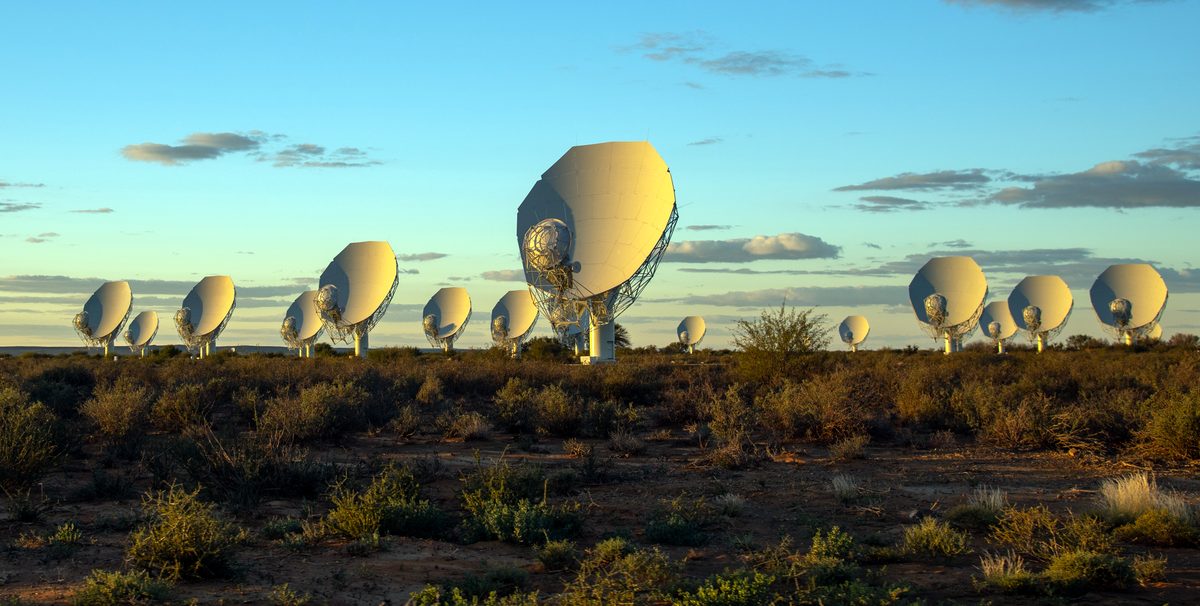
2018-MeerKAT-6
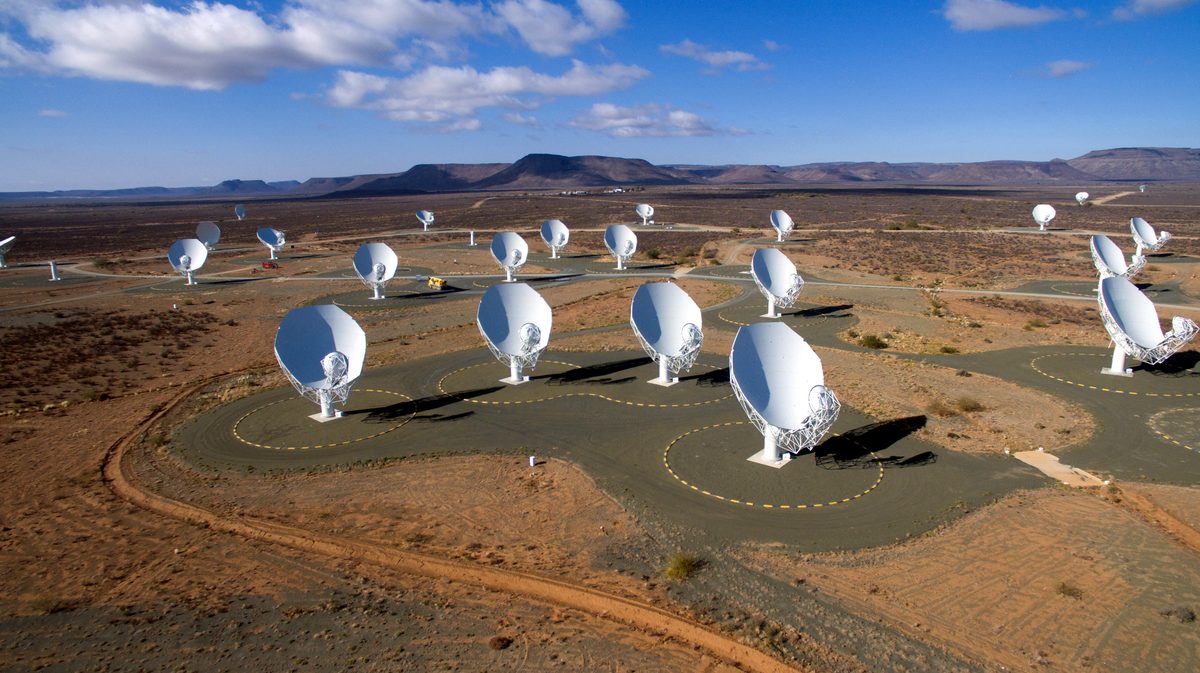
2017 meerkat 01
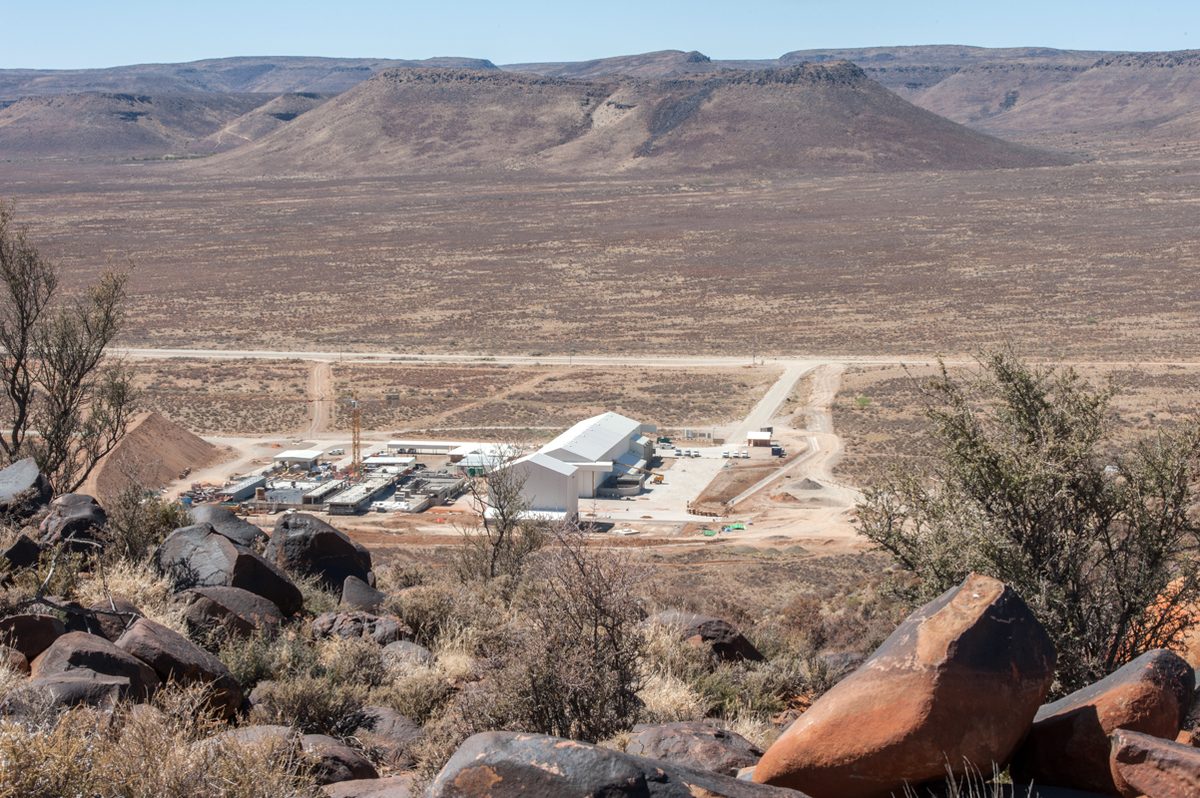
Meerkat National Park, Square Kilometre Array radio telescope facility
Images from Openverse under Creative Commons licenses.
Voices
Curated perspectives — historical figures and your fellow readers.
Play
Exploring all sides of a story is often best achieved with Play.
Most of these play right now — no account needed. Sign up to save scores, keep a streak, and unlock Debate and Predict.
Log in
Sign Up
Higher or Lower
A number from this story, against one from elsewhere in the news — guess which is bigger, then keep the chain going. 5 rounds, 3 strikes; a miss costs a strike and resets your streak.
Example
Anchor
EU tariff revenue
$52B
Big for this kind of number
Mystery
Pentagon AI contract
?
Round 1
Streak: 0
Mystery
?
Keyboard: ↓/L lower · ↑/H higher
0 pts
Best streak: 0 · Rounds: 0
0 points — sign up to put that on the leaderboard.
Now try on this story
Connections
Sixteen names from the news. Find the four hidden groups of four. Four mistakes max.
Loading today's puzzle…
0/4 groups
Mistakes
Sign up to keep a daily streak — a new puzzle lands every day.
Now try on this story
Exit debate?
Your progress in this debate will be lost.
How it works
- 1 Two AI personas square off on this story.
- 2 You predict who'll win each round — correct picks earn XP.
- 3 One crossfire question is yours to fire. Pick it carefully.
Couldn't generate a topic
Select Your Champions
Choose one persona for each side of the debate
DEBATE TOPIC
Choose personas with different perspectives for a more dynamic debate.
SIDE A (PRO)
Select debater for this side:
No debate personas available right now.
SIDE B (CON)
Select debater for this side:
No debate personas available right now.
VS
Get ready to make your prediction...
Round of
Claim
Evidence
Stakes
Crossfire Answer
Closing Statement
Claim
Evidence
Stakes
Crossfire Answer
Closing Statement
Your Crossfire Question
Generating arguments...
Who's Got This Round?
Make your prediction before the referee scores
The referee scores both sides on
Correct predictions earn +20 XP
· Press 1 or 2 to pick
Evidence
40%
Logic
30%
Detail
20%
Style
10%
Round Results
Your Pick
Not this time
(%)
Overall Score
/10
Your Pick
Not this time
(%)
Overall Score
/10
Set the Crossfire
Pick the question both personas must answer in the final round
Crafting crossfire questions...
Choosing a question earns +10 XP crossfire bonus
🏆
Total XP Earned
Cred Change
Predictions
Debate Oracle! You called every round!
Sharp Instincts! You know your debaters!
The Coin Flip Strategist! Perfectly balanced!
The Contrarian! Bold predictions!
Inverse Genius! Try betting the opposite next time!
XP Breakdown
Base completion
+20 XP
Rounds played ( rounds x 5 XP)
+ XP
Correct predictions ( correct x 20 XP)
+ XP
Crossfire bonus
+10 XP
Accuracy
%
Prediction History
Round
You picked:
✓
✗
Now try on this story
Keep debating to level up your credibility and unlock achievements
People Involved
Organizations Involved
University of Manchester
University
Lead institution in the study
UK university whose Jodrell Bank Centre for Astrophysics led the research.
South African Radio Astronomy Observatory (SARAO)
National facility
Operates MeerKAT telescope
South Africa's radio astronomy body, built and operates the MeerKAT array.
Square Kilometre Array Observatory (SKAO)
International organization
Future application of technique
International radio astronomy project that will incorporate MeerKAT and other arrays.
Timeline
1 event
Latest: Today
-
First direct hydrogen intensity mapping detection announced
Today Scientific announcementTeam led by University of Manchester uses 96 hours of MeerKAT data to detect hydrogen signal at redshifts 0.32 and 0.44, published in Astrophysical Journal Letters.
Historical Context
2 moments from history that rhyme with this story — and how they unfolded.
March 1951
Discovery of the 21-cm hydrogen line (1951)
Harvard researchers Harold Ewen and Edward Purcell detected the radio emission from neutral hydrogen in the Milky Way, using a small horn antenna on a roof. The 21-centimeter line became the backbone of radio astronomy.
Then
Astronomers used the line to map the Milky Way's spiral arms and gas distribution.
Now
Today, the 21-cm line is a standard probe of the interstellar medium and, at cosmological distances, the cosmic hydrogen distribution.
Why this matters now
The new detection extends that fundamental tool to the distant universe, measuring hydrogen at cosmic scales rather than within our galaxy.
1977-1986
CfA Redshift Survey (1986)
Astronomers at the Harvard-Smithsonian Center for Astrophysics charted the velocities of thousands of galaxies, producing the first 3D map of the cosmic neighborhood. The map revealed the 'Great Wall', a vast sheet of galaxies millions of light-years across.
Then
It demonstrated the extent of large-scale structure in the universe.
Now
Redshift surveys became a cornerstone of cosmology, used to measure dark matter distribution and the universe's expansion.
Why this matters now
Hydrogen intensity mapping aims to achieve what galaxy surveys do, but far faster by measuring all galaxies' combined hydrogen glow instead of detecting each one individually.