

Pull to refresh
Logo
First tower foundation poured on Guangxi section of Tibet-Guangdong UHVDC line

First tower foundation poured on Guangxi section of Tibet-Guangdong UHVDC line

Built World

Work advances on all four sections of the 2,681 km line that will carry Tibetan clean power to Guangdong by 2029

Today: First tower foundation poured on Guangxi section

Overview

Updated 1 hour ago

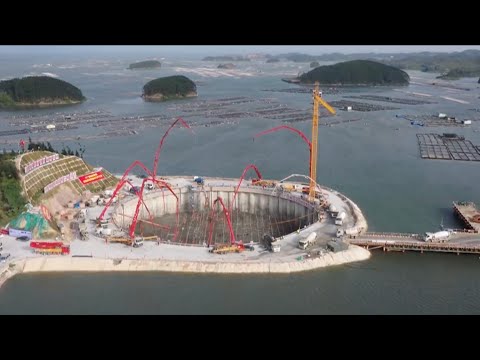
Workers in Nanning poured the first tower foundation for the Guangxi section of the Tibet-Guangdong ultra-high-voltage direct current (UHVDC) line on October 16. The milestone puts the line's 678 km middle section into active construction, bringing all four provincial segments of the 2,681 km corridor under way.

The project is the largest flexible UHVDC transmission line ever built, with about 530 billion yuan approved for investment. When it comes online in 2029, it will deliver over 43 billion kWh of clean power annually to the Greater Bay Area. That's roughly half of what the Three Gorges Dam generates in a year.

Why it matters

A single 2,681 km line will carry 10 GW of clean power from Tibet's plateau to Guangdong's factories — the largest renewable transmission project ever built.

Questions about this story

Free account needed to ask — your question is kept and asked for you right after sign-up. Answers are public.

No questions yet — be the first to ask.

Key Indicators

2,681 km
Total line length
Crosses Tibet, Yunnan, Guangxi and Guangdong
10 GW
Rated transmission capacity
Four-terminal flexible UHVDC system, a world first
530 billion yuan
Approved investment
Largest UHV project investment in China
43 billion kWh/year
Annual clean energy delivery
Targeted delivery to the Greater Bay Area once operational
33 million tonnes/year
Expected CO2 reduction
Annual emissions savings once fully operational

Voices

Curated perspectives — historical figures and your fellow readers.

Ever wondered what historical figures would say about today's headlines?

Sign up to generate historical perspectives on this story.

People Involved

Organizations Involved

Timeline

January 2026 2029

6 events Latest: Today
Tap a bar to jump to that date
  1. Planned full-line completion and commissioning

    Upcoming Construction

    The Tibet-Guangdong line is scheduled to begin commercial operation in 2029, delivering up to 10 GW of clean power to the Greater Bay Area.

  2. Line sections expected to enter tower assembly

    Upcoming Construction

    Project officials say some line sections will transition from foundation work to tower assembly by the end of 2026.

  3. First tower foundation poured on Guangxi section

    Today Construction

    Crews in Nanning began pouring the Guangxi section's first tower foundation, accelerating construction across the line's 678 km middle segment through karst terrain.

  4. Yunnan section enters full construction

    Construction

    The Yunnan 14 section opened in Guangnan County with first-tower pilot activities, putting the line's entire Yunnan segment into active construction.

  5. Guangdong section completes first tower foundation pour

    Construction

    The global first four-terminal UHVDC project finished its first tower foundation concrete pour in Guangdong, piloting fully mechanized green construction methods.

  6. Full-line groundbreaking ceremony held in Guangdong

    Construction

    The project's steady-growth and investment mobilization conference and first foundation excavation were held in Boluo County, Guangdong, marking the line's formal entry into construction.

Scenarios

1

Tibet-Guangdong UHVDC line begins commercial operation in 2029

Likely Resolves by End of 2029

Discussed by: China Southern Power Grid project officials; Xinhua reporting

All four provincial sections maintain construction momentum through 2028. Tower assembly begins as scheduled in late 2026, conductor stringing proceeds through 2027 and 2028, and system testing starts in 2029 with full commercial operation announced by year end.

2

Terrain and logistics push Tibet-Guangdong line completion past 2030

Possible Resolves by End of 2029

Discussed by: Engineering analysts following UHV construction challenges

The Tibetan plateau section's 4,000m-plus altitude, permafrost, earthquake fault zones and 37 km uninhabited stretch prove harder than planned. Construction weather windows at high altitude run only a few months per year, and material transport through the uninhabited zone adds delay. Guangxi's karst caves could also slow tower placement.

3

Phased commissioning: some Tibet-Guangdong segments activate before the full route

Uncertain Resolves by End of 2029

Discussed by: Energy sector analysts studying multi-terminal UHVDC operations

The four-terminal design allows intelligent scheduling between two power source terminals (Changdu, Linzhi) and two load terminals (Guangzhou, Shenzhen). If the Tibet section lags but eastern sections are ready, operators could run a partial configuration, delivering power before the full line is complete.

Historical Context

2 moments from history that rhyme with this story — and how they unfolded.

2000-present

West-East Power Transmission Program (2000)

China launched a national program to move electricity from resource-rich western provinces to coastal industrial centers. The initiative has driven construction of dozens of high-voltage corridors over 25 years and become the country's core mechanism for balancing regional energy supply and demand.

Then

First corridors in the early 2000s carried hydro and thermal power to Guangdong and Shanghai, easing chronic power shortages in coastal industrial cities.

Now

The program expanded from alternating current to ultra-high-voltage DC lines. The Tibet-Guangdong line is its most ambitious project to date, carrying 100% clean energy rather than coal power.

Why this matters now

Tibet-Guangdong is the next step in a 26-year strategy: push the distance and altitude limits of what China's grid can do.

2007-2010

Xiangjiaba-Shanghai ±800kV UHVDC (2010)

China built the world's first ±800kV ultra-high-voltage DC line from the Xiangjiaba hydropower station on the Jinsha River to Shanghai, a route of roughly 2,000 km. It proved electricity could be moved efficiently across the country's vast distances.

Then

The line entered commercial operation in 2010, delivering hydropower from the Jinsha River system to the Yangtze River Delta.

Now

It validated UHVDC technology for China's grid expansion and spawned a generation of similar projects across the country.

Why this matters now

Tibet-Guangdong follows the same cross-country transmission playbook but adds harder problems: four flexible DC terminals, higher altitude, and a 37 km uninhabited crossing.

Sources

(10)