
Pull to refresh
Logo
Daily Brief
Following
Why Sign Up
Ukraine's four-year campaign to dismantle Russia's Black Sea Fleet

Ukraine's four-year campaign to dismantle Russia's Black Sea Fleet

Force in Play
By Newzino Staff |

From the Moskva flagship to Sevastopol's last landing ships, how drones and missiles rewrote naval warfare

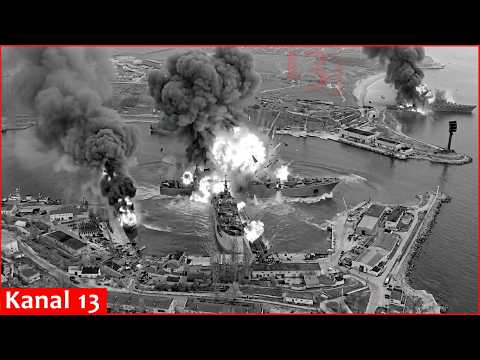
Today: Landing ships Yamal and Nikolai Filchenkov disabled in Sevastopol

Overview

Ukraine struck two large Russian Navy landing ships — the Yamal and the Nikolai Filchenkov — docked in Sevastopol Bay on April 20, disabling an estimated $150 million in naval assets and destroying a Podlet-K1 radar station. The same night, drones hit the Tuapse oil refinery in Krasnodar for the second time in a week, igniting tank farm fires at one of Russia's ten largest refineries. These were the latest in a sustained campaign that has forced Russia's Black Sea Fleet to abandon its historic base in Crimea and retreat to Novorossiysk — where it is still being hit.

Why it matters

A country with no navy has crippled a nuclear power's fleet and is now degrading its energy exports — rewriting how naval wars are fought.

Key Indicators

~30%
Black Sea Fleet destroyed or damaged
Ukraine's Defense Ministry estimate of cumulative fleet losses since February 2022
$150M
Value of ships disabled April 20
Combined estimated value of the Yamal ($80M) and Nikolai Filchenkov ($70M)
20%
Russian refining capacity knocked offline
Ukrainian drone strikes have idled roughly one-fifth of Russia's oil processing capacity
162M tonnes
Cargo shipped via Ukrainian Black Sea corridor
Total cargo exported through Ukraine's self-protected maritime corridor since August 2023
0
Russian warships remaining at Sevastopol
The last Black Sea Fleet vessel left Crimea's main naval base in July 2024

Interactive

Exploring all sides of a story is often best achieved with Play.

Ever wondered what historical figures would say about today's headlines?

Sign up to generate historical perspectives on this story.

Sign Up

Debate Arena

Two rounds, two personas, one winner. You set the crossfire.

People Involved

Organizations Involved

Timeline

  1. Landing ships Yamal and Nikolai Filchenkov disabled in Sevastopol

    Strike

    GUR's Prymary special unit struck two large landing ships docked in Sevastopol Bay, disabling $150 million in naval assets. The same operation destroyed a Podlet-K1 radar station. Separately, drones hit the Tuapse refinery for the second time in a week, killing one person and reigniting the tank farm.

  2. First April strike on Tuapse refinery

    Strike

    Ukrainian special forces hit the Rosneft-owned Tuapse oil terminal with drones, igniting fires that burned for several days before the follow-up strike.

  3. Last Kalibr-capable frigate Admiral Makarov hit

    Strike

    Drones struck the Admiral Makarov twice at Novorossiysk — once near its Kalibr cruise missile launchers and once on the bow. The Project 11356R frigate was Russia's last operational Kalibr-capable ship in the Black Sea.

  4. 200-drone swarm strikes Novorossiysk port

    Strike

    Ukraine launched over 200 aerial drones at Novorossiysk, damaging the minesweeper Valentin Pikul, anti-submarine ships Yeysk and Kasimov, and the frigate Admiral Essen. The strike also hit an S-300 radar and oil-loading equipment at the Sheskharis terminal, killing three Russian sailors.

  5. Sea Baby drone disables submarine at Novorossiysk

    Strike

    A Ukrainian Sea Baby underwater drone struck a Russian submarine at Novorossiysk, marking the first confirmed use of the system against a submerged target.

  6. Last Russian warship leaves Sevastopol

    Relocation

    The final Black Sea Fleet vessel departed its historic home port of Sevastopol for Novorossiysk, completing a full withdrawal driven by the sustained Ukrainian strike campaign.

  7. Missile corvette Ivanovets sunk by naval drones

    Strike

    GUR's Group 13 special unit used unmanned surface vehicles to sink the Tarantul-class missile corvette Ivanovets at Lake Donuzlav in Crimea, demonstrating the lethality of Ukraine's naval drone program.

  8. Landing ship Novocherkassk destroyed at Feodosia

    Strike

    Ukrainian cruise missiles hit the Novocherkassk while docked at Feodosia in Crimea. Secondary explosions — reportedly from Iranian-made Shahed drones stored aboard — tore the ship apart.

  9. Storm Shadow missiles hit Sevastopol fleet headquarters

    Strike

    British-supplied Storm Shadow cruise missiles struck the Black Sea Fleet's headquarters in Sevastopol and a dry dock containing the landing ship Minsk, triggering the fleet's eventual departure from Crimea.

  10. Ukraine opens self-protected grain corridor

    Strategic

    After Russia withdrew from the Black Sea Grain Initiative in July 2023, Ukraine established its own maritime corridor from Odesa ports, routing ships along the Romanian coast. The corridor has since moved over 162 million tonnes of cargo.

  11. Flagship Moskva sunk by Neptune missiles

    Strike

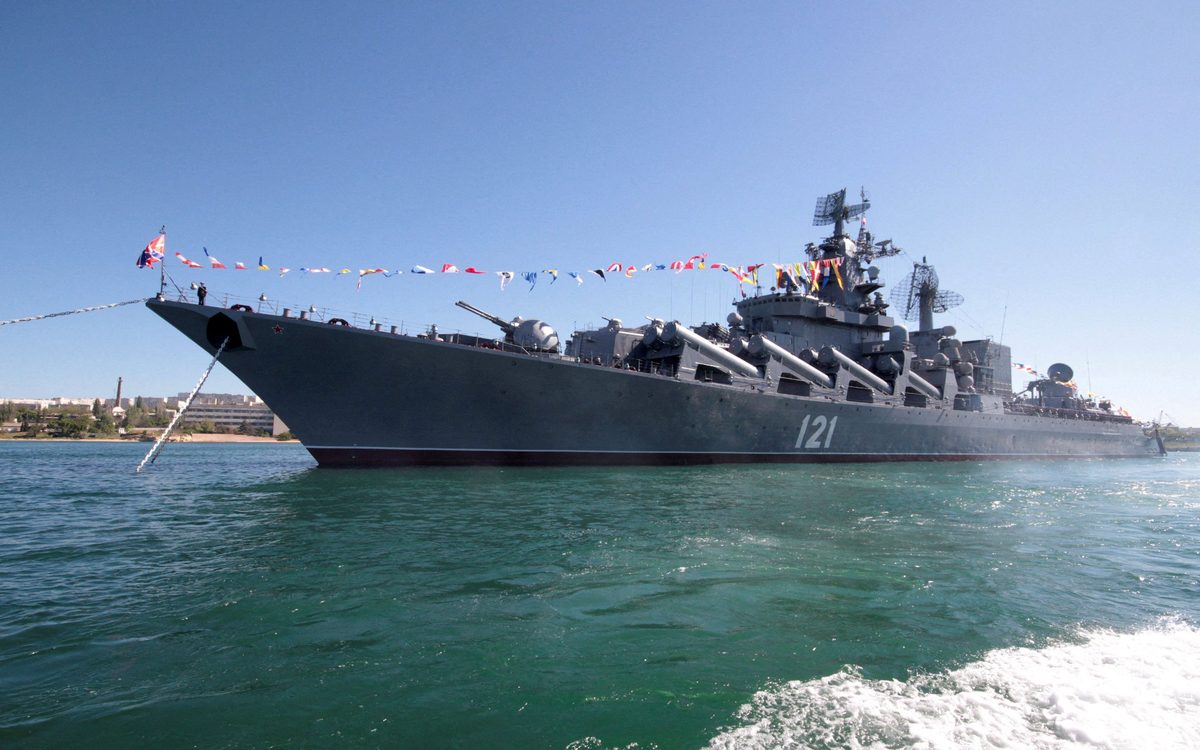
    Two Ukrainian-made R-360 Neptune anti-ship missiles struck the Slava-class cruiser Moskva, flagship of the Black Sea Fleet. The 12,000-tonne warship sank under tow — the largest Russian warship lost since World War II.

  12. Landing ship Saratov destroyed at Berdyansk

    Strike

    Ukrainian forces struck the port of Berdyansk in occupied territory, destroying the large landing ship Saratov and damaging two others.

Scenarios

1

Black Sea Fleet rendered operationally irrelevant

Discussed by: Naval analysts at the United States Naval Institute (USNI), Atlantic Council, and the Royal United Services Institute (RUSI)

If Ukraine continues striking warships at Novorossiysk at the current pace, the Black Sea Fleet could lose the ability to conduct meaningful surface operations within months. The Admiral Makarov strike already eliminated the fleet's last Kalibr cruise missile launcher in the theater. Without missile-capable ships, the fleet cannot contribute to Russia's long-range strike campaign against Ukrainian cities or threaten commercial shipping. Russia lacks the shipbuilding capacity to replace losses quickly — its shipyards are focused on submarine production for the Northern and Pacific fleets.

2

Russia redeploys Caspian Flotilla assets to compensate

Discussed by: Jamestown Foundation, Critical Threats Project at the American Enterprise Institute

Russia could attempt to reinforce the Black Sea with smaller missile-capable vessels from the Caspian Flotilla, which has launched Kalibr strikes against Ukraine before. However, moving ships through the Volga-Don canal system is slow, seasonal, and limited by vessel size. Any reinforcements arriving at Novorossiysk would face the same drone threat that has already damaged ships there. This option buys time but does not solve the fundamental vulnerability.

3

Ukraine's energy strikes force Russian refining crisis

Discussed by: Baker Institute at Rice University, Chatham House, Bloomberg commodity analysts

Ukrainian strikes have already idled 20% of Russia's refining capacity and forced a gasoline export ban. If attacks intensify with heavier warheads — the Unmanned Systems Forces now fields drones carrying 250-kilogram bombs at ranges up to 2,000 kilometers — Russia's repair capacity could fall behind the destruction rate. Domestic fuel shortages in southern Russia would worsen, and refined product exports would decline further, directly reducing government revenue. The Tuapse refinery is particularly strategic: it is Russia's only Black Sea refinery-export hub, connecting refining directly to maritime petroleum exports.

4

Ceasefire freezes the campaign before fleet is fully destroyed

Discussed by: European Council on Foreign Relations, Carnegie Endowment for International Peace

Ongoing diplomatic efforts — including a reported 20-point plan involving the United States — could produce a ceasefire that halts Ukrainian strikes before the Black Sea Fleet is completely neutralized. Russia would retain damaged but potentially repairable vessels and could rebuild refining capacity over several years. However, Ukraine's demonstrated capability would permanently alter the deterrence calculus: Russia would know that any resumption of hostilities would immediately expose its fleet and energy infrastructure to the same attacks.

Historical Context

Falklands War Exocet strikes (1982)

April-June 1982

What Happened

Argentina used just six French-made Exocet anti-ship missiles against the Royal Navy during the Falklands War, sinking the destroyer HMS Sheffield and the container ship Atlantic Conveyor, and damaging the destroyer HMS Glamorgan. The British fleet was forced to keep its two aircraft carriers further from shore, constraining air operations for the rest of the campaign.

Outcome

Short Term

Britain won the war but the Exocet threat reshaped its naval tactics in real time, forcing carriers to operate at reduced effectiveness.

Long Term

Navies worldwide invested heavily in anti-missile defense systems. The Exocet became a bestseller. The war demonstrated that a small number of precision anti-ship weapons could threaten naval operations disproportionate to their cost.

Why It's Relevant Today

Ukraine has taken this asymmetry much further — using domestically built drones costing tens of thousands of dollars to disable or destroy warships worth tens of millions, at a scale and duration far beyond what Argentina achieved in 1982.

Iran-Iraq Tanker War (1984-1988)

1984-1988

What Happened

During the Iran-Iraq War, both sides attacked oil tankers and energy infrastructure in the Persian Gulf. Iraq struck Iranian oil platforms and tankers with Exocet missiles; Iran retaliated with mines and small-boat attacks on shipping bound for Iraqi-allied Gulf states. Over 400 ships were attacked, and global oil markets were disrupted.

Outcome

Short Term

The United States intervened with Operation Earnest Will, escorting Kuwaiti tankers reflagged under the American flag. International shipping continued under military protection.

Long Term

The conflict established that attacks on energy infrastructure and maritime commerce could become a primary theater of war rather than a sideshow, influencing Persian Gulf security architecture for decades.

Why It's Relevant Today

Ukraine's simultaneous campaign against Russian warships and energy infrastructure mirrors the tanker war's logic: degrade the enemy's revenue and naval capability at the same time. Ukraine's self-protected grain corridor echoes the tanker escort concept, substituting drone dominance for surface escorts.

Houthi anti-ship campaign in the Red Sea (2023-2024)

November 2023 - 2024

What Happened

Yemen's Houthi movement used drones, anti-ship ballistic missiles, and cruise missiles to attack commercial shipping in the Red Sea, forcing major container lines to reroute around the Cape of Good Hope. The United States and United Kingdom launched Operation Prosperity Guardian but could not fully suppress the threat despite deploying carrier strike groups.

Outcome

Short Term

Global shipping costs spiked, container transit times increased by 10-14 days, and Red Sea traffic dropped dramatically. The U.S. Navy expended millions of dollars in missiles intercepting relatively cheap drones.

Long Term

The campaign demonstrated that non-state actors with cheap precision weapons could disrupt global maritime chokepoints, raising questions about the cost-effectiveness of traditional naval power projection.

Why It's Relevant Today

Ukraine's Black Sea campaign shows the state-actor version of this asymmetry: a country without a navy systematically dismantling a major fleet using the same class of weapons — drones and missiles — that the Houthis used to threaten commercial shipping. Both campaigns challenge assumptions about what naval dominance requires.

Sources

(14)