Pull to refresh
Logo
Daily Brief
Following
Why Sign Up
Pentagon orders U.S. troop withdrawal from Germany after Trump-Merz Iran rift

Pentagon orders U.S. troop withdrawal from Germany after Trump-Merz Iran rift

Force in Play
By Newzino Staff |

First brigade-level cut to U.S. forces in Europe in decades, alongside the cancellation of a long-range missile deployment meant to deter Russia

Yesterday: Trump says cuts will go 'a lot further'

Overview

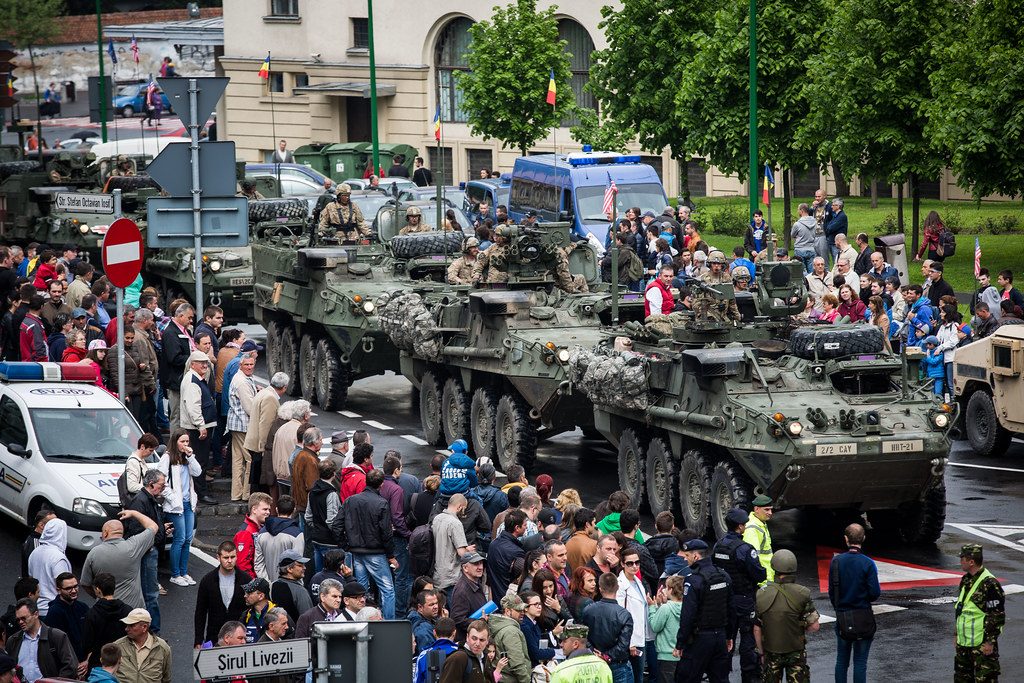
U.S. troops have been stationed in Germany continuously since 1945. On May 1, 2026, the Pentagon began rolling back a piece of that posture: roughly 5,000 service members—about one in seven Americans currently in the country—will leave over the next 6 to 12 months, taking a full brigade with them. A long-range fires battalion that the U.S. had pledged to deploy at the 2024 NATO summit, designed to put deeper-strike weapons on alliance soil for the first time since the Cold War, was cancelled in the same order.

Why it matters

If U.S. forces keep leaving Europe, NATO's deterrence runs on European fuel for the first time in 80 years.

Key Indicators

5,000
Troops being withdrawn
Roughly one-seventh of the U.S. force currently stationed in Germany.
~36,000
U.S. troops in Germany today
Down from 213,000 at the Cold War peak in 1990.
1
Brigade combat team affected
Pentagon is removing one full brigade, the largest building block of land combat power.
6-12 mo
Withdrawal window
Pentagon timeline for moving the troops home.
1 cancelled
Long-range fires battalion
Pledged at the 2024 NATO Washington Summit to deter Russia; will not deploy.

Interactive

Exploring all sides of a story is often best achieved with Play.

Ever wondered what historical figures would say about today's headlines?

Sign up to generate historical perspectives on this story.

Sign Up

Debate Arena

Two rounds, two personas, one winner. You set the crossfire.

People Involved

Organizations Involved

Timeline

  1. Trump says cuts will go 'a lot further'

    Statement

    President signals additional reductions beyond 5,000; Wicker and Rogers publicly object; NATO begins assessing impact.

  2. Pentagon announces 5,000-troop withdrawal

    Policy

    Defense Department orders the withdrawal of one brigade and cancels a planned long-range fires deployment over 6–12 months.

  3. Trump signals possible troop cut in Germany

    Statement

    President says he is 'looking at' reducing U.S. forces in Germany after the public feud with Merz.

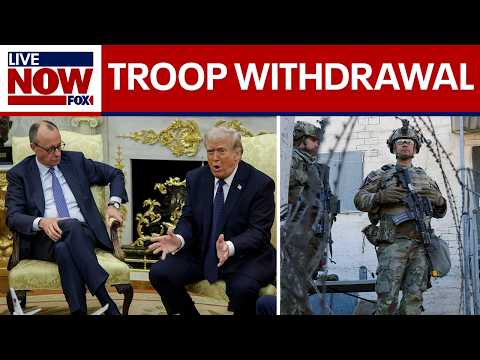
  4. Trump scolds Merz over Iran war criticism

    Statement

    Trump tells Merz to spend 'less time interfering' with U.S. efforts against Iran's nuclear program.

  5. NATO Washington Summit pledges long-range fires for Germany

    Policy

    U.S. and Germany announce planned deployment of long-range strike weapons on German soil starting in 2026.

  6. Russia invades Ukraine; U.S. surges forces in Europe

    Background

    Washington adds thousands of troops to NATO's eastern flank; many are still in place in 2026.

  7. Biden halts the 2020 withdrawal

    Policy

    New administration formally pauses and reverses the troop reduction order.

  8. Trump's first-term withdrawal plan announced

    Policy

    Pentagon under Trump announces plan to remove up to 12,000 troops from Germany; Congress and allies push back.

  9. Cold War peak: 213,000 U.S. troops in Germany

    Background

    U.S. Army Europe hits its postwar high before German reunification triggers a steep drawdown.

  10. U.S. troops first stationed in Germany

    Background

    American forces enter Germany at the end of World War II, beginning what becomes an unbroken 80-year presence.

Scenarios

1

Drawdown deepens, U.S. brigade combat presence in Germany ends

Discussed by: Stars and Stripes; Wilson Center analysts; Trump himself

Trump follows through on his 'a lot further' line, ordering successive cuts that pull the remaining U.S. ground combat formations out of Germany within 18 months. Air and headquarters elements at Ramstein and Wiesbaden remain, but the forward land deterrent against Russia ends. NATO's eastern flank then depends on Polish, German, and British ground formations and on rapid-reinforcement plans that are politically harder to execute without forward U.S. troops.

2

Congress conditions further cuts via the FY27 NDAA

Discussed by: Sen. Roger Wicker; Rep. Mike Rogers; defense press

Republican armed services chairs use the annual defense authorization bill to impose certification requirements, allied-consultation mandates, or numerical floors on U.S. force levels in Europe—mirroring the 2020 playbook that constrained Trump's first-term withdrawal. The cut at 5,000 holds, but additional reductions get slowed or blocked outside emergency authorities.

3

Germany and EU accelerate independent defense buildup

Discussed by: German Defense Ministry; Bundestag leadership; European Council watchers

Berlin uses the moment to push a sharp increase in defense spending and faster European procurement of long-range fires, air defense, and munitions—filling the gap left by the cancelled U.S. battalion. France and Poland join. NATO survives in name, but the operational center of European deterrence shifts toward a Franco-German-Polish core, with Washington as a more distant guarantor.

4

Russia probes the eastern flank as U.S. forces thin

Discussed by: European security analysts; NATO planners

Moscow tests the gap with hybrid pressure on the Suwalki Corridor, intensified Baltic airspace and undersea-cable incidents, or a new push in eastern Ukraine timed to U.S. transit windows. Whether NATO responds in unison without forward U.S. ground power is the live question; a misstep could pull the alliance into a higher-stakes confrontation.

5

Iran war ends, U.S.-Germany rapprochement reverses cuts

Discussed by: Diplomatic analysts; some congressional moderates

A negotiated end to the Iran war removes the political flashpoint. Trump and Merz patch the relationship, and the Pentagon quietly slows or reverses the drawdown before all 5,000 troops have moved. The cancelled long-range fires battalion still does not deploy, but force levels stabilize near current numbers.

Historical Context

Trump's first Germany withdrawal plan (2020)

July 2020 – February 2021

What Happened

In July 2020, the Trump administration ordered the withdrawal of up to 12,000 U.S. troops from Germany, citing Berlin's failure to meet NATO defense-spending targets. The plan drew bipartisan opposition in Congress, including from Republican defense leaders, and was never executed before the administration changed.

Outcome

Short Term

President Biden formally halted the withdrawal in February 2021. No troops were moved under the order.

Long Term

The episode established a pattern: presidential intent to cut Europe is durable across Trump terms, but execution depends on whether Congress and allies can stall long enough.

Why It's Relevant Today

The 2026 order revives the same goal—but is being executed immediately, while a friendly Congress is more constrained in its ability to slow the White House.

France leaves NATO's integrated military command (1966)

March 1966

What Happened

President Charles de Gaulle pulled France out of NATO's integrated military command structure, demanding that the roughly 26,000 U.S. troops stationed in France leave within a year. NATO's military headquarters relocated from Paris to Brussels.

Outcome

Short Term

U.S. forces relocated to Germany and Belgium; alliance command structure was rebuilt around a new center of gravity.

Long Term

France remained a NATO political member and rejoined the integrated command in 2009, but the alliance's military architecture was reshaped for four decades.

Why It's Relevant Today

Shows that ally friction can produce major posture changes without ending the alliance—and that the operational center of NATO can shift quickly when one member acts unilaterally.

Post-Cold War 'peace dividend' drawdown (1990–1994)

1990–1994

What Happened

After German reunification and the Soviet collapse, U.S. Army Europe fell from 213,000 soldiers in 1990 to roughly 100,000 by 1994. About 70,000 troops and 90,000 family members redeployed to the U.S. in 1992 alone, and the number of U.S. installations in Germany was cut roughly in half.

Outcome

Short Term

Massive base closures and unit deactivations across Germany; budget savings redirected domestically.

Long Term

Set the baseline U.S. footprint in Europe that persisted until the 2022 surge after Russia's invasion of Ukraine.

Why It's Relevant Today

Reference point for what large U.S. drawdowns from Germany look like—but that one followed a receding threat. The 2026 cut happens against an active war in Ukraine and a public alliance rift.

Sources

(9)