





Pull to refresh
Logo
AriBio's Alzheimer's pill slows decline in patients off other drugs, misses overall goal

AriBio's Alzheimer's pill slows decline in patients off other drugs, misses overall goal

New Capabilities

AR1001, a PDE5 inhibitor in the same class as Viagra, showed 31% slowing in a 604-patient subgroup and 7% across all 1,535 participants.

Overview

Updated 29 minutes ago

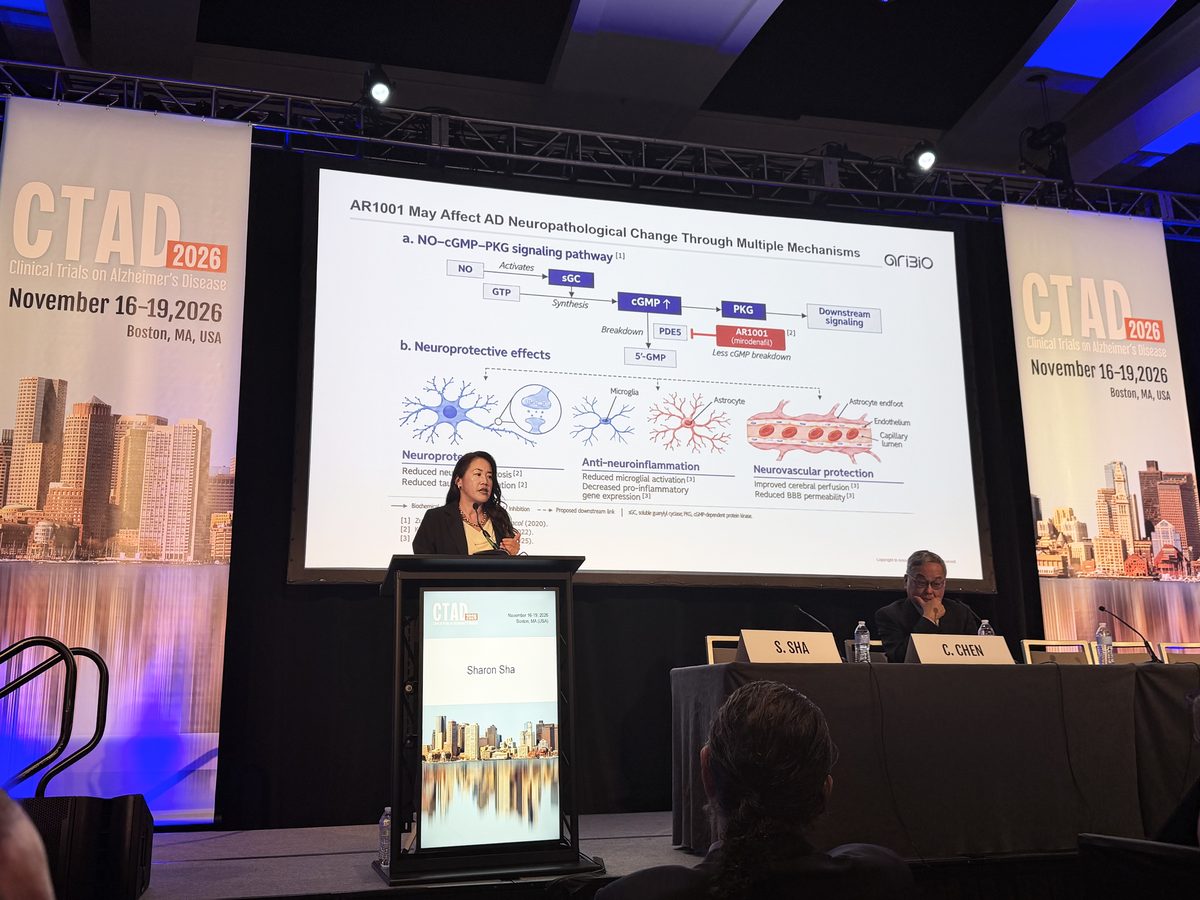
AR1001 is a once-daily tablet that blocks the enzyme PDE5, the same target as Viagra. Jamming that enzyme keeps a vessel-relaxing signal called cGMP switched on longer, and the same signal helps nerve cells strengthen their connections, which is the theory behind testing it in Alzheimer's.

In a 1,535-patient Phase 3 trial, AR1001 slowed cognitive decline by 31% among the 604 participants who took no other dementia drug. Across all 1,535 the slowing was 7% and not statistically significant, so AriBio's path to U.S. approval now runs through a subgroup.

Why it matters

A daily Alzheimer's pill would be easier to distribute than infused antibodies, if the effect holds in a confirmatory trial.

Questions about this story

Free account needed to ask — your question is kept and asked for you right after sign-up. Answers are public.

No questions yet — be the first to ask.

Key Indicators

31%
Slowing of decline, monotherapy group
CDR-SB difference of -0.44 points at 52 weeks (p=0.0266) in 604 patients off other Alzheimer's drugs.
7%
Slowing across all participants
Difference of -0.11 points on the same scale (p=0.40) across 1,535 patients.
604
Patients in the monotherapy group
Pre-specified subset taking no acetylcholinesterase inhibitor or memantine at baseline.
1,535
Phase 3 participants
Enrolled at more than 230 sites in 13 countries, treated for 52 weeks.
33%
Slowing at 78 weeks vs external control
Company comparison against the ADNI untreated cohort, not a randomized group.
0.61
CDR-SB gap versus ADNI at 78 weeks
Company-reported; external controls carry selection bias that a placebo arm avoids.

Voices

Curated perspectives — historical figures and your fellow readers.

Sign up to generate historical perspectives on this story.

People Involved

Organizations Involved

Timeline

3 events Latest: 2 days ago
  1. 78-week extension data released

    Latest Clinical trial

    AriBio reports 33% slowing versus an untreated external cohort and a 0.61-point CDR-SB gap.

  2. Results presented at CTAD in Boston

    Conference

    Outside researchers call the subgroup result promising and ask for further trials before regulators act.

  3. AriBio reports Phase 3 win in monotherapy group

    Clinical trial

    Company says AR1001 slowed decline 31% in 604 patients off other Alzheimer's drugs; the full 1,535-patient group missed.

Scenarios

1

AriBio files an FDA application on the subgroup result

Likely Resolves by End of 2027

Discussed by: AriBio executives, as reported by Chosun Biz

AriBio has said it plans to file. The application would lean on the 604-patient monotherapy result plus biomarker data showing cGMP rose in spinal fluid, betting regulators accept a pre-specified subgroup when the overall trial missed. A filing starts a months-long review, and the FDA can convene an advisory committee of outside scientists.

2

FDA demands a second trial limited to unmedicated patients

Possible Resolves by End of 2028

Discussed by: Trial investigators and outside researchers quoted by The Guardian

If reviewers treat the overall miss as decisive, the agency could refuse to file or issue a complete response letter asking for a trial restricted to patients off other Alzheimer's drugs. That design would be cleaner but slower to enroll, pushing any approval past 2030.

3

A Chinese or global partner licenses AR1001

Possible Resolves by Q2 2027

Discussed by: Fierce Pharma, which reported Fosun Pharma was weighing a licensing option

A license would give AriBio the cash and sales reach for a confirmatory trial and a launch outside Korea. Fosun Pharma, which already sells Alzheimer's products in China, was reported to be evaluating a deal. Terms would signal how much an outside company trusts the subgroup finding.

Historical Context

3 moments from history that rhyme with this story — and how they unfolded.

2021

Sildenafil and the Alzheimer's signal (2021)

Researchers mining U.S. insurance claims reported that people prescribed sildenafil, Viagra's generic, were diagnosed with Alzheimer's less often than comparable people who were not. The study was observational and could not show the drug caused the difference.

Then

Coverage framed sildenafil as a possible dementia drug; the researchers cautioned the link was correlational.

Now

It gave PDE5 inhibitors a rationale for testing in Alzheimer's, the path AR1001 later took.

Why this matters now

AR1001 tests the same enzyme target in a randomized trial, the step the 2021 finding could not take.

2019-2021

Aducanumab's split Phase 3 results (2019-2021)

Biogen's aducanumab produced one positive and one negative late-stage trial. The company halted the program, then revived it after a larger dataset showed a small benefit at a high dose.

Then

The FDA's outside advisers voted against approval; the agency granted accelerated approval in June 2021 anyway.

Now

Medicare limited coverage to patients in trials, uptake stayed minimal, and Biogen withdrew the drug in 2024.

Why this matters now

It shows how regulators handle mixed or subgroup-driven evidence, and how little a contested approval can deliver commercially.

2022-2023

Lecanemab sets the benchmark (2022-2023)

Eisai and Biogen's lecanemab slowed decline by 27% on the CDR-SB at 18 months in the Clarity AD trial, the first clearly positive Phase 3 for an amyloid-clearing antibody.

Then

The FDA granted full approval in July 2023.

Now

It became the reference point for every Alzheimer's drug that followed, including oral ones.

Why this matters now

AR1001's 31% comes from a smaller subgroup over 52 weeks, so the two figures are not directly comparable.

Sources

(9)