

Pull to refresh
Logo
Engineered bacterium enables rapid gene testing across diverse crop species

Engineered bacterium enables rapid gene testing across diverse crop species

New Capabilities

Rhizobium rhizogenes strain AS109 outperforms standard lab strains in most of 30 plant species tested and establishes faba bean as a rapid assay host

3 days ago: PLOS Biology publishes peer-reviewed AS109 study

Overview

Updated 1 hour ago

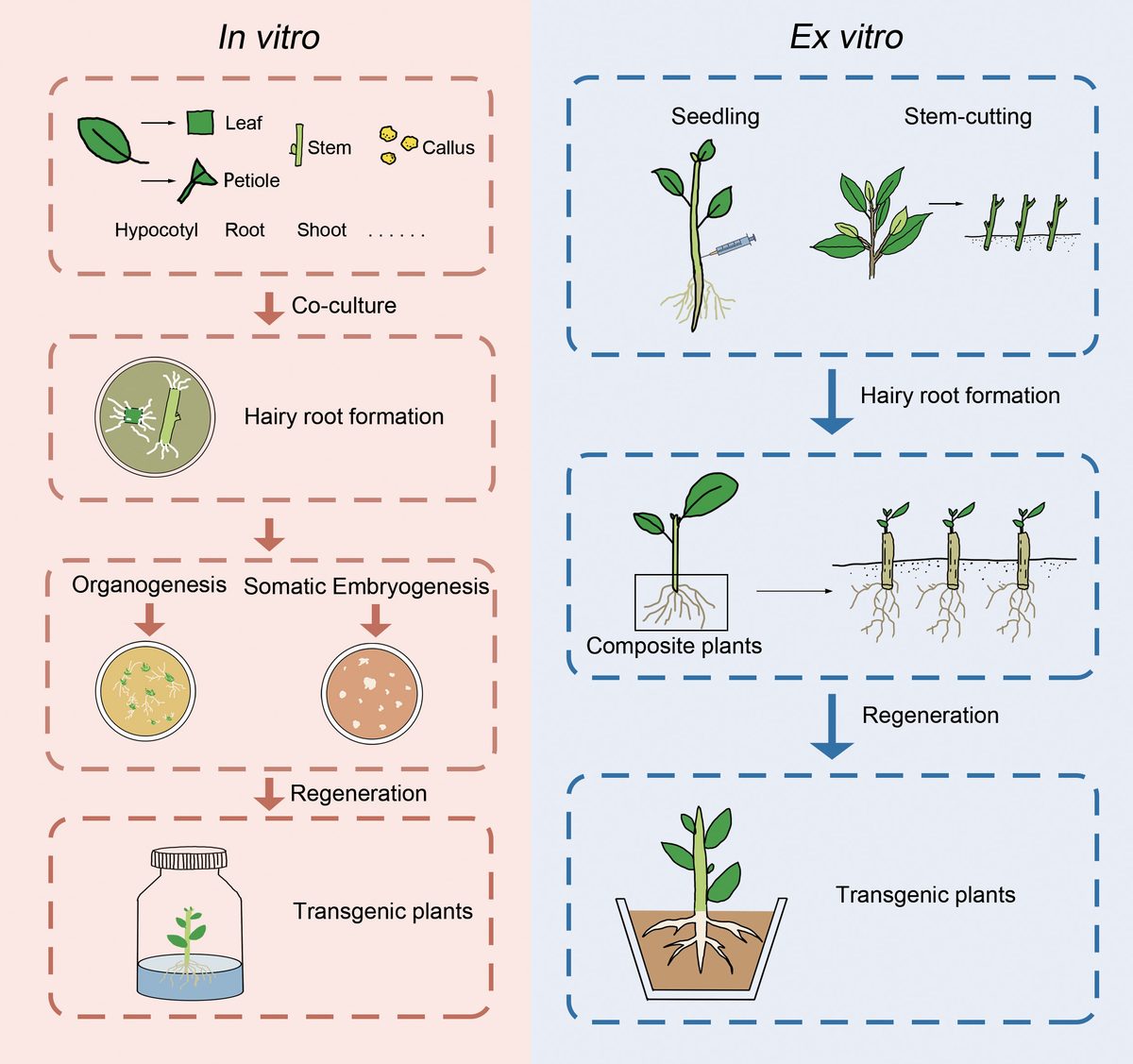
For three decades, rapid plant gene testing has centered on one species: Nicotiana benthamiana, a nightshade that accepts foreign DNA with unusual ease. On October 15, a UK-Taiwan team reported that an engineered bacterium, Rhizobium rhizogenes strain AS109, delivers transient gene expression across most of 30 dicot species tested, including faba bean, cowpea, common bean, and field mustard.

The group established functional assays in faba bean covering protein localization, RNA-interference gene silencing, immune receptor activation screens, and infection cell biology. Disease-resistance genes from nightshades can now be tested in a legume host in days, before committing to the slow stable transformation process. The platform bridges genomics-driven hypothesis generation and experimental testing in crops that previously had no rapid assay.

Why it matters

Legume crops gain a rapid assay for immune gene testing, closing a gap that left them dependent on slow stable transformation.

Questions about this story

Free account needed to ask — your question is kept and asked for you right after sign-up. Answers are public.

No questions yet — be the first to ask.

Key Indicators

30
Dicot plant species tested with AS109
AS109 was compared with five common lab agrobacterial strains across 30 species spanning multiple taxonomic families.
5
Functional assay types established in faba bean
Protein localization, RNAi silencing, elicitor recognition screens, NLR activation, and infection biology all work via AS109 in Vicia faba.
47
Agrobacterial strains screened to find A4
AS109's parent strain, A4, was the strongest transient expression performer among 47 agrobacterial strains tested in N. benthamiana.
2
Tested species without AS109 expression
Soybean and mung bean showed no transient expression with AS109 under the tested conditions.

Voices

Curated perspectives — historical figures and your fellow readers.

Ever wondered what historical figures would say about today's headlines?

Sign up to generate historical perspectives on this story.

People Involved

Organizations Involved

Timeline

April 2026 October 2026

2 events Latest: 3 days ago
  1. PLOS Biology publishes peer-reviewed AS109 study

    Latest Publication

    Peer-reviewed version establishes AS109 as a transient expression platform across diverse crop species with a faba bean assay suite.

  2. Preprint reports AS109 host range across dicots

    Research

    Team posts the broad-host-range AS109 study to bioRxiv, including faba bean functional assays and NLR transfer data.

Scenarios

1

Legume and brassica labs adopt AS109 as standard rapid assay

Likely Resolves by Q2 2029

Discussed by: The paper's authors; commentary in plant science outlets

If AS109 reproduces reliably in other laboratories, it becomes the default transient expression tool for legume and brassica functional genomics. The bottlenecks are reagent distribution and protocol familiarity; the paper provides detailed infiltration methods. Adoption would show up as independent citations and method reuse within two to three years.

2

Soybean and mung bean remain outside AS109's host range

Possible Resolves by End of 2028

Discussed by: The paper's reported failures in these two species

AS109 produced no transient expression in soybean or mung bean, both in the Phaseoleae tribe. If the barrier is biological — defense responses, tissue architecture, or receptor compatibility — extension will require engineering the strain or finding an alternative. This is the default scenario if no follow-up work addresses these species.

3

Legume disease-resistance genes validated through AS109 platform

Possible Resolves by End of 2028

Discussed by: The paper's discussion of extending NLR discovery to Fabaceae

The study already shows Solanaceae NLR pairs retain effector recognition in faba bean. If adoption spreads, the next step is screening legume immune receptors and pathogen effectors in faba bean, accelerating resistance-gene cloning in crops like pea, lentil, and chickpea where transformation is slow. This would mark a genuine translational outcome of the platform.

Historical Context

2 moments from history that rhyme with this story — and how they unfolded.

2006

Hairy root transformation in Phaseolus beans (2006)

Researchers transformed Phaseolus vulgaris, P. coccineus, P. lunatus, and P. acutifolius with Agrobacterium rhizogenes (now Rhizobium rhizogenes) to induce hairy roots, using root tissue for gene expression studies. It was the most advanced functional genomics tool legumes had.

Then

Hairy-root assays became the standard functional genomics approach for legumes, enabling RNAi and promoter studies in root tissue.

Now

Leaf-level transient expression remained unavailable for legumes, leaving foliar immunity and pathogen-interaction studies inaccessible.

Why this matters now

The 2006 work used the same bacterial genus to transform legumes but only reached root tissue. AS109 extends that genus to rapid leaf-level transient expression, enabling immune receptor and pathogen assays hairy roots could not provide.

Late 1990s-2000s

Nicotiana benthamiana becomes the transient expression standard (early 2000s)

Agroinfiltration in Nicotiana benthamiana — syringe-injecting Agrobacterium into leaves for rapid transgene expression — became the default assay in plant biology. Viral silencing suppressors like p19 pushed expression high enough for structural biology.

Then

The platform accelerated plant immunity research, enabling rapid effector-receptor interaction tests and protein structure studies.

Now

Its dependence on one plant family (Solanaceae) left most crop families without an equivalent rapid assay.

Why this matters now

AS109 inherits the agroinfiltration paradigm but broadens its host range, applying the same rapid leaf-assay logic to legume, brassica, and other species that previously had no equivalent.

Sources

(6)