
Pull to refresh
Logo
Euclid, built to map dark matter, finds its first new comet

Euclid, built to map dark matter, finds its first new comet

New Capabilities

A Helsinki doctoral student's detection software flagged the object in September; the Minor Planet Center confirmed it on October 8 as C/2026 S1 (Euclid).

Overview

Updated 1 hour ago

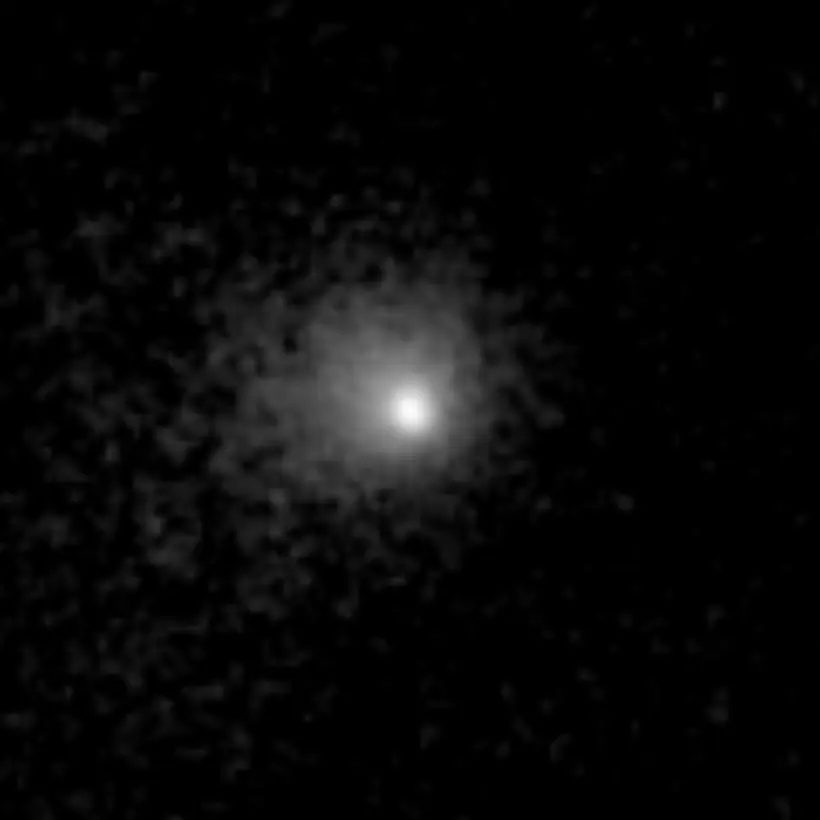
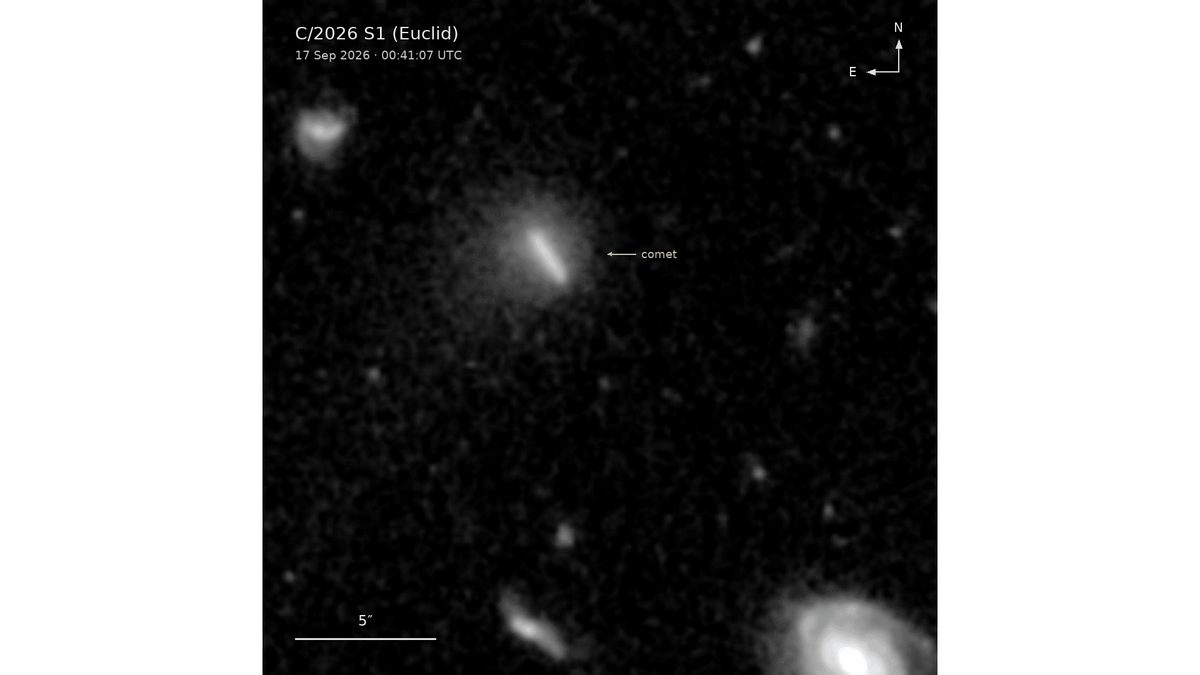
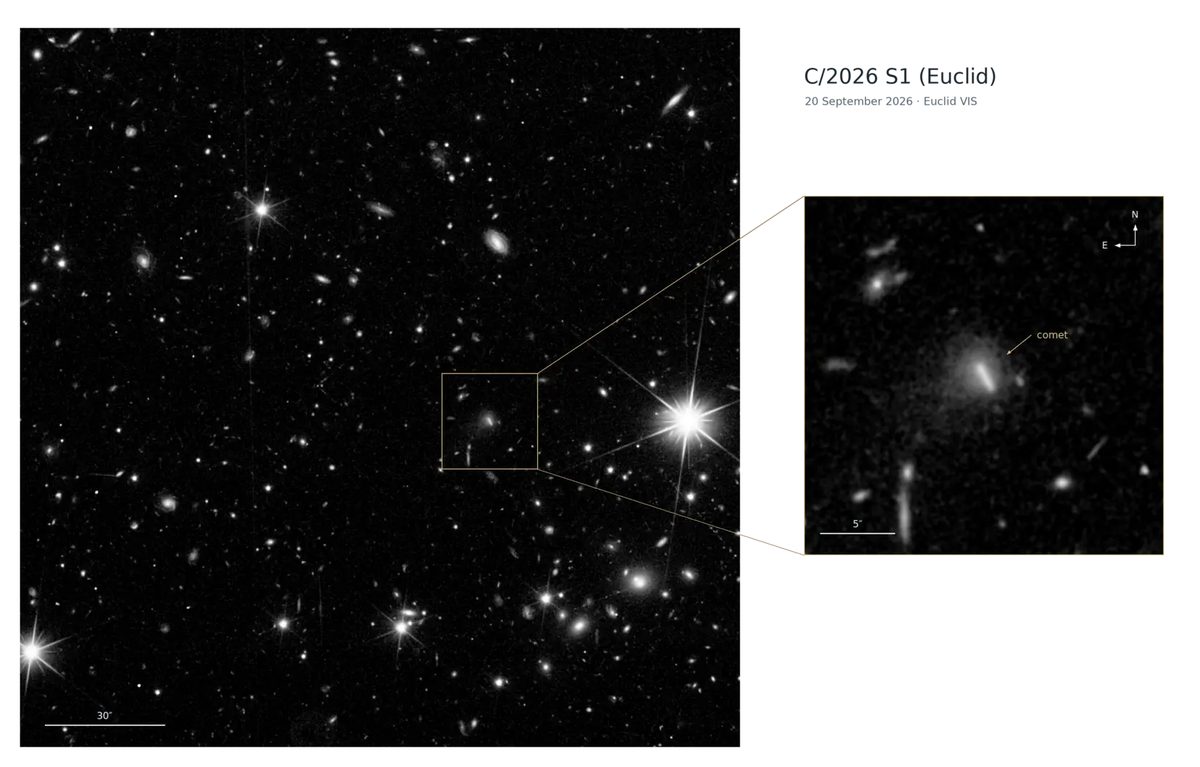
Euclid's job is to photograph distant galaxies so astronomers can map dark matter and dark energy. On September 16, 2026, it caught something much closer: a fast-moving object smeared across five fields of view, with a fuzzy cloud of dust around it.

The International Astronomical Union's Minor Planet Center confirmed it on October 8 as a comet no one had recorded before. It is now C/2026 S1 (Euclid), roughly 1.3 billion kilometers from Earth, on a path tilted far out of the flat plane where the planets orbit.

Comets are easiest to reach when they are found years before arrival. ESA's Comet Interceptor is designed to wait in space for exactly that kind of target, and the discovery gives the two mission teams a live rehearsal for the alert.

Why it matters

Comet Interceptor needs a comet found years before it arrives. Euclid just showed its archive can flag one and raise the alarm in time.

Questions about this story

Free account needed to ask — your question is kept and asked for you right after sign-up. Answers are public.

No questions yet — be the first to ask.

Key Indicators

1.3B km
Distance from Earth
Roughly the distance from the Sun to a point between the orbits of Jupiter and Saturn.
5
Fields of view containing the comet
The object appeared in five separate Euclid fields during the September scan.
16
Exposures captured
Between two and four exposures were taken of each field that held the comet.
Thousands of years
Orbital period
The comet arcs high above the planets' plane rather than travelling within it.

Voices

Curated perspectives — historical figures and your fellow readers.

Sign up to generate historical perspectives on this story.

People Involved

Organizations Involved

Timeline

September 2026 November 2026

3 events Latest: 2 days ago
  1. Detection, alert and orbit described in full

    Latest Announcement

    Published accounts detail the software, the catalogue checks and the comet's steep orbit.

  2. Minor Planet Center confirms a new comet

    Confirmation

    The object is designated C/2026 S1 (Euclid), the mission's first previously unknown comet.

  3. Euclid images the comet in five fields

    Detection

    Sixteen exposures across nine days capture a fast-moving object with a fuzzy coma.

Scenarios

1

Euclid's software flags a second new comet

Possible Resolves by End of 2027

Discussed by: Euclid Consortium Solar System Objects Science Working Group

Pöntinen's moving-object code keeps running over Euclid's archive as the survey adds images. The team itself says very few comets are expected, because the telescope avoids the crowded band of the solar system and rarely revisits a patch of sky. A second detection would need another chance alignment between a comet's path and the scanning schedule, plus the same multi-frame confirmation.

2

Follow-up observations pin down the comet's orbit and origin

Likely Resolves by Q2 2028

Discussed by: Minor Planet Center and ground-based follow-up observers

The comet reaches its closest point to the Sun in September 2027, at roughly 2.08 astronomical units, and ground telescopes have a limited window to track it before and after. More positions let astronomers calculate its orbital period precisely and judge whether it came from the distant Oort Cloud or somewhere nearer. This is the routine path most new comets take once the alert goes out.

3

Comet Interceptor flies to a comet Euclid found first

Unlikely Resolves by End of 2031

Discussed by: ESA project scientists and the Comet Interceptor team

Comet Interceptor is built to choose its target after launch, which only works if survey telescopes can spot a pristine comet years ahead. Euclid has now demonstrated the detection and alert chain once. A Euclid-flagged comet becoming the actual destination would require the object to pass the mission's criteria for a first-time visitor, and the team has said this comet does not.

Historical Context

3 moments from history that rhyme with this story — and how they unfolded.

June 2021

Dark Energy Survey finds Comet Bernardinelli–Bernstein (2021)

Two graduate students, Pedro Bernardinelli and Gary Bernstein, searched six years of Dark Energy Survey images for moving objects and found a giant comet inbound from the outer solar system. The object was roughly 100 kilometers across and would not reach its closest point to the Sun until 2031.

Then

It was announced as the largest comet then known, found in data collected for a cosmology project.

Now

It showed that survey archives, reprocessed with moving-object software, can produce major comet discoveries years before the objects arrive.

Why this matters now

Euclid's find followed the same route: cosmology images, detection code, and a comet identified long before its closest approach to the Sun.

1983

IRAS spots comets during an infrared sky survey (1983)

The Infrared Astronomical Satellite was built to survey the sky in infrared and map dust and galaxies. During its ten months of operation it also picked up comets, including C/1983 H1, named IRAS–Araki–Alcock after the satellite and two amateur astronomers who found it independently as it passed near Earth.

Then

The comet made an unusually close pass by Earth, and IRAS data added to the observations of it.

Now

It set a pattern in which survey instruments built for other science quietly add to the comet catalogue.

Why this matters now

Euclid is the same kind of instrument: a survey telescope with no comet-hunting mandate that still produces comets as a by-product.

1995 to present

SOHO becomes the most prolific comet finder (1995–present)

The Solar and Heliospheric Observatory was launched to watch the Sun's atmosphere and the solar wind. Its coronagraph, which blocks the Sun's glare, turned out to be an efficient comet detector. Thousands of comets have been found in its images, most of them fragments of the Kreutz family, many identified by amateur volunteers reviewing public data.

Then

Comet discovery shifted from dedicated hunts toward mining archives of instruments built for other purposes.

Now

Volunteer review and automated searches of archived images became a standard part of comet discovery.

Why this matters now

Pöntinen's software does for Euclid's deep-sky images what SOHO's archive did for solar physics: turns another mission's data into comet discoveries.

Sources

(7)