
Pull to refresh
Logo
Daily Brief
Following
Why Ranks Sign Up
AMD ships MI400 GPUs and Helios rack to challenge Nvidia

AMD ships MI400 GPUs and Helios rack to challenge Nvidia

New Capabilities

OpenAI, Meta, Microsoft, and Oracle commit to AMD's data-center AI chips as volume production begins

Yesterday: AMD launches MI400 and Helios at volume

Overview

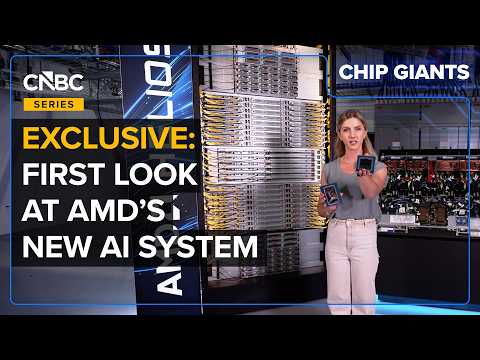
For a decade, training a large AI model meant buying Nvidia. On July 23, 2026, AMD put a second option on the table at volume: the Instinct MI400 GPU and a full rack system called Helios, already booked by OpenAI, Meta, Microsoft, and Oracle.

The stakes are the supply of AI compute itself. Nvidia still holds an estimated 80 to 90 percent of the market. If AMD's hardware performs as promised, the companies building AI now have a real second supplier, which changes pricing, availability, and who controls the buildout.

Why it matters

A credible second supplier of AI chips means lower prices and faster availability for the compute that powers nearly every AI product people use.

Questions about this story

No questions yet — be the first to ask.

Key Indicators

12 GW
Capacity committed by OpenAI and Meta
Combined power capacity of AMD deployments the two firms have pledged, at 6 gigawatts each.
40 PFLOPS
Peak low-precision compute, MI455X
The flagship chip's rated FP4 performance, AMD's measure of AI throughput.
432 GB
HBM4 memory per GPU
More onboard memory than Nvidia's competing Rubin chip, which carries 288 gigabytes.
~85%
Nvidia's AI accelerator market share
Estimated share AMD is trying to erode, per industry analyst figures.
$5.8B
AMD quarterly data-center revenue
Against Nvidia's $75.2 billion in the same period, showing the gap AMD is closing.

Voices

Curated perspectives — historical figures and your fellow readers.

Ever wondered what historical figures would say about today's headlines?

Sign up to generate historical perspectives on this story.

Play

Exploring all sides of a story is often best achieved with Play.

Log in to play. Track your picks, climb the leaderboards. Log in Sign Up
Predict 3 ways this could play out. Contrarian picks score more — points lock when the scenario resolves. Log in to play
Higher or Lower Two numbers from this story. Guess which is bigger. 5 rounds to set a streak. Log in to play
Connections Sixteen names from the news. Find the four hidden groups of four. Log in to play

People Involved

Organizations Involved

Timeline

October 2025 July 2026

4 events Latest: Yesterday
Tap a bar to jump to that date
  1. AMD launches MI400 and Helios at volume

    Latest Product Launch

    At the Advancing AI 2026 keynote in San Francisco, AMD details volume production of the MI400 series, the Helios rack, and the EPYC 'Venice' processor, naming OpenAI, Meta, Microsoft Azure, and Oracle as customers.

  2. Meta expands AMD partnership to 6 gigawatts

    Partnership

    Meta enlarges its AMD commitment to 6 gigawatts, bringing the combined OpenAI and Meta total to 12 gigawatts of planned deployments.

  3. AMD reveals full MI400 lineup at CES

    Product Reveal

    Lisa Su presents five MI400 accelerators and the Helios rack, with the flagship MI455X rated at up to 40 petaflops of FP4 compute. Production is targeted for the second half of 2026.

  4. OpenAI commits to 6 gigawatts of AMD GPUs

    Partnership

    AMD and OpenAI announce a multi-year deal for 6 gigawatts of Instinct GPUs, with warrants for up to 160 million AMD shares. It is the first anchor commitment for the coming MI400.

Historical Context

2 moments from history that rhyme with this story — and how they unfolded.

June 2017

AMD EPYC breaks Intel's server grip (2017)

AMD launched its first EPYC server processors under Lisa Su, targeting a data-center market where Intel held well over 95 percent share. Early buyers were skeptical of switching. AMD competed on core count, memory, and price.

Then

Adoption was slow at first as customers tested reliability and software support.

Now

Over several years EPYC took more than a third of the server CPU market, proving AMD could unseat an entrenched leader.

Why this matters now

The MI400 follows the same playbook against Nvidia that EPYC ran against Intel: a credible challenger chipping away at a near-monopoly over years, not months.

2006 onward

Nvidia's CUDA lock-in builds a moat (2006 onward)

Nvidia released CUDA, a software platform that made its GPUs the default for scientific and later AI computing. Developers built their tools around it. Rivals with competitive hardware still struggled because the software ran on Nvidia.

Then

CUDA drove GPU adoption in research and finance well before the AI boom.

Now

It became Nvidia's deepest advantage, locking in customers even when competing chips matched on raw specs.

Why this matters now

AMD's hardware can match Nvidia on memory and compute, but the harder fight is software. Whether developers port workloads to AMD's ROCm platform will decide if MI400 sells.

Sources

(7)