


Pull to refresh
Logo
Daily Brief
Following
Why Sign Up
Benin's democratic model erodes as opposition is systematically excluded from elections

Benin's democratic model erodes as opposition is systematically excluded from elections

Rule Changes
By Newzino Staff |

Once the cradle of West African democracy, Benin holds a presidential vote with only a token challenger after a decade of tightening electoral rules under Patrice Talon

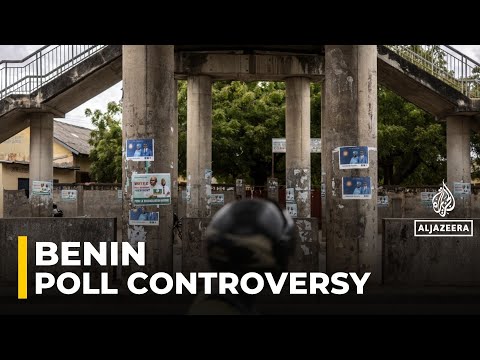
Yesterday: Benin votes with only two candidates and low turnout

Overview

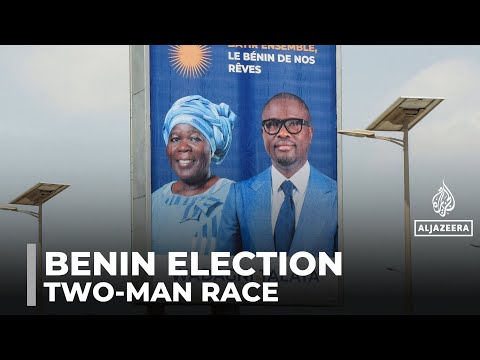
Benin held its presidential election on April 12 with only two candidates on the ballot after the main opposition party was barred from competing. Finance Minister Romuald Wadagni, endorsed by outgoing President Patrice Talon, faced Paul Hounkpè of the Cowry Forces for an Emerging Benin party in a contest whose outcome was never seriously in doubt. Polling stations in the economic capital Cotonou were sparsely attended.

Why it matters

A country that was the model for African democratization now demonstrates how incumbents can dismantle competitive elections through legal engineering.

Key Indicators

2
Candidates on the presidential ballot
Down from six in the 2016 election that brought Talon to power
0
Opposition seats in the National Assembly
Talon's two allied parties hold all 109 seats after January 2026 parliamentary elections
15%
Sponsorship threshold for presidential candidates
Raised from 10% in a 2024 reform, requiring endorsement from elected officials the opposition no longer has
7%
GDP growth in 2025
Benin's economy is one of West Africa's strongest performers, complicating the narrative of pure decline
~23%
Voter turnout in restricted elections
Turnout collapsed from 66% when elections were competitive to roughly 23% in 2019, with similarly low figures expected

Interactive

Exploring all sides of a story is often best achieved with Play.

Ever wondered what historical figures would say about today's headlines?

Sign up to generate historical perspectives on this story.

Sign Up

Debate Arena

Two rounds, two personas, one winner. You set the crossfire.

People Involved

Organizations Involved

Timeline

  1. Benin votes with only two candidates and low turnout

    Election

    Voters chose between Wadagni and Hounkpè in a presidential election widely seen as predetermined. Polling stations in Cotonou were sparsely attended. Provisional results were expected within 48 hours.

  2. Constitutional Court bars opposition candidate from presidential ballot

    Legal

    Les Démocrates leader Renaud Agbodjo was disqualified for failing to secure the required 15% of elected officials' endorsements — a threshold now impossible to meet with no opposition members in the National Assembly. The party declined to endorse an alternative candidate.

  3. Parliamentary elections leave opposition with zero seats

    Election

    Talon's two allied parties — Progressive Union for Renewal and Republican Bloc — won all 109 National Assembly seats. Les Démocrates won about 16% of the vote but failed to meet the 20% threshold required in each of 24 electoral districts. This left the opposition unable to sponsor a presidential candidate.

  4. Military coup attempt fails after loyalist forces intervene

    Military

    Lieutenant Colonel Pascal Tigri and a group of soldiers seized state television and declared Talon removed from office. The Republican Guard repelled the mutineers within hours. ECOWAS deployed troops from Nigeria, Sierra Leone, Ivory Coast, and Ghana. Tigri fled to Burkina Faso via Togo. The plotters cited the jihadist insurgency in the north and neglect of soldiers' families.

  5. Electoral code amended to raise presidential sponsorship threshold to 15%

    Legislation

    The National Assembly raised the required endorsement threshold for presidential candidates from 10% to 15% of elected representatives and mayors. The new figure matched the exact number of sponsorships held by Les Démocrates, raising suspicions it was tailored to exclude them.

  6. Talon wins reelection with 86% amid opposition boycott

    Election

    Talon was reelected in a vote boycotted by major opposition parties. Key challengers were either in prison or barred from running. The election was held amid protests and reports of voter intimidation.

  7. Opposition leader Reckya Madougou arrested before presidential vote

    Arrest

    Madougou, a former justice minister planning to challenge Talon, was arrested on terrorism charges. Constitutional law professor Joël Aïvo was also detained. By April 2021, at least 400 people had been arrested on political charges.

  8. Parliamentary elections held with zero opposition parties on ballot

    Election

    All opposition parties were excluded after failing to meet new registration requirements. Only two pro-Talon parties competed. Turnout collapsed to 23% from 66% in the prior election. Security forces killed at least seven protesters, and the government shut down the internet on election day.

  9. Charter of Political Parties imposes stringent party registration rules

    Legislation

    Talon pushed through reforms requiring parties to meet high registration requirements, beginning the consolidation of the political landscape that would squeeze out smaller and opposition parties.

  10. Cotton magnate Patrice Talon wins presidency

    Election

    Talon, one of Benin's wealthiest businessmen, won the presidency in a competitive six-candidate race, promising to serve only a single term and to reform the country's institutions.

  11. Benin's National Conference establishes multiparty democracy

    Political

    A sovereign national conference of delegates from across Beninese society drafted a new democratic constitution, ending 17 years of Marxist-Leninist single-party rule under General Mathieu Kérékou. Benin became the model for democratic transitions across francophone Africa.

Scenarios

1

Wadagni wins, continues Talon's system with an economic mandate

Discussed by: France 24, Al Jazeera, and most election analysts consider this the near-certain outcome

Wadagni wins comfortably and governs as a continuity candidate, maintaining Talon's economic program and the electoral framework that excludes opposition. With all 109 Assembly seats held by allied parties, he faces no institutional check on executive power. His legitimacy rests on economic performance — 7% growth, Eurobond credibility — rather than democratic competition. The question becomes whether voter apathy deepens or economic results sustain passive acquiescence.

2

Growing internal pressure forces partial democratic reopening

Discussed by: Ghana Center for Democratic Development, Africa Center for Strategic Studies, and Carnegie Endowment analysts

Persistently low turnout and international criticism erode the new president's legitimacy. Combined with the security costs of the northern jihadist insurgency and the memory of the December 2025 coup attempt, Wadagni calculates that controlled liberalization — releasing political prisoners, lowering electoral thresholds — is safer than continued exclusion. This would follow the pattern of Senegal, where institutional pressure eventually produced a genuine opposition victory in 2024.

3

Military instability returns as democratic channels stay closed

Discussed by: Al Jazeera opinion writers, West Africa security analysts, and researchers tracking the Sahel spillover

The December 2025 coup attempt demonstrated that closed political systems generate pressure that can escape through military channels. If Wadagni maintains Talon's exclusionary framework while the jihadist insurgency in the north worsens, a future coup attempt could draw on both military grievances and popular frustration with rigged elections. The coup plotters who fled to Burkina Faso and Niger — both now military-ruled — may find willing patrons.

4

Opposition regroups outside formal politics, builds pressure through protests and diaspora

Discussed by: Democracy in Africa, International Institute for Security Studies (ISS Africa)

With all institutional avenues blocked, opposition energy channels into street protests, civil society organizing, and diaspora advocacy — the same pattern that preceded the 1990 National Conference. This would not produce immediate change but could build toward a crisis point, particularly if economic growth slows or the security situation deteriorates. The risk is that the government responds with further repression, deepening the cycle.

Historical Context

Benin's own National Conference (1990)

February 1990

What Happened

Facing economic bankruptcy and months of unpaid public salaries, military ruler Mathieu Kérékou convened a national conference of delegates from across Beninese society. The conference declared itself sovereign, drafted a democratic constitution, and organized competitive multiparty elections in 1991. Benin became the first francophone African country to transition peacefully from authoritarian rule to democracy.

Outcome

Short Term

Kérékou lost the 1991 election to Nicéphore Soglo and peacefully handed over power — a first in the region.

Long Term

Benin became 'the school of democracy' for West Africa, inspiring national conferences in Niger, Togo, and Congo. The country completed three consecutive peaceful transfers of power between 1991 and 2016.

Why It's Relevant Today

The 1990 conference is the benchmark against which Benin's current trajectory is measured. A country that pioneered African democratization is now demonstrating how that same democracy can be dismantled through legal engineering rather than military force.

Ivory Coast's exclusionary elections under Ouattara (2025)

October 2025

What Happened

President Alassane Ouattara, 83, won a fourth term after his main challenger Tidjane Thiam — a former Credit Suisse chief executive — was barred from running on a dual-nationality technicality. Turnout was low and streets were empty on election day.

Outcome

Short Term

Ouattara won without meaningful competition. International criticism was muted.

Long Term

The election reinforced a regional pattern: incumbents in Ivory Coast, Cameroon, Togo, and now Benin using legal technicalities to eliminate challengers while maintaining the appearance of electoral process.

Why It's Relevant Today

Benin's 2026 election follows the same playbook as Ivory Coast's 2025 vote: raise legal barriers high enough that opposition candidates cannot clear them, then hold an election with a compliant challenger. The parallel shows this is becoming a regional governance model, not an isolated case.

Senegal's democratic resilience (2024)

March 2024

What Happened

After President Macky Sall attempted to postpone elections and imprison opposition candidate Ousmane Sonko, sustained popular pressure and institutional resistance forced the vote to proceed. Sonko's proxy candidate Bassirou Diomaye Faye won the presidency in the first round, marking a genuine democratic transfer of power.

Outcome

Short Term

Sall conceded and left office. Faye became Africa's youngest elected president at 44.

Long Term

Senegal's result demonstrated that democratic backsliding is not inevitable in West Africa — institutions and popular mobilization can push back.

Why It's Relevant Today

Senegal is the counter-example to Benin. Both countries faced incumbent attempts to constrain opposition, but Senegal's institutions held. The contrast raises the question of whether Benin's erosion is now too advanced for a similar correction, or whether popular frustration could eventually produce a similar reckoning.

Sources

(12)