Anchor

Bessent's $6 billion operation to cool the bond market sent the 10-year yield to 4.85%, its highest since November 2023.
Today: Buyback operation scheduledNew here? Follow stories to track developments over time. Create a free account to get updates when stories you care about change.
Overview
Updated 1 hour agoTreasury Secretary Scott Bessent announced a $6 billion bond buyback Wednesday to cool a debt-market "fever" he blames on the financial press. Yields jumped instead: the 10-year Treasury hit 4.85%, its highest since November 2023, and the Nasdaq fell 0.8%.
The reversal shows the limits of Bessent's reach into a bond market stressed by the Iran war, oil above $100 a barrel, and a national debt that just passed $40 trillion. Rising long-term yields mean pricier mortgages, costlier debt service, and fresh pressure on the Trump administration's economic plans.
Why it matters
Rising long-term yields push up mortgage rates and federal debt-service costs — and this intervention made them higher, not lower.
Questions about this story
Free account needed to ask — your question is kept and asked for you right after sign-up. Answers are public.
No questions yet — be the first to ask.
Key Indicators
4.85%
10-year Treasury yield
Highest close since November 2023, after the buyback announcement.
5.30%
20- and 30-year Treasury yields
Both maturities surged to about 5.3% on the same day.
$6 billion
Planned Treasury buyback
Triple the standard $2 billion operation, but at the low end of what dealers expected.
$40 trillion+
US national debt
Crossed the $40 trillion mark as the yield surge raised servicing costs.
$100+/barrel
Brent crude
Topped $100 after strikes on Iranian energy infrastructure, feeding inflation fears.
Related Media
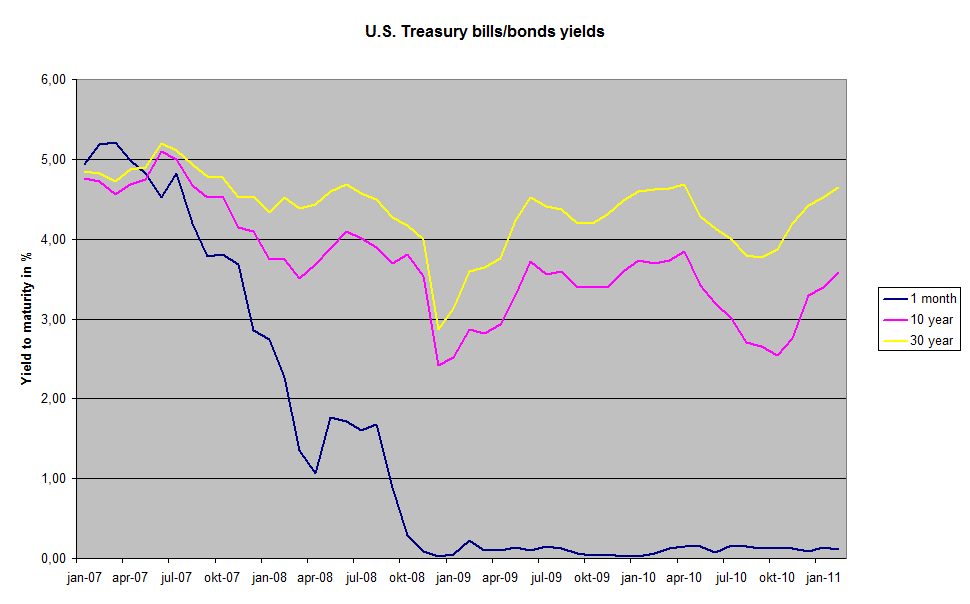
File:US Treasury bills and bonds yield.png
Captivating view of the US Treasury Department facade with columns and American flag at dusk.
148.9K views
4:31
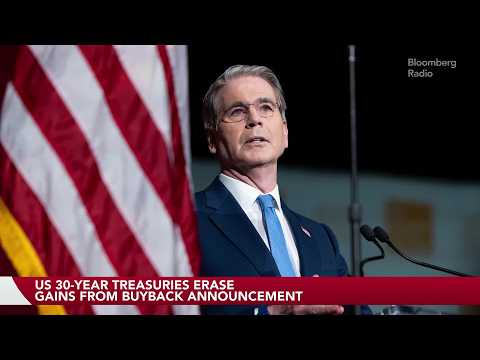
US 30-Year Bonds Erase Gains From Treasury's Buyback ...
Bloomberg Podcasts

14.0K views
8:05
Can Treasury buybacks stop rising US bond yields? | Morning Bid
Reuters
123.5K views
6:46
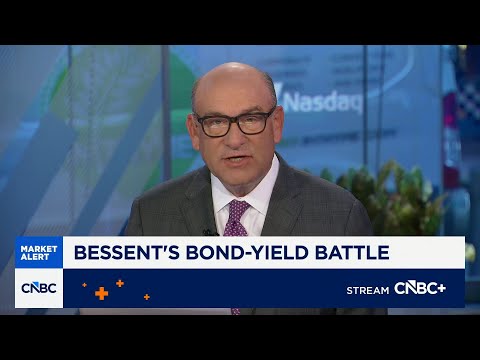
Treasury Secretary Bessent's bond-yield battle: Here's what to ...
CNBC Television
Images from Openverse under Creative Commons licenses. Videos from YouTube.
Voices
Curated perspectives — historical figures and your fellow readers.
Play
Exploring all sides of a story is often best achieved with Play.
Most of these play right now — no account needed. Sign up to save scores, keep a streak, and unlock Debate and Predict.
Log in
Sign Up
Higher or Lower
A number from this story, against one from elsewhere in the news — guess which is bigger, then keep the chain going. 5 rounds, 3 strikes; a miss costs a strike and resets your streak.
Example
Anchor
EU tariff revenue
$52B
Big for this kind of number
Mystery
Pentagon AI contract
?
Round 1
Streak: 0
Mystery
?
Keyboard: ↓/L lower · ↑/H higher
0 pts
Best streak: 0 · Rounds: 0
0 points — sign up to put that on the leaderboard.
Now try on this story
Connections
Sixteen names from the news. Find the four hidden groups of four. Four mistakes max.
Loading today's puzzle…
0/4 groups
Mistakes
Sign up to keep a daily streak — a new puzzle lands every day.
Now try on this story
Exit debate?
Your progress in this debate will be lost.
How it works
- 1 Two AI personas square off on this story.
- 2 You predict who'll win each round — correct picks earn XP.
- 3 One crossfire question is yours to fire. Pick it carefully.
Couldn't generate a topic
Select Your Champions
Choose one persona for each side of the debate
DEBATE TOPIC
Choose personas with different perspectives for a more dynamic debate.
SIDE A (PRO)
Select debater for this side:
No debate personas available right now.
SIDE B (CON)
Select debater for this side:
No debate personas available right now.
VS
Get ready to make your prediction...
Round of
Claim
Evidence
Stakes
Crossfire Answer
Closing Statement
Claim
Evidence
Stakes
Crossfire Answer
Closing Statement
Your Crossfire Question
Generating arguments...
Who's Got This Round?
Make your prediction before the referee scores
The referee scores both sides on
Correct predictions earn +20 XP
· Press 1 or 2 to pick
Evidence
40%
Logic
30%
Detail
20%
Style
10%
Round Results
Your Pick
Not this time
(%)
Overall Score
/10
Your Pick
Not this time
(%)
Overall Score
/10
Set the Crossfire
Pick the question both personas must answer in the final round
Crafting crossfire questions...
Choosing a question earns +10 XP crossfire bonus
🏆
Total XP Earned
Cred Change
Predictions
Debate Oracle! You called every round!
Sharp Instincts! You know your debaters!
The Coin Flip Strategist! Perfectly balanced!
The Contrarian! Bold predictions!
Inverse Genius! Try betting the opposite next time!
XP Breakdown
Base completion
+20 XP
Rounds played ( rounds x 5 XP)
+ XP
Correct predictions ( correct x 20 XP)
+ XP
Crossfire bonus
+10 XP
Accuracy
%
Prediction History
Round
You picked:
✓
✗
Now try on this story
Keep debating to level up your credibility and unlock achievements
People Involved
Organizations Involved
U.S. Department of the Treasury
Federal Agency
Running expanded buyback operations to support the bond market
The Treasury announced it would repurchase up to $6 billion of longer-term debt, triple its usual buyback size.
Board of Governors of the Federal Reserve System
Central Bank
Signaling a possible need for higher rates under chair Kevin Warsh
The Fed's July minutes raised the potential need for rate hikes unless inflation cools, a signal that fed the yield surge.
Timeline
July 2026 September 2026
5 events
Latest: Today
Tap a bar to jump to that date
-
Buyback operation scheduled
Today PolicyTreasury is set to repurchase up to $6 billion of 10- and 20-year bonds in its Thursday operation.
-
Treasury's $6 billion buyback backfires
PolicyTreasury announces an up-to-$6 billion buyback; the 10-year yield jumps to 4.85%, the S&P 500 falls 0.6%, and the Nasdaq falls 0.8%.
-
Brent crude tops $100 a barrel
MarketOil surged after reports of strikes targeting Iranian energy infrastructure, deepening inflation fears.
-
Treasury doubles its buyback program
PolicyTreasury commits to buying at least $4 billion of long bonds per operation, up from $2 billion, for September through November.
-
Warsh press conference spooks bond markets
StatementNew Fed chair Kevin Warsh declined to commit the Fed to curbing inflation; long yields began a sharp climb.
Historical Context
3 moments from history that rhyme with this story — and how they unfolded.
September 2011 - December 2012
Operation Twist (2011-2012)
The Fed sold short-term Treasuries and bought long-term ones, aiming to push down long yields without printing money. It repeated the program in 2012.
Then
Long yields dipped modestly, then resumed their drift higher within months.
Now
Studies found the effect on yields small and temporary, cementing a verdict that duration-based interventions barely move markets against fundamentals.
Why this matters now
Bessent's buybacks are a duration-based intervention, and the 2011 experience predicts the muted, temporary effect investors are pricing in.
May - July 2013
The 2013 Taper Tantrum
In May 2013, Fed chair Ben Bernanke said the Fed could slow its bond purchases. Ten-year Treasury yields jumped roughly a percentage point in weeks, and global markets sold off.
Then
The Fed delayed tapering for months, but long rates stayed high regardless.
Now
The episode became shorthand for how a single policy signal can move long yields against an official's wishes.
Why this matters now
Warsh's July press conference played a similar role in 2026, and Bessent's response shows officials lack a quiet tool to undo the move.
September 2016 - March 2024
Japan's yield curve control (2016-2024)
The Bank of Japan pledged to cap 10-year government bond yields near zero, buying unlimited bonds to defend the line. It pushed the cap to 0.25%, then 0.5%, then 1% as markets kept testing it.
Then
The BoJ bought ever-larger volumes and kept missing its targets as yields pressed against the cap.
Now
In March 2024 the BoJ abandoned yield curve control, capping eight years of losing stands against market pressure.
Why this matters now
It is the modern case study of an official ceiling on long bond yields: authorities can delay pressure but cannot cap it forever. Bessent's buybacks are a milder version of the same fight.
Sources
(10)Related Stories
Treasury triples long-term debt buybacks as yields hit 2007 levels
Money Moves
Updated Yesterday
Scott Bessent’s farmland divestiture: ethics clash inside Trump’s Treasury
Money Moves
Updated May 10
Treasury Secretary Bessent's congressional confrontations
Rule Changes
Updated May 27
Wall Street confronts stagflation trap as job losses collide with an oil shock
Money Moves
Updated May 30
Precious metals flash crash: The Warsh shock
Money Moves
Updated May 26
Bank of Japan's market operations track the unwinding of its easing era
Money Moves
Updated Aug 24