



Pull to refresh
Logo
Daily Brief
Following
Why Sign Up
Bezos bets on physical AI with Project Prometheus

Bezos bets on physical AI with Project Prometheus

Money Moves
By Newzino Staff |

The Amazon founder's startup trains AI on real-world physics data, targeting manufacturing and engineering

Today: Prometheus nears $10B raise at $38B valuation

Overview

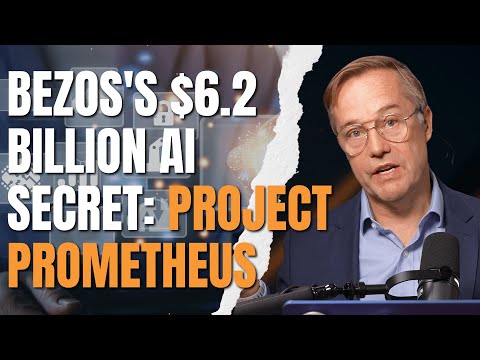
Jeff Bezos stepped down as Amazon's chief executive in 2021. Now he's back running a company — and it has nothing to do with e-commerce. Project Prometheus, the physical artificial intelligence startup Bezos co-founded in November 2025, is nearing completion of a $10 billion funding round at a $38 billion valuation, with BlackRock and JPMorgan among the investors. The round would bring total funding past $16 billion in under six months.

Why it matters

If physical AI works at scale, it reshapes how everything from semiconductors to aircraft gets designed and built.

Key Indicators

$38B
Current valuation
Reached in under six months from founding, before any publicly known product
$16B+
Total funding raised
Combines the $6.2 billion launch round with the current $10 billion raise
<1%
AI penetration in global manufacturing
The $16.8 trillion manufacturing sector has barely begun adopting AI
120+
Employees hired by December 2025
Researchers recruited from Meta, OpenAI, and Google DeepMind

Interactive

Exploring all sides of a story is often best achieved with Play.

Ever wondered what historical figures would say about today's headlines?

Sign up to generate historical perspectives on this story.

Sign Up

Debate Arena

Two rounds, two personas, one winner. You set the crossfire.

People Involved

Organizations Involved

Timeline

  1. Prometheus nears $10B raise at $38B valuation

    Funding

    The Financial Times reported that the startup was close to completing a $10 billion funding round backed by BlackRock and JPMorgan, bringing total capital raised past $16 billion in under six months.

  2. Prometheus poaches xAI co-founder from OpenAI

    Hiring

    Kyle Kosic, one of xAI's first eleven employees and a builder of the Colossus supercomputer, left OpenAI to join Prometheus — highlighting the intensifying AI talent war.

  3. Reports emerge of Bezos seeking $100B industrial acquisition fund

    Strategy

    TechCrunch and others reported that Bezos was seeking to raise a $100 billion fund through Prometheus to buy and transform manufacturing companies in chipmaking, defense, and aerospace — applying the startup's AI models directly to acquired factories.

  4. Prometheus surpasses 120 employees in first weeks

    Growth

    The startup rapidly hired over 120 researchers and engineers, recruiting from Meta, OpenAI, and Google DeepMind. Offices opened in San Francisco, London, and Zurich.

  5. Bezos and Bajaj launch Project Prometheus with $6.2B

    Founding

    Jeff Bezos and Vik Bajaj unveiled Project Prometheus, a physical AI startup, with $6.2 billion in initial funding. Bezos took the co-chief executive role — his first operational position since leaving Amazon in 2021.

Scenarios

1

Prometheus closes $100B fund and begins acquiring factories

Discussed by: TechCrunch, Axios, and financial analysts covering the industrial AI space

If Bezos secures the full $100 billion acquisition fund, Prometheus would own the manufacturing facilities where its AI is deployed — removing the need to sell software to skeptical factory operators. This vertical integration strategy would give the company direct access to the real-world operational data it needs to train its models, while generating revenue from the acquired businesses. Success would depend on whether physical AI models can match real-world physics with enough fidelity to improve actual production lines.

2

Physical AI proves harder than expected; Prometheus pivots to software licensing

Discussed by: AI researchers and industry skeptics cited in The Decoder and industry analysis

Training AI on physical-world data is fundamentally harder than training on text — experiments are expensive, slow, and messy. If Prometheus's models cannot reliably simulate material stress, airflow, or manufacturing tolerances, the company may scale back its acquisition ambitions and instead license its technology as software tools to existing manufacturers. This would make it a competitor to industrial software giants like Siemens rather than a factory owner.

3

Prometheus becomes the dominant platform for AI-driven manufacturing

Discussed by: Bullish investors and AI industry commentators on LinkedIn and venture capital publications

With over $16 billion in capital, talent from the top AI labs, and Bezos's operational track record, Prometheus could establish itself as the go-to platform for applying AI to physical engineering and manufacturing. The global AI-in-manufacturing market is projected to grow from $34 billion in 2025 to $155 billion by 2030, and Prometheus would be positioned to capture a large share if its models deliver.

4

Regulatory and labor pushback slows Prometheus's expansion

Discussed by: Senator Bernie Sanders, labor advocates, and regulatory analysts

Acquiring and automating factories at scale would trigger workforce displacement concerns and potential regulatory scrutiny. Senator Bernie Sanders has already cited Prometheus specifically when discussing AI's threat to manufacturing jobs. Antitrust regulators could also examine whether a single entity controlling both the AI platform and the factories it runs creates competition concerns, especially in sensitive sectors like defense and chipmaking.

Historical Context

SoftBank Vision Fund (2017)

May 2017

What Happened

Masayoshi Son launched the $100 billion SoftBank Vision Fund — the largest technology investment vehicle ever assembled at the time — backed by Saudi Arabia's sovereign wealth fund and other institutional investors. The fund poured billions into companies like WeWork, Uber, and dozens of AI and robotics startups, betting that massive capital deployment could reshape entire industries.

Outcome

Short Term

The fund's sheer size gave SoftBank enormous influence over startup valuations and strategy, pushing companies to prioritize growth over profitability.

Long Term

Several marquee investments, most notably WeWork, collapsed in value. The Vision Fund posted tens of billions in losses before recovering partially. The experience became a cautionary tale about whether scale of capital alone can create technological transformation.

Why It's Relevant Today

Bezos's reported $100 billion fund echoes Son's thesis that massive capital can reshape industries, but targets physical manufacturing rather than software platforms. The key question is whether Prometheus's technical thesis — AI trained on physical data — is more grounded than Vision Fund bets that relied primarily on market dominance.

Google's acquisition of Boston Dynamics (2013)

December 2013

What Happened

Google acquired Boston Dynamics, the leading robotics company known for its agile humanoid and quadruped robots, as part of a broader push into robotics led by Android co-creator Andy Rubin. Google also acquired seven other robotics companies in a six-month span, signaling ambitions to dominate physical-world AI.

Outcome

Short Term

Rubin departed Google in 2014 amid personal conduct allegations, and the robotics division lost its champion inside the company.

Long Term

Google sold Boston Dynamics to SoftBank in 2017, which later sold it to Hyundai in 2020. The episode demonstrated that even the world's richest tech company struggled to commercialize physical-world AI without clear product-market fit and sustained executive commitment.

Why It's Relevant Today

Prometheus faces the same core challenge: bridging the gap between impressive physical AI research and commercially viable products. Bezos's decision to take an operational role — rather than delegating to a division head — may reflect lessons from Google's experience, where leadership turnover derailed the effort.

OpenAI's funding trajectory (2019-2025)

2019-2025

What Happened

OpenAI went from a nonprofit research lab to the most heavily funded AI company in history, raising over $20 billion from Microsoft and others. Its valuation climbed from roughly $14 billion in 2021 to over $150 billion by late 2025, driven by the commercial success of ChatGPT and its underlying language models.

Outcome

Short Term

OpenAI's fundraising set the template for AI companies raising at extraordinary valuations on the strength of technology demonstrations rather than traditional revenue metrics.

Long Term

The company's growth forced a restructuring from nonprofit to capped-profit to full for-profit, and triggered a leadership crisis in November 2023 that nearly destroyed the company.

Why It's Relevant Today

Prometheus is following a similar capital-intensive trajectory — reaching a $38 billion valuation in under six months — but in a domain (physical AI) with no equivalent of ChatGPT to demonstrate consumer-facing value. Whether the capital markets will remain as patient with manufacturing AI as they have been with language AI is an open question.

Sources

(9)