
Overview
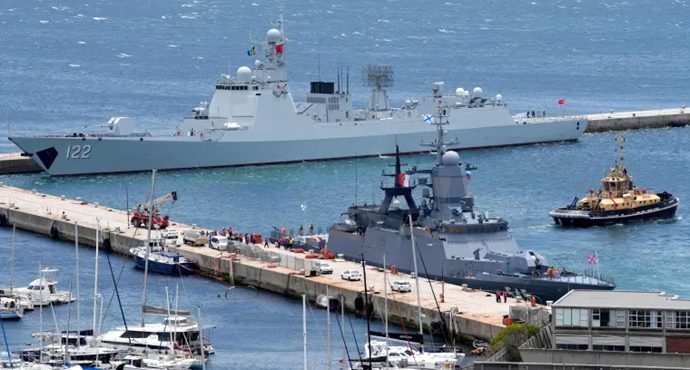
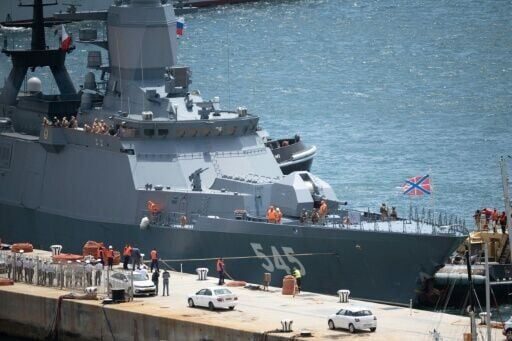
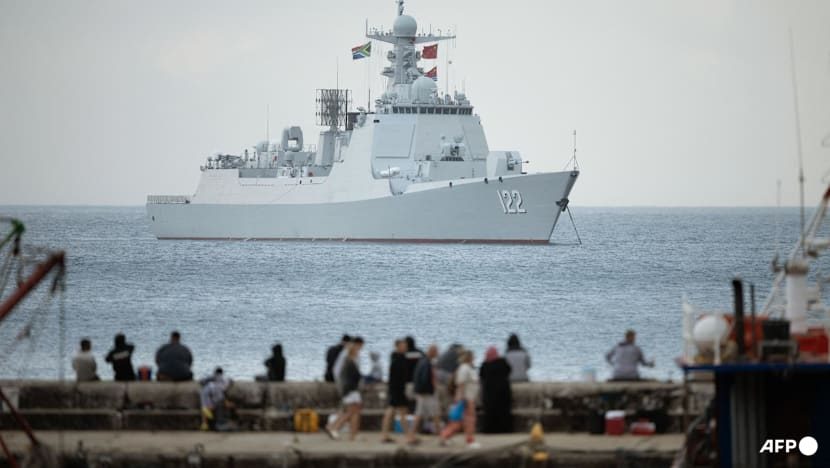
Chinese destroyers, Russian corvettes, and Iranian warships sailed into South Africa's Simon's Town Naval Base on January 9 for a week-long joint exercise. China leads the operation. Russia and Iran—both heavily sanctioned, both fighting active wars—sent their fleets. India and Brazil, despite the BRICS branding, are nowhere to be found. On January 10, the South African government doubled down, calling the drills 'essential' maritime cooperation despite mounting domestic and international pressure.
The exercise exposes a fundamental tension: BRICS has no defense treaty, no military command structure, no mechanism to plan joint operations. What's happening off Cape Town isn't collective security—it's a diplomatic signal wrapped in naval drills. South Africa risks Western displeasure to host forces from nations under international sanctions. Its opposition calls it abandoning non-alignment. Military spokespersons insist the exercises are routine and non-political. But the warships docked at Simon's Town—once the Royal Navy's South Atlantic headquarters—tell a different story about whose partnerships South Africa now prioritizes.
Key Indicators
People Involved
Organizations Involved
An economic bloc representing half the world's population and 41% of global GDP at purchasing power parity—with no defense treaty.
A force operating one frigate and struggling with 68% of budget consumed by salaries.
The world's largest navy by hull count, now leading exercises 8,000 miles from Beijing.
South Africa's official opposition, warning the exercise undermines non-alignment and risks trade retaliation.
Timeline
-
Government Defends Exercises as 'Essential'
PoliticalSouth African government issued official statement defending naval drills with Iran, Russia, and China as 'essential' maritime cooperation. SANDF spokesperson Lt. Col. Mpho Mathebula rejected DA criticism, stating exercise was 'not political in nature' and noting SA also conducts exercises with US Navy.
-
Will for Peace 2026 Commences
MilitaryWeek-long exercise begins in South African territorial waters. Theme: 'Joint Actions to Ensure the Safety of Shipping and Maritime Economic Activities.' India and Brazil absent.
-
Warships Arrive at Simon's Town
MilitaryChinese, Russian, and Iranian vessels docked. Iran's Makran forward base ship, China's Tangshan destroyer, Russia's Stoykiy corvette visible in False Bay.
-
Exercise Rebranded as 'Will for Peace 2026'
PoliticalSANDF officially announced exercise with new name. DA called it Mosi III with 'softer language,' questioning whether rebranding addressed concerns.
-
Chinese Warships Stop in Mombasa
MilitaryPLAN destroyer Tangshan and supply ship Taihu conducted maintenance in Kenya en route from Gulf of Aden anti-piracy operations to South Africa.
-
Mosi III Postponed to Avoid G20 Clash
PoliticalExercise originally scheduled for November delayed after diplomatic pressure. South Africa hosting G20 summit made timing politically awkward.
-
AGOA Trade Preferences Expire
EconomicAfrican Growth and Opportunity Act expired after Congress declined to renew the program. South Africa and other African nations lost duty-free access to US markets. The expiration removes one major trade leverage point the US previously held over South Africa's foreign policy choices.
-
BRICS Pay Prototype Demonstrated
EconomicAt Kazan summit, Russia showcased alternative payment system using QR codes and local currencies to bypass SWIFT and reduce dollar dependence.
-
Four New Members Join BRICS
PoliticalEgypt, Ethiopia, Iran, and UAE became full members. Saudi Arabia delayed decision. BRICS now represents 3.2 billion people, 41% of global GDP at PPP.
-
BRICS Expands to Nine Members
PoliticalJohannesburg summit announced Egypt, Ethiopia, Iran, Saudi Arabia, UAE, and Argentina invited. Only Argentina declined under new president.
-
US Accuses South Africa of Arming Russia
DiplomaticUS Ambassador Reuben Brigety alleged Russian ship Lady R loaded weapons at Simon's Town, threatening AGOA trade status. South Africa denied allegations.
-
Exercise Mosi II Begins on Ukraine Anniversary
MilitaryTen days of drills near Durban coincided with first anniversary of Russia's Ukraine invasion, sparking diplomatic controversy and US Congressional criticism.
-
Exercise Mosi I — First Trilateral Drills
MilitarySouth Africa, China, and Russia conducted first joint naval exercise off Cape Town. The operation established pattern for future cooperation.
Scenarios
US Revokes AGOA Benefits, SA Pivots East
Discussed by: Democratic Alliance, military analysts, Bloomberg
If Washington determines South Africa's hosting of sanctioned forces undermines US foreign policy interests—a statutory AGOA requirement—it could strip duty-free trade access. South Africa exports $3 billion to the US under AGOA, concentrated in automotive and agriculture. Loss would hit manufacturing jobs in provinces ANC needs electorally. Government responds by deepening BRICS ties, accelerating yuan-rand trade, joining BRICS Pay. Economic pain in short term, but signals full break from Western economic dependence. China and Russia expand investment to cushion blow. South Africa becomes test case for whether Global South nations can realign away from Western markets without economic collapse.
Exercises Become Annual, India and Brazil Never Join
Discussed by: Defense analysts, Foreign Policy Research Institute, Atlantic Council
The 'BRICS' branding remains, but the exercise settles into a permanent China-Russia-Iran-South Africa format. India won't join because it contradicts Quad commitments and its border dispute with China makes joint military operations politically impossible. Brazil stays out because its security relationships with non-BRICS states matter more than symbolic solidarity. The exercise becomes an annual signal of an alternative security architecture—not collective defense, but coordinated opposition to Western naval dominance in the Global South. Participation expands to include Pakistan, Venezuela, Nicaragua as 'BRICS partner countries.' The bloc splits into economic cooperation (all nine members) versus security signaling (the willing four).
South Africa Cancels Future Exercises After Economic Blowback
Discussed by: Western embassies, South African business community
Trade warnings from US and EU materialize. Investment flows drop. Tourism takes hit from reputational damage. Business lobby pressures Ramaphosa: symbolic BRICS solidarity isn't worth risking the $53 billion EU relationship. Government quietly announces 2027 exercise postponed 'for budgetary reasons'—true enough given SANDF's crisis—and it never reschedules. South Africa maintains BRICS economic membership but backs away from military cooperation with sanctioned states. China and Russia express disappointment but continue bilateral engagement. DA claims victory. ANC splits between pragmatists and ideological hard-liners who see it as capitulation to Western pressure.
Exercise Expands into Permanent BRICS+ Maritime Command
Discussed by: Chinese military publications, BRICS policy researchers
If BRICS formalizes military cooperation beyond ad hoc exercises, it could establish a maritime coordination center—not NATO-level integration, but something between symbolic drills and actual alliance. Headquarters in South Africa, rotating command, focused on anti-piracy and 'freedom of navigation' in Global South waters (coded pushback against Western naval presence). Ethiopia and Indonesia join as BRICS+ partners. The structure remains loose enough for India to participate without contradicting Quad membership—purely defensive, no Article 5 commitment. Gives institutional permanence to China-Russia-Iran security alignment while providing cover for cautious participants. Represents genuine alternative security architecture outside Western-led system.
Historical Context
Non-Aligned Movement During Cold War
1961-1991What Happened
Yugoslavia, India, Egypt, and dozens of newly independent nations formed the Non-Aligned Movement, refusing to pick sides between US and Soviet blocs. The movement claimed principled neutrality while many members accepted weapons and aid from both superpowers. Some, like India, tilted Soviet while maintaining non-aligned rhetoric. The tension between declared neutrality and actual partnerships mirrored today's contradictions.
Outcome
Short term: NAM gave smaller nations diplomatic leverage, playing superpowers against each other for better terms on aid and trade.
Long term: Collapsed with USSR. By 1990s, members abandoned pretense of equidistance, pursuing bilateral interests over bloc solidarity.
Why It's Relevant
South Africa inherited the ANC's Cold War-era alignment with Moscow while claiming post-apartheid non-alignment—the same rhetorical gap NAM members navigated.
Shanghai Cooperation Organisation Military Exercises
2003-presentWhat Happened
China and Russia launched 'Peace Mission' joint exercises under SCO framework, inviting Central Asian members. Like BRICS naval drills, these were branded as multilateral operations but dominated by China-Russia bilateral cooperation. India joined SCO in 2017 but participates selectively in military activities, avoiding exercises that might conflict with Quad commitments. Pakistan participates more actively, using SCO military ties to balance US relationship.
Outcome
Short term: Established pattern of China-Russia security coordination outside Western institutions, normalized as counter-terrorism cooperation.
Long term: Created muscle memory for joint operations, but never evolved into formal alliance. Remains tool for diplomatic signaling more than warfighting integration.
Why It's Relevant
BRICS naval exercises follow the SCO model: loose multilateral branding masking China-Russia core, with selective participation from others based on their hedging strategies.
US Revocation of Thailand's Trade Benefits (1989)
1989-1990What Happened
After Thailand failed to protect intellectual property rights adequately, the US suspended some Generalized System of Preferences benefits—a precursor to AGOA. Thailand faced economic pressure but didn't fundamentally change foreign policy orientation. It negotiated partial restoration while maintaining relationships with both Western and Asian partners. The episode showed that trade benefit revocation can sting without forcing wholesale realignment.
Outcome
Short term: Some Thai exports lost competitive advantage; government made token reforms to restore benefits partially.
Long term: Thailand continued hedging between US security partnership and growing Chinese economic relationship, proving trade tools don't determine strategic alignment.
Why It's Relevant
If US revokes South Africa's AGOA benefits over the naval exercises, history suggests short-term pain but not necessarily the policy reversal Washington seeks.
