
Pull to refresh
Logo
China installs world's largest offshore converter station off Guangdong

China installs world's largest offshore converter station off Guangdong

New Capabilities

The 25,000-tonne 'Heart of the Sea Wind' converts power from 163 turbines to DC, unlocking deep-sea wind farms

Today: Station settled in place off Yangjiang, commissioning continues

Overview

Updated 1 hour ago

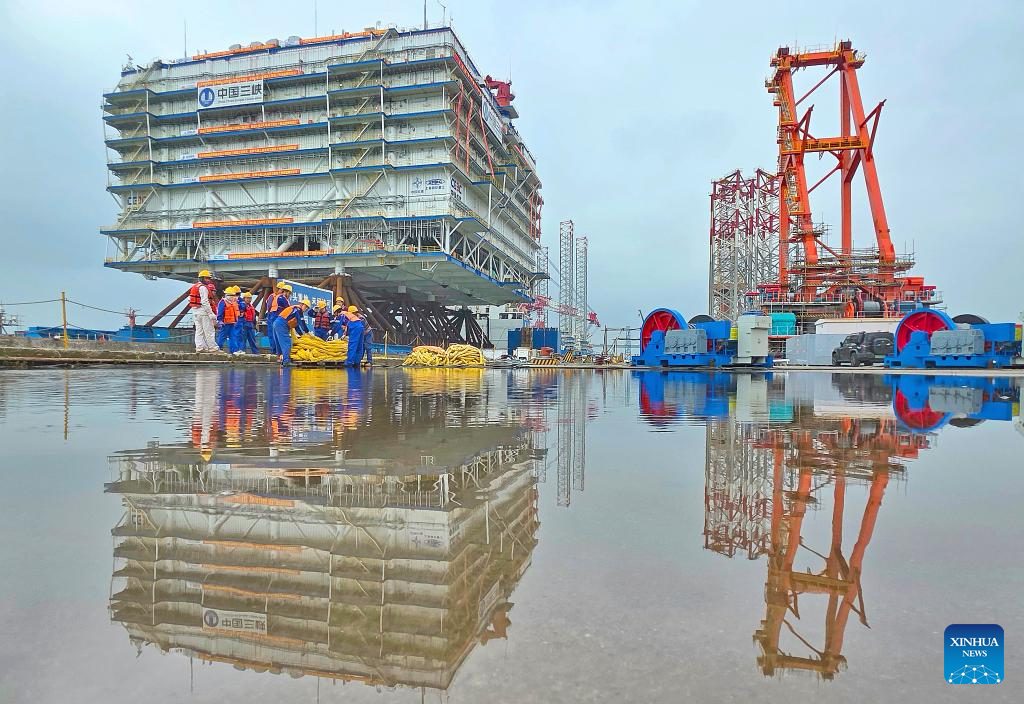
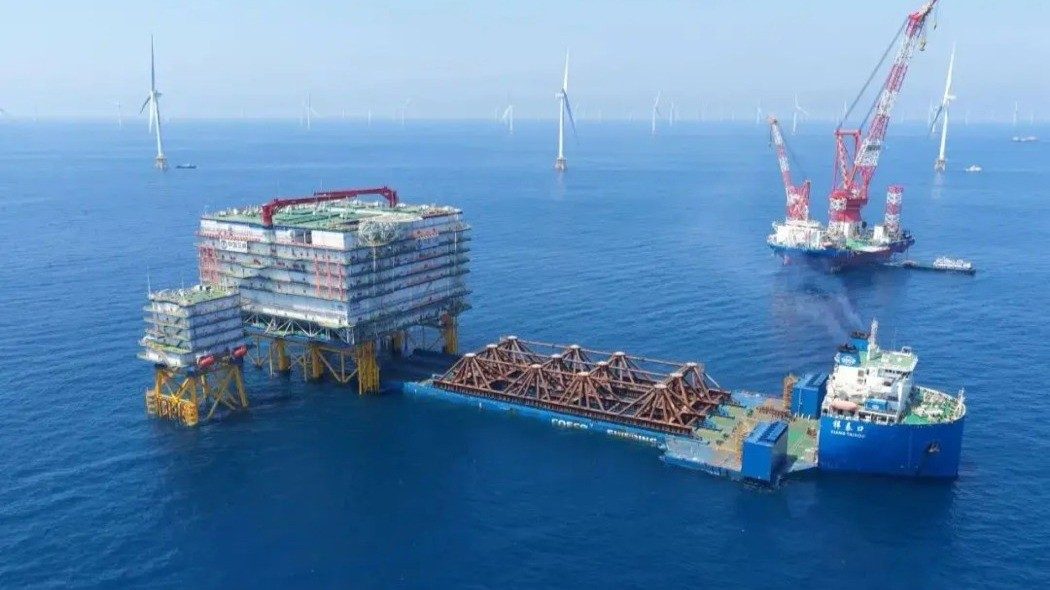
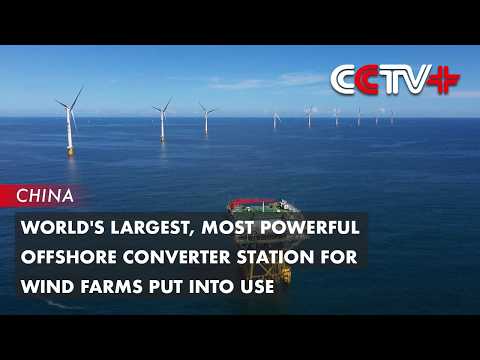
The world's largest offshore converter station now sits 100 kilometers off Guangdong's coast, resting on steel jacket foundations hammered into the seabed. The 25,000-tonne platform, named 'Heart of the Sea Wind,' collects power from 163 wind turbines and converts it from alternating current to ±500 kilovolt direct current.

That conversion matters because AC power degrades severely over long submarine cables — flexible DC transmission cuts about 60 percent of that loss. Making the switch lets wind farms push into deeper water, where winds are stronger and more consistent, and still deliver power to shore efficiently. Once commissioned, the station will feed about 6 billion kilowatt-hours a year into Guangdong's grid, roughly equivalent to cutting 5 million tonnes of CO2 emissions annually.

Why it matters

China's far-offshore wind farms now have a proven way to deliver power to shore — 6 billion kWh a year for Guangdong's grid, with about 60 percent less transmission loss than AC.

Questions about this story

Free account needed to ask — your question is kept and asked for you right after sign-up. Answers are public.

No questions yet — be the first to ask.

Key Indicators

25,000 tonnes
Weight of converter station
The upper structure alone weighs 25,000 tonnes, requiring a float-over installation because no domestic crane could lift it.
2,000 MW
Transmission capacity
First ±500 kV, 2,000 MW flexible DC offshore converter station in the world.
6 billion kWh/year
Annual power delivery
Projected clean electricity delivered to the Guangdong-Hong Kong-Macau grid once fully commissioned.
1,090 nautical miles
Sea voyage from Nantong to Yangjiang
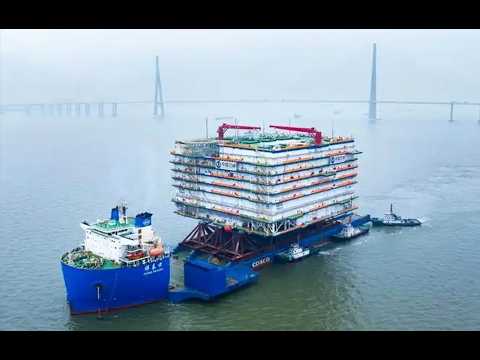
The station was carried on a semi-submersible vessel from Jiangsu province to its final site.
60%
Power loss reduction vs. AC transmission
Flexible DC transmission cuts roughly 60 percent of the energy lost compared with conventional AC over long submarine cables.
163
Wind turbines served
The station collects power from turbines across the Yangjiang Qingzhou V and VII offshore wind farms.

Voices

Curated perspectives — historical figures and your fellow readers.

Ever wondered what historical figures would say about today's headlines?

Sign up to generate historical perspectives on this story.

People Involved

Organizations Involved

Timeline

May 2026 October 2026

5 events Latest: Today
Tap a bar to jump to that date
  1. Station settled in place off Yangjiang, commissioning continues

    Today Milestone

    State media confirmed the structure is fully positioned in the Qingzhou sea area; it will deliver about 6 billion kWh of green power yearly once operational.

  2. Station moves to final cabling and testing phase

    Milestone

    Reports confirmed the station fully installed about 100 km offshore; subsea cable installation and joint offshore-onshore testing began before commercial operation.

  3. Full offshore installation declared complete

    Verification

    China Classification Society confirmed the leg mating unit welding finished, completing all offshore structural work.

  4. Float-over installation completes with millimeter precision

    Installation

    After seven hours of positioning, the station's eight insertion spikes locked into the seabed jacket foundation off Yangjiang, setting six world records.

  5. Heart of the Sea Wind departs Nantong

    Logistics

    The 25,000-tonne converter station left Nantong, Jiangsu province, on a semi-submersible vessel for a 1,090-nautical-mile voyage to Yangjiang.

Scenarios

1

Heart of the Sea Wind begins commercial operation by mid-2027

Likely Resolves by Q2 2027

Discussed by: CGTN, SASAC, and project disclosures describing the commissioning path

Subsea cables get laid without major setbacks, joint offshore-onshore testing passes, and the station begins feeding the Guangdong grid. China Three Gorges announces grid connection and the first delivered power.

2

Model replicated: China orders comparable stations for future deep-sea projects

Possible Resolves by Q2 2028

Discussed by: China Electricity Council officials and state media framing the project as a template

Once the technology proves out, Chinese developers order similar ±500 kV flexible DC stations for other far-offshore wind bases, scaling the 10 GW-class Yangjiang build-out and similar projects in the East China Sea.

3

Commissioning slips into 2028 on cable or integration problems

Unlikely Resolves by Jan 31, 2028

Discussed by: The complexity of the first ±500 kV DC submarine cable plus joint offshore-onshore testing

Faults emerge in the world's first ±500 kV submarine DC cable or in grid synchronization, pushing first commercial power past initial schedules. Station remains installed but idle beyond early 2028.

Historical Context

2 moments from history that rhyme with this story — and how they unfolded.

March 1954

Gotland HVDC Link (1954)

Sweden commissioned the world's first commercial high-voltage direct current (HVDC) link, a 20 MW, 98-kilometer submarine cable connecting the island of Gotland to the mainland. It was built mainly to transmit surplus wind power from the island.

Then

Gotland's wind power became sellable to the mainland, and the technology proved HVDC could cross open water efficiently.

Now

HVDC became the standard for long-distance and submarine power transmission worldwide, with voltages and capacities rising steadily over seven decades.

Why this matters now

The Heart of the Sea Wind is the direct descendant of this first link — same physics, same purpose, but 100 times the voltage and carrying far more power from dozens of turbines.

2009–2012

BorWin1 — First Offshore Wind HVDC Converter (2012)

Germany's BorWin alpha went into service in the North Sea as the world's first offshore wind HVDC converter station, collecting power from the 400 MW BorWin1 and BorWin2 wind farms and transmitting it to the mainland grid.

Then

It proved offshore conversion was technically feasible, opening the North Sea's deeper wind zones to development.

Now

Set the template China has now scaled: collect AC from turbines, convert offshore to DC, and ship it ashore with minimal loss.

Why this matters now

China used the same architecture but built it five times larger — 2,000 MW at ±500 kV versus BorWin's 400 MW — and made all key components domestically.

Sources

(9)